EagleEye

vip
Age 1.7 Year
Peak Tier 5
Actions speak louder than words prove it by your actions
#DailyPolymarketHotspot
Ethereum is currently trading around $2,050–$2,250 as of late May 2026, representing a sharp 55%–60% decline from its August 2025 all-time high near $4,954. This correction has placed Ethereum in one of its most complex valuation phases ever, where strong on-chain fundamentals exist alongside weakened short-term market sentiment.
From a broader market structure perspective, Ethereum is now trading inside a long accumulation-distribution range between:
Major Support Zone: $1,800 – $2,000
Mid Range Equilibrium: $2,200 – $3,000
Macro Resistance Zone: $3,800 – $5,000
This
ETH-0.56%
SOL-0.19%
BTC-0.86%
HighAmbition
#DailyPolymarketHotspot
Ethereum is currently trading around $2,050–$2,250 as of late May 2026, representing a sharp 55%–60% decline from its August 2025 all-time high near $4,954. This correction has placed Ethereum in one of its most complex valuation phases ever, where strong on-chain fundamentals exist alongside weakened short-term market sentiment.
From a broader market structure perspective, Ethereum is now trading inside a long accumulation-distribution range between:
Major Support Zone: $1,800 – $2,000
Mid Range Equilibrium: $2,200 – $3,000
Macro Resistance Zone: $3,800 – $5,000
This creates a wide volatility band where price can swing significantly based on liquidity shifts, ETF flows, and macro sentiment.
The core contradiction remains unchanged: Ethereum network activity, staking participation, and tokenization growth are expanding, but price action reflects delayed institutional demand and macro compression.
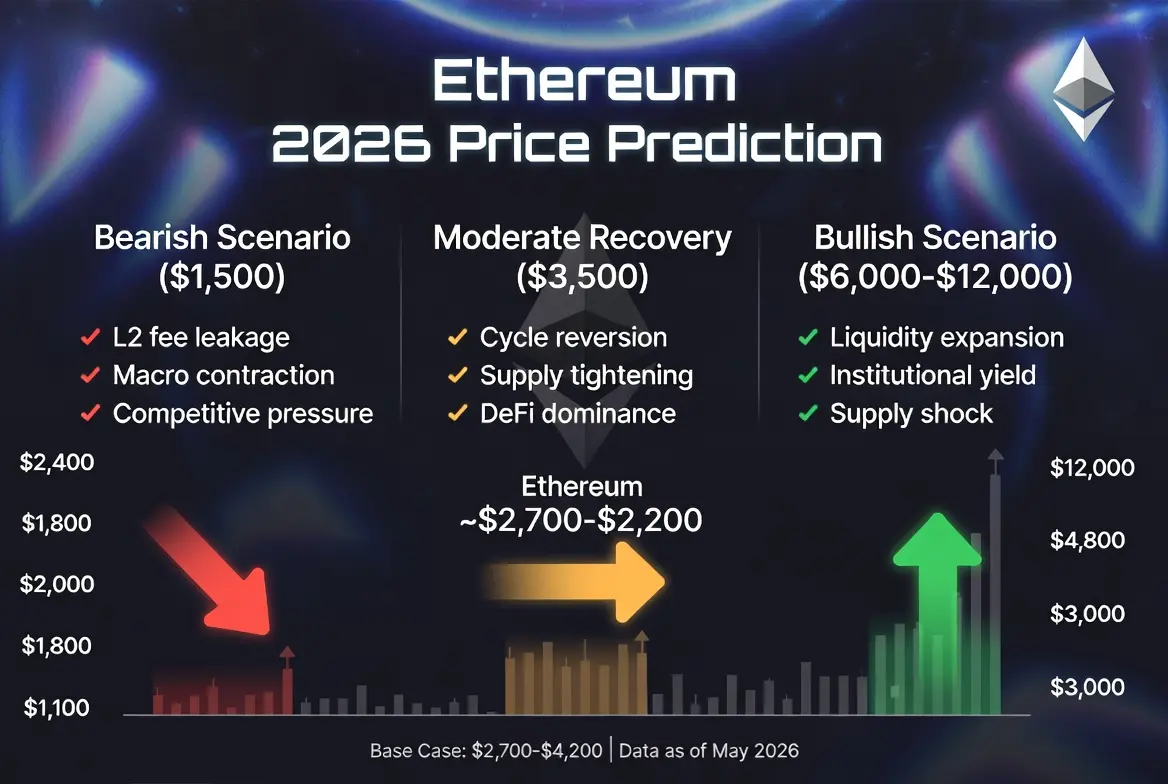
The $1,500 Scenario: Bearish Arguments
Argument 1 — Layer 2 Fee Revenue Leakage
The Dencun upgrade drastically reduced transaction costs, increasing scalability but reducing base-layer revenue.
Key structural impacts:
Daily gas revenue dropped from $30M+ → ~$500K–$1.2M
L2 chains like Base generate $80M–$120M monthly revenue, but only a small fraction returns to ETH
Estimated valuation leakage impact: $30B–$60B implied market cap compression
If this trend accelerates, Ethereum risks being perceived purely as a settlement coordination layer rather than a revenue-generating asset.
Bearish price implications:
Breakdown scenario: $1,400 – $1,600
Extreme stress wick: $1,100
Argument 2 — Macro Liquidity Contraction
Ethereum remains highly sensitive to global liquidity cycles.
If restrictive monetary conditions persist:
Risk assets globally could compress another 20%–35%
Crypto beta typically amplifies downside by 2x–3x
Historical ETH drawdowns:
2018: -83%
2022: -78%
A repeat mid-cycle contraction would place ETH in:
Bear case target range: $1,300 – $1,800
Worst liquidity shock: $900–$1,200 (tail risk)
Argument 3 — Competitive Pressure from Alternative Chains
If Solana, modular chains, or app-specific chains continue expanding:
Developer migration could increase by 15%–25% annually
TVL fragmentation reduces Ethereum dominance
Fee competition limits ETH premium capture
Bearish structural valuation adjustment:
ETH dominance compression: 18% → 10–12%
Price drag estimate: -20% to -35% relative impact
Argument 4 — Weak ETF Flow Expansion
Ethereum ETF inflows remain inconsistent:
Bitcoin ETFs: multi-billion weekly peaks
Ethereum ETFs: $100M–$500M episodic flows
Without staking-enabled ETFs:
Yield disadvantage vs TradFi remains
Institutional allocation stays capped at low single-digit portfolio weight
Bear case impact range:
Suppressed valuation ceiling: $1,800 – $2,400
Breakdown risk zone: below $2,000
Argument 5 — Regulatory Classification Risk
If ETH faces restrictive classification in major jurisdictions:
Exchange liquidity fragmentation increases
Institutional custody constraints tighten
Derivative market exposure reduces
Bear scenario pricing impact:
Short-term shock range: -25% to -45%
Target zone: $1,200 – $1,800
The $3,500 Scenario: Moderate Recovery Arguments
Argument 1 — Cycle Mean Reversion
Ethereum has repeatedly followed deep correction → recovery cycles:
2018 bottom → 2021 peak: ~55x expansion
2022 bottom → 2025 peak: ~4x–6x expansion
From current levels:
Recovery base case: $3,200 – $3,800
Equilibrium fair value: $3,400–$3,600
Argument 2 — Structural Supply Tightening
ETH supply dynamics remain highly constrained:
Staked ETH: 60%–70%
Burned supply (EIP-1559): continuous deflationary pressure
Liquid float estimated reduction: -40% effective availability
Price sensitivity increases sharply:
+$5B inflow → +15%–25% price impact
+$10B inflow → +30%–60% price expansion
Mid-cycle valuation:
$3,000 – $3,800 fair range
Argument 3 — DeFi & Stablecoin Dominance
Ethereum remains dominant in:
DeFi TVL: $50B–$70B range
Stablecoin settlement: majority share
Institutional tokenized liquidity: growing steadily
Fair value implication:
Network-backed valuation floor rises to $2,800+
Expansion zone: $3,200 – $4,000
Argument 4 — Tokenization Growth Curve
Institutional adoption is accelerating:
Tokenized real-world assets: growing 40%–80% annually
Ethereum share: ~60%–70%
Medium-term valuation band:
Conservative impact: $3,200
Expansion fair value: $3,800
Argument 5 — Staking Yield Enhancement
Post-upgrade staking improvements:
Effective yield range: 3.5% – 6.5%
Increased lock-up ratio stabilizes supply
Resulting price support zone:
Strong floor: $2,700 – $3,000
Recovery target: $3,500
The Bullish Scenario: $6,000–$12,000 Range
Argument 1 — Macro Liquidity Expansion
If global liquidity shifts:
Rate cuts or QE expansion
Risk assets reprice higher
ETH beta amplification:
Base rally: +120%–180%
High liquidity expansion: +250%–400%
Price projection:
Conservative bull: $6,000–$7,500
Strong bull: $9,000–$12,000
Argument 2 — Institutional Yield Asset Narrative
Ethereum evolves into:
Settlement layer + yield-bearing asset
ETF staking integration potential
Valuation analogies:
Similar to hybrid tech + bond yield asset
Institutional allocation target: 2%–5% portfolios
Bull range:
$7,000 – $10,000
Argument 3 — Supply Shock Dynamics
If demand accelerates:
ETF inflows: $10B–$25B scenario
Liquid float contraction intensifies
Result:
Rapid repricing phase
Short squeeze + structural squeeze combo
Price acceleration zones:
Breakout: $4,800
Expansion: $6,500
Peak cycle: $10,000–$12,000
Argument 4 — L2 Value Recapture Shift
If Ethereum upgrades successfully:
Blob fee increases
Revenue-sharing mechanisms improve
Narrative flips from:
“Value leakage” → “ecosystem expansion”
Re-rating impact:
+30% to +70% valuation uplifting
Argument 5 — Network Effect Strengthening
Ethereum remains:
Largest DeFi ecosystem
Deepest liquidity layer
Strongest institutional custody integration
Composability advantage expands value exponentially in multi-asset tokenized economy.
Bull valuation band:
$8,000 – $12,000
My Assessment: Most Probable 2026 Price Range
Base Case Range: $2,700 – $4,200
Reasoning:
Macro remains uncertain but stabilizing
ETF flows improve gradually, not explosively
L2 leakage partially offsets gains
Institutional adoption continues but slowly
Bear Case Range: $1,500 – $2,200
Triggered only if:
Global liquidity tightens further
ETF flows stagnate completely
Risk-off macro dominates 2026
Bull Case Range: $6,000 – $10,000+
Requires:
Strong liquidity expansion
Staking ETF approval
Institutional inflow acceleration
Tokenization boom phase
Key Levels to Monitor
Major Support: $1,800 / $2,000
Accumulation Zone: $2,000 – $2,600
Breakout Trigger: $3,000
Macro Bull Confirmation: $4,800
Expansion Zone: $6,000 – $10,000
Ethereum in 2026 is not a simple directional trade but a liquidity-driven revaluation asset. Price is currently compressed below its fundamental trajectory, but the timing of re-rating depends entirely on macro liquidity cycles and institutional flow acceleration.
The most realistic expectation remains:
Stable accumulation zone now
Gradual recovery toward $3,500
Conditional upside toward $6,000+ in strong macro expansion
Ethereum’s long-term structural strength remains intact, but short-term price behavior will continue to reflect global liquidity conditions more than internal network fundamentals.@Gate_Square @Gate广场_Official #TradeCFDWinGold #StockTradingChallengeUpTo17000U #DailyPolymarketHotspot #PlatinumCardCreatorExclusive
repost-content-media
  • Reward
  • 5
  • Repost
  • Share
Tradestorm:
To The Moon 🌕
View More
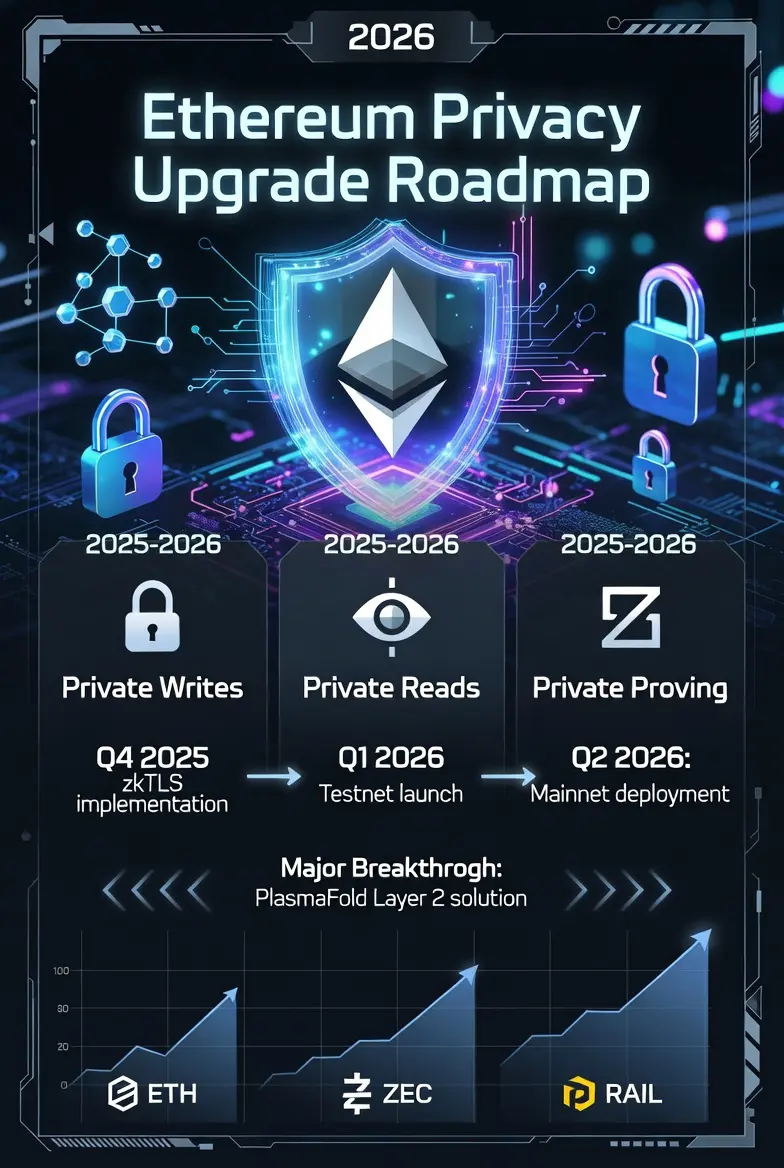
#EthereumPrivacyUpgradeRoadmap
The Ethereum Foundation made a historic decision in September 2025 by officially integrating privacy into its core roadmap through the Privacy Stewards of Ethereum (PSE) initiative. This marked a fundamental transformation from the previous approach where privacy was handled by third-party protocols and layer-2 solutions. Ethereum Foundation Co-Director Tomasz Stańczak emphasized that institutional privacy has become a mandatory requirement, not an optional feature. The Foundation established a dedicated 50-person privacy team operating outside the protocol team
HighAmbition
#EthereumPrivacyUpgradeRoadmap
The Ethereum Foundation made a historic decision in September 2025 by officially integrating privacy into its core roadmap through the Privacy Stewards of Ethereum (PSE) initiative. This marked a fundamental transformation from the previous approach where privacy was handled by third-party protocols and layer-2 solutions. Ethereum Foundation Co-Director Tomasz Stańczak emphasized that institutional privacy has become a mandatory requirement, not an optional feature. The Foundation established a dedicated 50-person privacy team operating outside the protocol team, demonstrating unprecedented commitment to this sector.
Three Pillars of Ethereum Privacy Architecture
The roadmap centers on three fundamental capabilities that will define Ethereum's privacy infrastructure through 2026 and beyond. First, Private Writes enable confidential on-chain activities without exposing transaction details to the public. This pillar incorporates stealth addresses where recipients receive funds through one-time addresses derived from shared secrets, ensuring only the intended recipient can spend the funds. Homomorphic encryption allows smart contracts to process confidential information while keeping the underlying data hidden. Privacy Pools represent a breakthrough innovation enabling selective disclosure, allowing users to prove they are not mixing funds with sanctioned addresses while maintaining privacy from the general public.
Second, Private Reads address the critical vulnerability where every balance check and dApp interaction currently leaks information. RPC providers can see IP addresses, controlled addresses, token holdings, and activity patterns. The solution involves Oblivious RAM (ORAM) technology that accesses data without revealing which specific data was accessed. Privacy-preserving RPC architectures blind queries before sending them to providers, while client-side verification using cryptographic proofs eliminates trust requirements in RPC providers.
Third, Private Proving focuses on making zero-knowledge proof generation fast, cheap, and accessible on everyday devices. The "prove anywhere" initiative targets sub-30-second proof times on mobile devices by Q1 2026, with distributed proving networks launching in Q2 2026 that split proof generation across multiple devices.
PlasmaFold: The Technical Breakthrough
PlasmaFold represents Ethereum's most significant Layer 2 innovation for privacy. This experimental design employs a hybrid architecture where operators generate proofs server-side for honest block construction while users maintain balance proofs on their own devices. This separation enables instant, non-interactive exits via balance proofs while block proofs handle most validations, eliminating complex exit games and minimizing user costs. The architecture makes private and public transactions equally efficient without extra gas costs or longer confirmation times. The public testnet is expected in Q1 2026, with security audits scheduled for Q2 2026 and mainnet launch targeted for mid-2026.
Key Projects and Implementations
The Ethereum Foundation has supported over 50 open-source privacy research projects since 2018. Semaphore provides a zero-knowledge identity framework for anonymous signaling and voting. TLSNotary pioneered zkTLS technology to prove facts about web data with cryptographic guarantees. Zupass successfully demonstrated privacy-preserving event ticketing at Devcon 2025. Anon Aadhaar enables private national ID verification proving Indian citizenship without exposing ID documents. MACI delivers collusion-resistant private voting for DAOs.
Kohaku serves as Ethereum's comprehensive privacy-and-security toolkit for wallets, functioning as an open-source wallet SDK that allows any wallet to integrate privacy features using Railgun and Privacy Pools implementations. Vitalik Buterin first showcased Kohaku publicly at Devcon in late 2025, and the Ethereum Foundation described it as the most exciting upcoming privacy development in recent years.
zkTLS and Regulatory Compliance
The zkTLS technology entering production in Q4 2025 enables users to prove facts about web data without revealing underlying information. Users can demonstrate credit scores above 700 without showing actual scores, prove they are not on sanctions lists without revealing identity, demonstrate tax compliance without exposing trading history, and verify accredited investor status without sharing financial details. The Institutional Privacy Task Force (IPTF) actively works with regulatory bodies in the US, EU, and Asia to define standards for selective disclosure, positioning privacy and compliance as complementary rather than opposing forces.
Privacy Token Market Performance
The privacy sector experienced extraordinary price appreciation throughout 2025 and 2026. Zcash (ZEC) surged over 1,000% to exceed $440, driven by renewed institutional interest in privacy infrastructure. Railgun (RAIL) demonstrated exceptional performance with gains exceeding 300% year-to-date, reaching approximately $3.87 per token with a market capitalization of around $222 million. The token posted a 32% gain in a single 24-hour period during May 2026 as privacy protocol demand intensified. Railgun's market cap expanded by over 400% from May 2025 lows, reflecting strong investor confidence in Ethereum-based privacy solutions.
Monero (XMR) broke its 8-year high in 2026, demonstrating that privacy assets are experiencing sustained value appreciation rather than temporary sentiment-driven rallies. The broader privacy-token sector attracted significant attention from institutional investors and venture capital, with Andreessen Horowitz identifying privacy as the most important moat for 2026 in their State of Crypto report.
Ethereum Price Outlook
Ethereum's price predictions for 2026 vary considerably based on privacy upgrade execution and broader market conditions. Analysts project targets ranging from $2,700 to $3,000 in the near term if Ethereum breaks the $2,500 resistance level. More optimistic forecasts target $7,500 to $8,000 as institutional privacy features drive adoption. Some projections even eye $10,000 based on sustained institutional demand, ETF flows, staking growth, and broader market support.
However, Ethereum faces significant challenges. The cryptocurrency declined more than 30% in the first quarter of 2026 amid Trump's tariff war and rising geopolitical tensions. Prediction market Polymarket currently assigns nearly 60% probability to Ethereum losing its number two cryptocurrency ranking to Tether's USDT stablecoin in 2026. Technical analysis shows Ethereum trading near critical support at $2,130, with a decisive break below potentially triggering a slide toward the $800-$900 range. Conversely, a break above $2,460 would diminish bearish risks and support further upside.
Competitive Landscape
Ethereum and Cardano's Midnight currently represent the primary contenders aggressively developing institutional privacy solutions. Zcash maintains leadership in the privacy narrative but faces erosion of market share unless it expands beyond private transfers to offer more practical use cases. Railgun competes directly with Zcash and Monero while offering distinct advantages through its opt-in privacy features that align better with current regulatory environments for privacy-based tokens.
The Ethereum Foundation's 47-member Privacy Cluster, coordinated by Igor Barinov, includes PSE focusing on privacy protocol UX, the Institutional Privacy Task Force bridging institutions and Ethereum, and Kohaku providing reference wallet implementations. This coordinated approach gives Ethereum significant competitive advantages in the institutional privacy sector.
Timeline and Milestones
The privacy roadmap follows a structured timeline through 2026. Q4 2025 marked zkTLS entering production. Q1 2026 targets mobile proving becoming viable with sub-30-second proof times, first privacy-preserving RPC implementations going live, and PlasmaFold public testnet launch. Q2 2026 focuses on distributed proving networks launching, PlasmaFold security audits completion, standards finalization for private reads, and mainnet launch for PlasmaFold. Q3-Q4 2026 aims for client-side verification becoming standard and modular ZK wallets achieving widespread adoption.
Institutional Adoption Drivers
The privacy upgrade roadmap directly addresses institutional requirements that have previously limited Ethereum adoption in traditional finance. Enterprise treasury operations require confidential transaction capabilities to protect competitive information. Anonymous governance voting enables participation without revealing institutional positions. Private DeFi interactions allow sophisticated financial strategies without exposing proprietary trading patterns. Cross-border payments benefit from privacy features that protect commercial relationships while maintaining regulatory compliance.
The anticipated tokenization boom in 2026 positions Ethereum's privacy infrastructure as critical infrastructure for institutional adoption. As traditional financial assets move on-chain, the ability to conduct confidential transactions while maintaining audit trails and compliance capabilities becomes essential.
Ethereum's privacy upgrade roadmap represents one of the most significant protocol developments since the transition to proof-of-stake. The comprehensive approach addressing private writes, private reads, and private proving establishes Ethereum as the leading platform for institutional privacy solutions. The substantial price appreciation in privacy tokens like Railgun and Zcash demonstrates market recognition of this trend. Ethereum's success in executing this roadmap will determine whether it captures the institutional privacy market or cedes ground to competitors like Cardano's Midnight or maintains Zcash's dominance in the privacy narrative. The coordinated effort across 47 privacy experts, dedicated institutional task forces, and regulatory engagement positions Ethereum favorably for the privacy-centric evolution of blockchain technology in 2026 and beyond.@Gate_Square @Gate广场_Official #StockTradingChallengeUpTo17000U #TradeCFDWinGold #DailyPolymarketHotspot #SocialFiSectorUp5.9%
repost-content-media
  • Reward
  • 3
  • Repost
  • Share
LittleGodOfWealthPlutus:
Hold firmly to 💎
View More
#GatePredictionMarketAddsSmartMoneyTracking
What Is Gate Prediction Market?
Gate.io is widely recognized as one of the most established and innovative cryptocurrency exchanges in the global digital asset ecosystem. With a user base in the tens of millions and support for thousands of listed assets, it has built a reputation for combining liquidity, accessibility, and advanced trading infrastructure in one unified platform.
In 2026, Gate took a significant step forward by integrating prediction market functionality directly into its ecosystem through a seamless in-app experience. This allows u
HighAmbition
#GatePredictionMarketAddsSmartMoneyTracking
What Is Gate Prediction Market?
Gate.io is widely recognized as one of the most established and innovative cryptocurrency exchanges in the global digital asset ecosystem. With a user base in the tens of millions and support for thousands of listed assets, it has built a reputation for combining liquidity, accessibility, and advanced trading infrastructure in one unified platform.
In 2026, Gate took a significant step forward by integrating prediction market functionality directly into its ecosystem through a seamless in-app experience. This allows users to participate in real-world event forecasting markets—covering areas such as crypto trends, global politics, macroeconomics, and sports—without needing external wallets or complex blockchain interactions.
One of the most important advantages of this system is simplicity. Users can trade directly using USDT from their exchange balance, making participation feel similar to traditional spot or derivatives trading while still being based on event outcomes rather than asset prices.
The latest upgrade focuses on intelligence-driven decision support, particularly through Smart Money tracking, introduced in Gate App versions 8.19 and improved further in 8.20. This update positions Gate not just as a trading platform, but as a structured prediction intelligence ecosystem where user behavior, capital movement, and historical performance data are all combined into one analytical framework.
Smart Money Identification — The Core Concept
What Smart Money Means in Gate Prediction Markets
Within Gate’s prediction ecosystem, Smart Money refers to traders who consistently demonstrate strong predictive accuracy and disciplined risk behavior over time. Unlike casual participants, these traders are evaluated based on long-term performance rather than isolated wins.
The system identifies Smart Money using multiple quantitative signals, including:
Long-term profitability across diverse prediction events
Consistent win-rate stability across categories
Risk-adjusted returns rather than high-risk lucky outcomes
Behavioral consistency during volatile market phases
Accuracy across repeated event cycles
This creates a data-driven filter that highlights participants who show skill-based edge rather than randomness.
Why This Matters in Real Market Behavior
Prediction markets often suffer from crowd-driven bias, where sentiment dominates logic. Smart Money tracking introduces a counterbalance by revealing where experienced traders are positioning themselves.
For example, if a market shows a 55–60% probability for one outcome based on general participation, but Smart Money is heavily concentrated on the opposite side, this divergence becomes an important informational signal.
It does not guarantee certainty, but it improves clarity by separating emotional crowd behavior from historically validated decision-making patterns.
Trader Classification System — Smart Money, Sharks, and Whales
Structured Market Intelligence Layers
Gate introduces a three-tier classification system designed to break down trader behavior into meaningful categories:
Smart Money:
Highly consistent performers with strong long-term predictive accuracy. These traders represent strategic intelligence in the system.
Sharks:
High-impact traders who often operate in specific niches or short-term opportunities. Their behavior can signal early momentum shifts or sudden sentiment changes.
Whales:
Large-capital participants whose influence comes from position size. Even without perfect accuracy, their trades can significantly shift market probabilities.
Objective Labeling Mechanism
All classifications are assigned through automated evaluation models analyzing:
Historical performance consistency
Capital deployment behavior
Event category specialization
Trade timing efficiency
Risk-to-reward balance over time
This removes subjective bias and creates a transparent performance hierarchy.
Upgraded Leaderboard System — Multi-Dimensional Rankings
Evolution from Simple Metrics to Intelligence Dashboard
The updated leaderboard transforms from a basic ranking system into a full analytical engine, including:
Net profit and loss tracking across markets
Trading volume activity over time
Highest single-event gain analysis
Win-rate efficiency and stability metrics
Category-based specialization scoring
This shift allows users to understand not just outcomes, but underlying trading behavior patterns.
Interpretive Layer Enhancements
An additional layer allows users to attach contextual insights or annotations to trader profiles, such as strategy style or market expertise. This improves interpretability and reduces blind copy-trading behavior.
Enhanced User Profile Pages — Performance Transparency
Equity Curves and Behavioral Visualization
Each trader profile now includes a detailed performance curve that shows capital growth or decline over time. This helps distinguish between:
Consistent compounding performers
Short-term spike-driven traders
High-volatility inconsistent profiles
Full Trade Lifecycle Visibility
Users can analyze complete trade histories, including:
Entry timing and execution behavior
Position adjustments during active events
Reaction patterns to breaking updates
Exit strategy and timing decisions
This level of transparency makes trading behavior more explainable and analyzable.
Top Holders Module — Capital Concentration Insights
What It Reveals
The Top Holders module displays the largest active positions in any event, including:
Major capital holders
Directional bias (Yes or No positioning)
Exposure size relative to market depth
Historical accuracy in similar event categories
Why This Is Important
Market probability alone can be misleading. A high probability outcome may come from either:
Broad retail participation, or
Concentrated informed positioning
This module helps distinguish between the two, offering deeper insight into conviction strength behind market movement.
Real-Time Market Tracking and Filtering
Advanced Live Data Controls
Users can filter markets based on:
Smart Money-only views
Whale activity tracking
Outcome-specific segmentation (Yes/No)
Volume, momentum, and participation trends
Detecting Early Market Shifts
Rapid changes in Smart Money positioning often signal new informational inputs. Monitoring these movements allows users to anticipate shifts before they fully reflect in price probabilities.
AI-Powered Market Analysis — Structured Intelligence Layer
AI-Based Event Breakdown
Each event includes AI-generated structured insights such as:
Key influencing developments
Critical variables affecting outcomes
Latest real-time updates
Forward-looking scenario analysis
Integration with Behavioral Data
The AI system does not operate alone—it combines with Smart Money tracking and live market data to create a multi-layer intelligence dashboard.
This reduces manual research requirements while improving decision clarity.
Quick Trade Feature — Execution Efficiency Upgrade
Streamlined Trading Flow
The Quick Trade system reduces friction by enabling:
One-tap order execution
Direct trading from event listings
Instant Yes/No positioning
Importance in Fast Markets
This feature is especially valuable during:
Live sports events
Breaking news scenarios
Rapid sentiment shifts in crypto-related predictions
Execution speed becomes a strategic advantage rather than a convenience feature.
Sports Prediction Market Upgrades — Real-Time Intelligence Layer
Unified Match Experience
All related markets for a single sports event are grouped together, allowing seamless switching between outcomes and derivatives.
Live Match Integration
Real-time data includes:
Score updates
Match phases and timing
Statistical performance tracking
Expanded Betting Structures
Users gain access to:
Over/under markets
Point spread predictions
Sport-specific outcome derivatives
This brings prediction markets closer to advanced sports analytics systems used by professionals.
Search, Classification, and Trend Discovery System
Intelligent Market Discovery
The search system includes:
Fuzzy matching for flexible queries
Trend-based recommendations
Category and subcategory navigation
Live Market Highlights
The platform highlights:
High-liquidity active markets
Smart Money concentrated positions
Near-resolution events
High-volatility price movement zones
Breaking Event Detection
Markets tied to major real-world developments are surfaced instantly, allowing faster participation in high-impact scenarios.
Polymarket Integration — Bridging Web2 and Web3 Prediction Systems
Seamless Hybrid Model
Gate integrates prediction markets in a way that removes traditional complexity barriers:
No external wallet requirement
No gas fee interaction for basic users
Direct USDT-based participation
Familiar centralized exchange interface
Dual Access Flexibility
Advanced users can still access decentralized pathways, creating a hybrid system that supports both simplicity and full Web3 flexibility.
Gate’s Smart Money tracking upgrade represents a significant evolution in prediction market infrastructure. By combining behavioral analytics, capital flow tracking, AI-driven insights, and real-time execution tools, the platform transforms prediction trading into a structured intelligence system.
Rather than relying solely on raw probability or crowd sentiment, users now gain access to layered insights that reflect actual trader performance, capital concentration, and historical accuracy.
Gate’s approach positions it as more than just a trading platform—it becomes an analytical ecosystem where market intelligence, user behavior, and real-world events converge into a unified decision-making framework.@Gate_Square @Gate广场_Official #StockTradingChallengeUpTo17000U #TradeCFDWinGold #DailyPolymarketHotspot
repost-content-media
  • Reward
  • 2
  • Repost
  • Share
LittleGodOfWealthPlutus:
Direct to the Moon🌕
View More
#PlatinumCardCreatorExclusive

Gate Platinum Card — The Moment Crypto Fully Blends Into Real-World Money Systems
The Gate Platinum Card represents more than just another crypto payment product — it represents a structural transition in how money itself is defined in the modern digital economy.
For years, crypto existed in a parallel financial universe, separated from traditional banking systems, treated as speculative, volatile, and disconnected from everyday life. But this type of infrastructure begins to collapse that separation entirely, replacing the idea of “crypto vs fiat” with somethin
HighAmbition
#PlatinumCardCreatorExclusive
Gate Platinum Card — The Moment Crypto Fully Blends Into Real-World Money Systems
The Gate Platinum Card represents more than just another crypto payment product — it represents a structural transition in how money itself is defined in the modern digital economy.
For years, crypto existed in a parallel financial universe, separated from traditional banking systems, treated as speculative, volatile, and disconnected from everyday life. But this type of infrastructure begins to collapse that separation entirely, replacing the idea of “crypto vs fiat” with something far more unified: a single, continuous financial layer where value moves without friction across systems, borders, and platforms.
This is not just a product evolution.
This is a financial identity shift.
FROM DIGITAL ASSET STORAGE TO REAL-WORLD SPENDING POWER
The most important transformation introduced by the Gate Platinum Card is not technological — it is functional. Crypto is no longer just something held, traded, or stored for potential appreciation. It becomes directly usable in real-world economic environments through Visa-supported global merchant networks.
That changes everything about how users perceive value:
• Assets are no longer “inactive holdings”
• Crypto is no longer locked inside exchanges
• Financial value becomes instantly deployable
• Digital wealth becomes part of everyday economic behavior
When a user can hold BTC, ETH, or stablecoins and immediately use them for daily transactions, the psychological barrier between investment and consumption disappears completely.
Bitcoin stops feeling like an “asset you wait on” and starts feeling like “money you can use anywhere.”
THE GLOBAL FINANCIAL NETWORK EFFECT — WHY THIS MATTERS AT SCALE
The real power of the Gate Platinum Card is not just individual usability — it is network expansion. Every merchant integrated through Visa rails becomes a potential crypto-access point without requiring direct crypto adoption from the merchant side.
This creates a layered financial effect:
• Crypto becomes indirectly accepted everywhere Visa is accepted
• Exchange friction is reduced to near-zero abstraction
• Conversion delays between crypto and fiat disappear in user experience
• Cross-border spending becomes seamless and instant
• Financial accessibility expands beyond traditional banking limitations
In practical terms, this means:
A user in Asia, Europe, or the Middle East can hold digital assets and spend globally without traditional banking delays, SWIFT limitations, or currency conversion bottlenecks.
That is not just convenience.
That is infrastructure-level financial compression.
THE DEATH OF “CONVERSION THINKING” IN MONEY FLOW
Traditional finance forces users to constantly think in conversions:
Crypto → Fiat → Bank → Card → Merchant
Each step introduces:
• Time delays
• Fees
• Banking friction
• Psychological separation from asset value
The Gate Platinum Card removes that mental chain entirely.
Instead of conversion, users experience:
“Direct usability of stored value”
This is a massive cognitive shift.
Money stops being something that “moves through systems” and becomes something that “flows naturally.”
That is why this type of product is not just financial innovation — it is behavioral engineering at scale.
FINANCIAL MOBILITY — THE RISE OF BORDERLESS MONEY USERS
A major hidden trend behind this evolution is the rise of globally mobile individuals:
• Remote professionals
• Digital entrepreneurs
• Traders operating across multiple exchanges
• Content creators with multi-currency income streams
• Freelancers paid in crypto or stablecoins
For these users, traditional banking systems are no longer aligned with their lifestyle.
They require:
• Instant settlement
• Multi-asset support
• Cross-border accessibility
• Unified spending systems
• Real-time financial flexibility
The Gate Platinum Card fits directly into this shift by allowing financial identity to move with the user instead of being locked to geography.
CRYPTO IS SHIFTING FROM SPECULATION TO UTILITY-DRIVEN ECONOMY
One of the most important macro signals this card represents is the transition of crypto from speculation to utility.
For years, crypto markets were driven by:
• Trading cycles
• Liquidity waves
• Narrative speculation
• Exchange-driven volume
Now a new layer is emerging:
Real transactional usage
When crypto is used for payments, subscriptions, travel, and daily spending, it introduces continuous demand independent of market speculation.
That creates:
• Organic liquidity demand
• Real-world asset circulation
• Reduced dependency on trading cycles
• Stronger ecosystem stability over time
• Sustainable long-term economic integration
Utility always builds longer-lasting value structures than speculation.
THE PSYCHOLOGY OF SPENDING CRYPTO — A NEW FINANCIAL BEHAVIOR MODEL
One of the most overlooked transformations is psychological.
Traditional banking teaches users:
• Spending = loss
• Saving = safety
• Consumption = value reduction
Crypto-integrated spending systems change that perception.
When spending is linked with:
• Rewards
• Cashback in digital assets
• Asset appreciation potential
• Portfolio-based financial tracking
Then every transaction becomes part of a larger financial loop instead of a simple expense.
Users start thinking in:
• Value circulation
• Asset velocity
• Portfolio flow
• Net financial movement
This is a fundamental upgrade in financial awareness.
LAYERED FINANCIAL INFRASTRUCTURE — NOT JUST A CARD
The Gate Platinum Card should not be viewed as a standalone product.
It is part of a broader emerging infrastructure stack:
• Crypto exchanges (liquidity layer)
• Stablecoins (settlement layer)
• Visa/Mastercard rails (global acceptance layer)
• Digital wallets (user interface layer)
• Payment cards (execution layer)
When all these layers converge, the result is a fully integrated financial ecosystem where value can move instantly from blockchain to real economy without friction.
That is the real transformation happening underneath.
THE FUTURE OF DIGITAL FINANCE IS ALREADY FORMING
What makes this development even more important is timing. The world is entering a period where digital economies, AI-driven commerce, decentralized finance, and global online workforces are expanding simultaneously. Financial systems built for the old banking era struggle to keep pace with this speed.
Products like the Gate Platinum Card represent the early architecture of a future where financial access is instant, borderless, programmable, and deeply integrated into digital lifestyles.
The future financial winner may not be the institution with the largest physical banking network — but the platform capable of moving value globally with the least resistance.
IMPACT ON GLOBAL FINANCIAL SYSTEMS
If adoption of such systems continues expanding, long-term implications include:
• Reduced dependence on traditional banking intermediaries
• Increased competition for cross-border payment networks
• Pressure on legacy remittance systems
• Faster capital velocity in global markets
• Blurring boundaries between fiat and crypto economies
This does not replace traditional finance overnight.
But it gradually integrates crypto into everyday economic behavior until separation becomes irrelevant.
FINAL REALITY — THIS IS NOT A PRODUCT EVOLUTION, IT IS A FINANCIAL ERA SHIFT
At the deepest level, the Gate Platinum Card is not simply about spending crypto.
It represents a directional shift in global finance where:
• Digital assets become usable currency
• Payment systems become borderless by default
• Financial identity becomes global rather than local
• Money becomes programmable, mobile, and continuous
The most important transformation is not technological.
It is structural.
And once this structure fully matures, the distinction between “crypto money” and “traditional money” will no longer matter — because the entire system will converge into one unified financial layer.
A layer where money is no longer defined by where it comes from…
But by how instantly it can move.
And how seamlessly it can be used anywhere in the world.
@Gate_Square @Gate广场_Official #StockTradingChallengeUpTo17000U #TradeCFDWinGold #DailyPolymarketHotspot
repost-content-media
  • Reward
  • 4
  • Repost
  • Share
Yusfirah:
To The Moon 🌕
View More
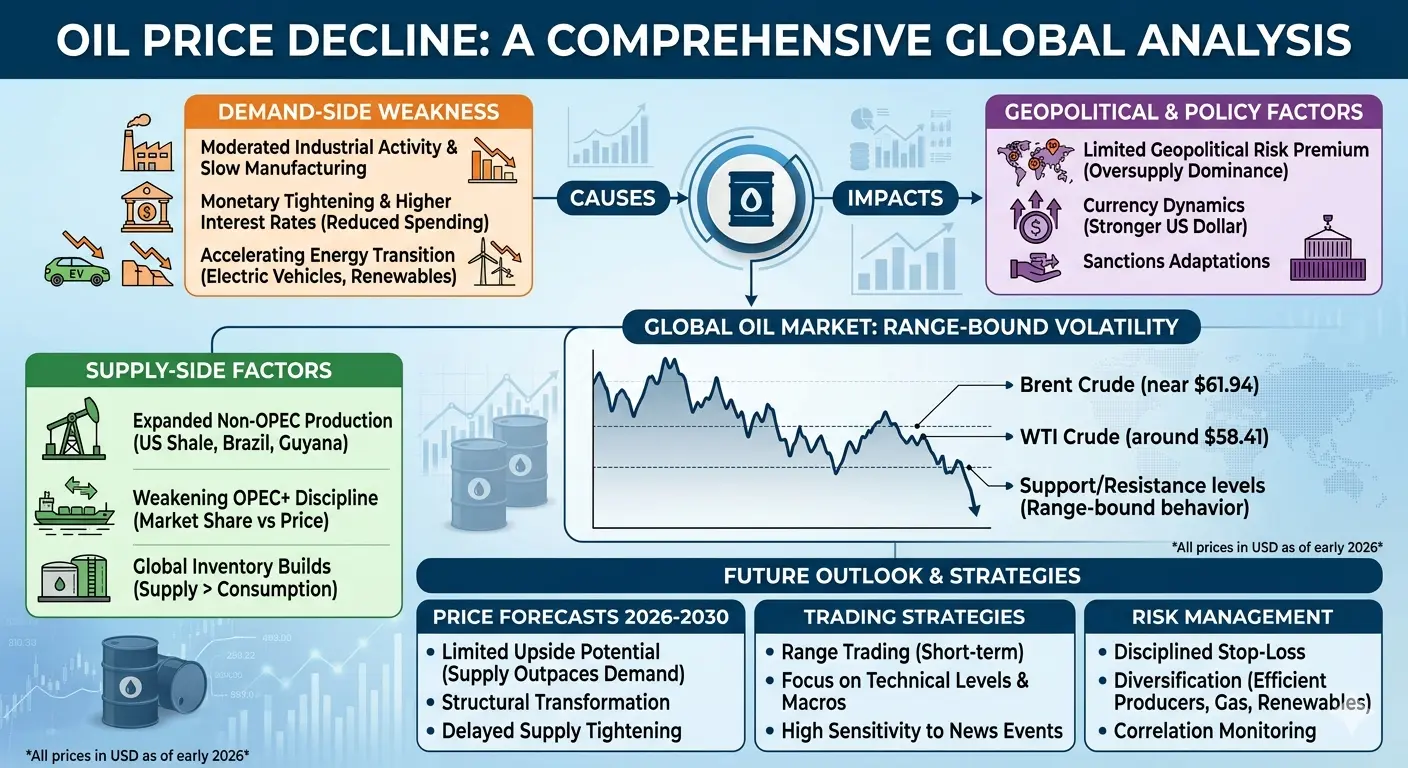
#OilPricesDecline
Global oil markets are undergoing a sharp structural reset driven by shifting supply dynamics and weakening demand momentum.
Crude prices are reacting violently to changing geopolitical expectations and rising production capacity worldwide.
What once looked like a sustained high-price cycle is now transitioning into a correction-driven environment.
Investors are now facing a complex landscape where volatility, uncertainty, and rapid repricing dominate market behavior.
Understanding the Oil Price Decline
The oil price decline refers to a sustained reduction in global crude oi
HighAmbition
#OilPricesDecline
Global oil markets are undergoing a sharp structural reset driven by shifting supply dynamics and weakening demand momentum.
Crude prices are reacting violently to changing geopolitical expectations and rising production capacity worldwide.
What once looked like a sustained high-price cycle is now transitioning into a correction-driven environment.
Investors are now facing a complex landscape where volatility, uncertainty, and rapid repricing dominate market behavior.
Understanding the Oil Price Decline
The oil price decline refers to a sustained reduction in global crude oil benchmarks such as West Texas Intermediate (WTI) and Brent crude. It reflects a broad macroeconomic adjustment rather than a simple short-term price movement.
Lower crude prices generally reduce transportation and production costs, ease inflationary pressure for importing nations, and improve consumer purchasing power. However, they also reduce fiscal revenue for oil-exporting economies and create financial pressure for energy-dependent corporations and national budgets.
This cycle is not isolated—it is deeply connected to global supply chains, macroeconomic conditions, geopolitical stability, and long-term energy transition trends.
Key Drivers Behind the Oil Price Decline
1. Expanding Global Supply and Structural Output Growth
A major driver of the current decline is the sustained increase in global oil supply.
Historically, OPEC has played a central role in balancing global oil markets. However, recent production patterns indicate a shift toward higher output even during periods of weaker pricing.
Global production has reached historically elevated levels, estimated between 106–109 million barrels per day. Supply growth is being led not only by OPEC+ members but also by strong output from the United States, Brazil, Canada, and Guyana.
The International Energy Agency continues to report that global supply growth is consistently outpacing demand growth, resulting in rising inventories and downward pressure on prices.
Technological improvements in shale production and efficiency gains in mature fields have also lowered production costs, enabling producers to maintain high output even in weaker price environments.
2. Weakening Global Demand Conditions
Demand growth has slowed significantly across major economies.
The International Energy Agency has repeatedly revised demand forecasts downward due to weaker industrial activity and slower global economic expansion.
Key demand-side pressures include:
Slower industrial production across Europe and Asia
Reduced global trade and logistics activity
High interest rates limiting economic growth
Slowing manufacturing and freight demand
Rapid electric vehicle adoption in major economies
Efficiency improvements across transport and aviation sectors
China’s long-term energy transition strategy is especially influential, as electrification and renewable expansion continue to reduce long-term crude oil dependency.
3. Geopolitical and Currency Factors
Geopolitical developments traditionally add a risk premium to oil prices. However, recent market behavior shows declining premiums due to expectations of stabilization and improved diplomatic conditions.
As tensions ease, previously priced-in supply risks are removed, triggering downward price adjustments.
Additionally, fluctuations in the US dollar significantly impact oil pricing. Since crude oil is priced in USD globally, a stronger dollar increases costs for international buyers and suppresses demand.
Current Oil Market Situation (May 26, 2026)
As of the latest market session, crude oil is experiencing sharp volatility following a corrective move lower.
WTI Crude Oil: $91.80 – $92.60 per barrel
Brent Crude Oil: $98.00 – $99.00 per barrel
These levels reflect a clear decline from recent highs above $100–$110 per barrel, signaling a transition from peak pricing into a correction phase.
The move highlights how sensitive crude markets remain to geopolitical signals and supply expectation shifts.
Technical Market Structure
The technical outlook remains corrective and uncertain:
WTI is testing key short-term support zones after a breakdown from recent highs
Brent is stabilizing after a sharp downside adjustment
Momentum indicators such as RSI are approaching neutral-to-oversold conditions
Volatility remains elevated, reflecting unstable trend formation
Overall, the market is in a consolidation phase following a rapid repricing event.
Price Forecasts and Institutional Outlook
Leading financial institutions maintain a cautious medium-term outlook:
Goldman Sachs expects continued pressure due to strong supply growth and moderating demand conditions.
JPMorgan Chase projects gradual stabilization as supply-demand imbalances adjust over time.
U.S. Energy Information Administration expects moderate easing in prices as inventories remain elevated.
Reuters highlights persistent oversupply risks driven by non-OPEC production expansion.
International Energy Agency continues to emphasize structural demand weakness and strong supply growth.
Long-Term Outlook (2027–2030)
The long-term oil market structure is undergoing a fundamental transformation.
Key structural trends include:
Accelerating global energy transition
Rapid electric vehicle adoption
Expansion of renewable energy infrastructure
Slowing long-term oil demand growth
Continued petrochemical demand in emerging markets
Despite these shifts, crude oil will remain a critical global energy source for decades due to its role in transportation, industry, and chemical production.
However, growth rates are expected to decline significantly compared to historical averages.
Trading Strategy and Investment Approach
Short-Term Trading Environment
The current market environment is highly volatile and sensitive to macro news.
Key observations:
WTI is fluctuating near $90–$95 zones
Brent is trading around $95–$100 levels
Resistance remains strong near recent breakdown areas
Volatility creates short-term trading opportunities but increases risk
The market currently favors range-based and event-driven trading strategies rather than strong directional positioning.
Long-Term Investment Strategy
For long-term investors:
Focus on low-cost, efficient energy producers
Diversify across traditional and renewable energy sectors
Closely monitor OPEC+ policy shifts
Maintain hedging strategies for volatility protection
Companies with strong balance sheets and low production costs are better positioned to survive prolonged price corrections.
Risk Management Considerations
Effective risk control is essential in the current environment:
Maintain disciplined position sizing due to volatility
Align stop-loss levels with key technical structures
Monitor increasing correlation between commodities and risk assets
Use hedging instruments such as options for downside protection
Scenario Analysis: Upside vs Downside
Upside Scenario
Prices could rebound strongly if:
Major supply disruptions occur
Geopolitical tensions escalate unexpectedly
Global economic growth accelerates
Production cuts are implemented by major producers
In such cases, crude could revisit $110–$130+ per barrel.
Downside Scenario
Prices could fall further if:
Global recession significantly reduces demand
Energy transition accelerates faster than expected
Supply continues expanding without coordination
Persistent oversupply conditions develop
In extreme scenarios, prices could retest significantly lower levels.
The current oil price decline reflects a structural adjustment driven by expanding supply, moderating demand, and evolving geopolitical conditions. Prices around $91–$92 (WTI) and $98–$99 (Brent) indicate a correction phase rather than a stable long-term equilibrium.
Institutions such as Goldman Sachs and U.S. Energy Information Administration continue to highlight uncertainty in medium-term price direction.
Overall, the oil market is transitioning into a highly dynamic phase where flexibility, disciplined risk management, and scenario-based strategies are essential for both traders and investors.#StockTradingChallengeUpTo17000U #TradeCFDWinGold #DailyPolymarketHotspot @Gate_Square @Gate广场_Official
repost-content-media
  • Reward
  • 2
  • Repost
  • Share
Tradestorm:
To The Moon 🌕
View More
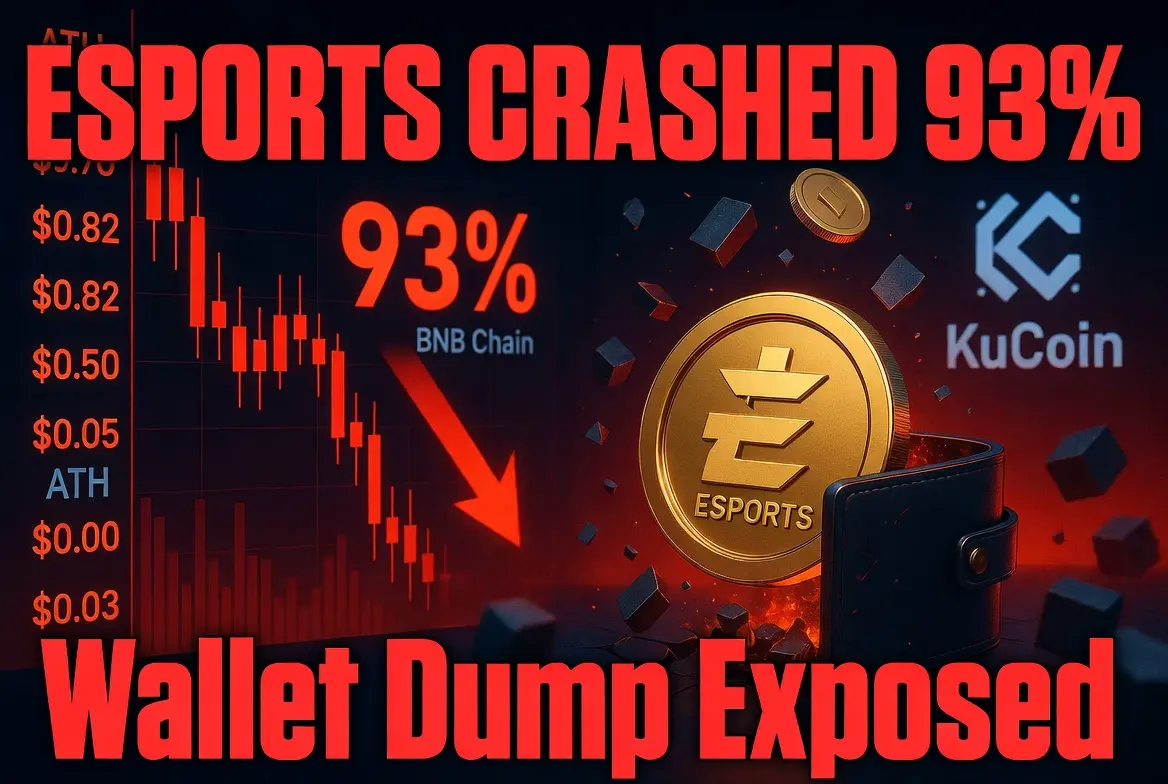
#ESPORTSPriceCrashesAfterWalletDump
ESPORTS Price Crash After Wallet Dump
1. What Is ESPORTS Token?
ESPORTS is the native governance and utility token of Yooldo Games, a multi-chain Web3 gaming and esports platform built on blockchain infrastructure. The project aims to merge traditional competitive gaming with decentralized systems through Play-to-Earn mechanics, AI-based gaming systems, esports tournaments, and Web3-native ownership models.
The ecosystem operates with a dual-token structure:
$ESPORTS — Governance and utility token used for staking, ecosystem participation, payments, gover
ESPORTS46.73%
HighAmbition
#ESPORTSPriceCrashesAfterWalletDump
ESPORTS Price Crash After Wallet Dump
1. What Is ESPORTS Token?
ESPORTS is the native governance and utility token of Yooldo Games, a multi-chain Web3 gaming and esports platform built on blockchain infrastructure. The project aims to merge traditional competitive gaming with decentralized systems through Play-to-Earn mechanics, AI-based gaming systems, esports tournaments, and Web3-native ownership models.
The ecosystem operates with a dual-token structure:
$ESPORTS — Governance and utility token used for staking, ecosystem participation, payments, governance voting, and rewards
• $TROB — In-game token used for gameplay mechanics, rewards, tournament systems, and game economy functionality
Yooldo attracted early attention after being selected for major accelerator programs in 2023. The platform positioned itself as an AI-native Web3 gaming infrastructure designed to bridge traditional gaming with blockchain-based ownership and engagement systems.
At the time of the crash, ESPORTS had a maximum supply of 900 million tokens and an estimated circulating supply of approximately 460 million tokens.
2. Price Before The Crash — How High Did ESPORTS Go?
Before the collapse on May 25, 2026, ESPORTS experienced strong upward momentum driven by exchange listing hype, speculative buying activity, and rapidly expanding retail participation.
Major price milestones included:
• Initial low around $0.05226 in July 2025
• Recovery toward $0.128 during August 2025
• Strong breakout toward $0.3747 in November 2025
• Trading stability around $0.40–$0.46 during early May 2026
• Listing rally pushing the token toward $0.70–$0.75 between May 22–24, 2026
• All-Time High (ATH): $0.8283 on May 20, 2026
• Final 24-hour pre-crash high: $0.7509 on May 25, 2026
The listing event acted as a strong psychological catalyst. Retail traders interpreted increased exchange visibility as confirmation of long-term growth potential, leading to higher liquidity and aggressive trading activity.
Later analysis suggested that this environment may have created favorable conditions for large holders to exit positions during peak demand.
3. The Wallet Dump — What Exactly Happened?
On May 25, 2026, ESPORTS experienced a severe and rapid market collapse.
Step 1: Preparation Phase
Weeks before the crash, a large volume of tokens was reportedly unlocked from previously inactive wallets believed to be associated with early holders or project-linked entities.
Step 2: Distribution Across Wallets
Before the crash, tokens were distributed across multiple wallets through structured transfers. This type of behavior is often associated with coordinated distribution patterns rather than organic trading activity.
Step 3: Exchange Inflows Begin
Shortly before the collapse, significant token amounts began moving into exchange-linked wallets, creating hidden selling pressure while market optimism remained high.
Step 4: Main Selling Phase
During the crash window:
• Estimated tokens sold: ~197.8 million ESPORTS
• Approximate share of circulating supply: ~43%
• Estimated value: ~$13.6M range
• Duration: 2–4 hours
The rapid sell pressure overwhelmed available liquidity in a short timeframe.
Step 5: Collapse Spiral
Once liquidity weakened, order books failed to absorb the selling volume. Panic selling accelerated, stop-loss triggers activated, and confidence collapsed rapidly, resulting in a near-vertical price decline.
4. Price After The Crash — How Low Did It Go?
The market structure collapsed within a single trading session.
Major post-crash figures:
• Pre-crash high: $0.7509
• Intraday low: approximately $0.03359
• Estimated decline: 91%–93%
• Panic trading volume: ~$49 million
• Market value destruction: over $110 million
Following the crash, ESPORTS briefly traded in a highly unstable range between $0.04 and $0.06.
Market sentiment shifted sharply toward extreme caution due to structural breakdown and liquidity loss.
5. On-Chain Warning Signals BEFORE The Crash
Several warning indicators were observed before the collapse:
Equal-Sized Wallet Transfers
Identical token movements across multiple wallets suggested structured distribution behavior rather than organic trading activity.
Artificial Price Stability
Despite rising supply pressure, price action remained unusually stable, masking underlying selling activity.
Exchange Deposits
Large inflows into exchanges occurred before the crash, indicating potential sell-side preparation.
Within a short time window after these signals, the market collapsed.
6. Was This an Insider-Linked Event?
No official confirmation exists. However, analysts highlighted several concerning patterns:
• Multisig wallet activity linked to early allocations
• Coordinated wallet distribution behavior
• Exchange inflows during peak hype
• Rapid liquidation of a large supply portion
• Weak communication during the event
Due to these factors, market sentiment shifted toward suspicion of coordinated large-holder exits.
7. Current Market Status
As of May 26, 2026:
• Trading range: $0.044–$0.067
• Decline from ATH: more than 90%
• Market sentiment: extremely weak
• Liquidity: very low
• Volatility: high
A major concern remains potential additional supply from remaining large holders.
8. Price Forecast — Can ESPORTS Recover?
Short-Term Outlook
Possible scenarios:
• Further downside toward $0.01–$0.03
• Stabilization between $0.04–$0.08
• Speculative rebound toward $0.10
Medium-Term Outlook
Recovery requires:
• Transparency regarding wallet activity
• Restored investor confidence
• Locked supply mechanisms
• Ecosystem development progress
Without these factors, recovery remains limited.
Long-Term Outlook
Possible outcomes vary widely:
• Weak recovery: $0.05–$0.10
• Moderate recovery: $0.15–$0.25
• Strong recovery: $0.40–$0.60
• Full ATH recovery: highly uncertain
9. Maximum Upside Potential
Scenarios include:
• Extreme downside: $0.01–$0.03
• Weak recovery: $0.05–$0.10
• Moderate recovery: $0.15–$0.25
• Strong recovery: $0.40–$0.60
• Return to ATH: unlikely under current conditions
Overhead supply remains a key limitation.
10. Trading Strategy and Risk Management
For Current Holders
• Monitor wallet activity closely
• Avoid emotional averaging decisions
• Consider partial exits on rebounds
• Focus on risk management
For New Participants
• Treat as ultra-high-risk asset
• Keep exposure minimal
• Avoid chasing volatility
• Wait for transparency improvements
Key Lessons
• Listings can create exit liquidity
• Wallet concentration increases risk
• Exchange inflows often precede sell-offs
• On-chain data can signal early warnings
11. Upcoming Risks
Token Unlock Event
A scheduled unlock may introduce additional supply pressure into already weak market conditions.
Remaining Large Wallets
Significant holdings remain concentrated in a few wallets, increasing downside risk.
Transparency Issues
Lack of clear communication continues to limit trust recovery.
12. Critical Market Phase
The ESPORTS crash represents one of the most severe GameFi market collapses of 2026.
The token moved from strong speculative momentum and highs above $0.82 into a rapid decline exceeding 90% within a short timeframe.
The combination of concentrated supply, exchange-driven liquidity cycles, and rapid sell pressure created a breakdown in market structure and investor confidence.
At this stage, ESPORTS remains in a highly fragile condition. Future recovery depends on transparency, ecosystem development, and restoration of trust among market participants.
Without these improvements, long-term recovery remains uncertain.#StockTradingChallengeUpTo17000U #TradeCFDWinGold #DailyPolymarketHotspot #SocialFiSectorUp5.9%
repost-content-media
  • Reward
  • 3
  • Repost
  • Share
ZeddicusZulZorander:
Well written
View More
[Macro Event Week]
live-cover
0 views
Ended • No Replay
  • Reward
  • 1
  • Repost
  • Share
Ryakpanda:
Just charge forward 👊
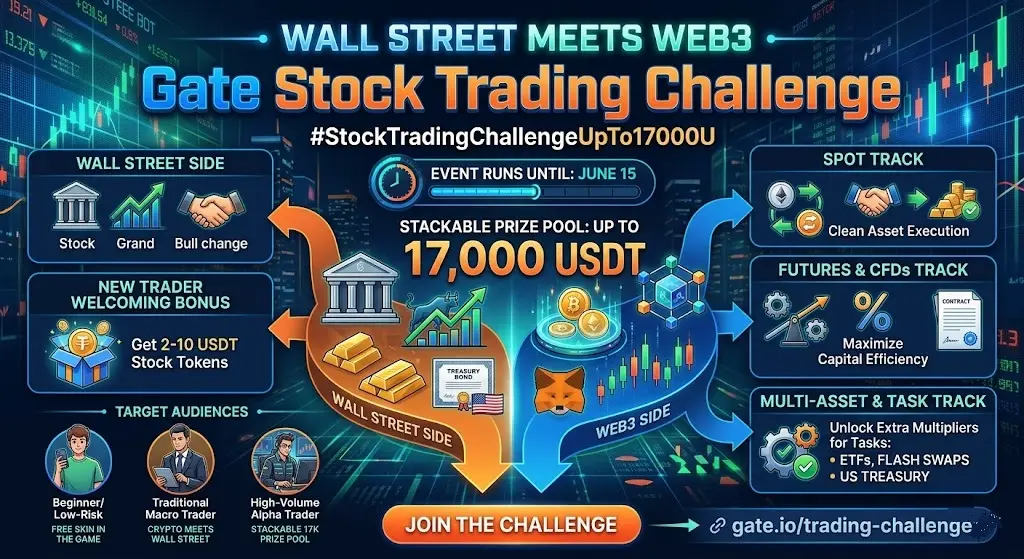
#StockTradingChallengeUpTo17000U
This promotion packs a ton of value, especially for an campaign bridging crypto and traditional stock markets. Because it features stackable rewards across three distinct tracks (spot, futures, and CFD), it allows different styles of traders to maximize their return depending on their capital allocation.
If you are putting together marketing copy, an announcement post, or a strategic breakdown for this campaign, here is how you can organize the key details to make it highly scannable and engaging for your audience:
Gate Stock Trading Challenge
Event Deadline:
ybaser
#StockTradingChallengeUpTo17000U
This promotion packs a ton of value, especially for an campaign bridging crypto and traditional stock markets. Because it features stackable rewards across three distinct tracks (spot, futures, and CFD), it allows different styles of traders to maximize their return depending on their capital allocation.
If you are putting together marketing copy, an announcement post, or a strategic breakdown for this campaign, here is how you can organize the key details to make it highly scannable and engaging for your audience:
Gate Stock Trading Challenge
Event Deadline: Active now until June 15, 2026
Reward Tiers & Tracks
Participants can stack earnings across multiple activities to clear a maximum pool of up to 17,000 USDT.
The Three Core Tracks: Spot, Futures, and CFDs (Contracts for Difference).
New Trader Welcoming Bonus: New accounts instantly pick up 2-10 USDT in stock tokens just for getting started.
Task-Based Cash Bonuses: Extra cash multipliers are unlocked by completing dedicated mini-tasks for Flash Swaps, ETFs, and US Treasury products.
Referral Boost: Stack additional rewards by inviting friends to join the trading challenge tracks.
Beginners / Low-Risk"Free Skin in the Game"The 2-10 USDT welcome stock tokens & easy Flash Swap tasks.
Traditional Macro Traders"Crypto Meets Wall Street"The inclusion of CFDs, ETFs, and US Treasury yield tasks.
High-Volume Alpha Traders"Stackable 17K Prize Pool"Maximizing volume across spot and futures tracks simultaneously.
Given the unique mix of traditional finance (stocks, government bonds) and cryptocurrencies in the campaign, focusing on the Traditional Macro/Multi-Asset Investor angle is highly effective. It highlights the available product diversity (ETFs, CFDs, US Treasury Bonds) while also emphasizing the large and accumulating prize pool.
Wall Street meets Web3. The Gate Stock Trading Challenge has officially BEGUN, bringing together traditional markets and cryptocurrencies with a massive accumulating prize pool of 17,000 USDT!
Whether you trade Spot, Futures, or CFDs, your volume matters.
Here's how to claim your share before June 15th 👇
Key Trading Paths and Benefits
Choose your playstyle—or combine all three:
Spot Trading – Clean asset trading.
Futures and CFDs – Maximize capital efficiency.
New to the platform? Get a quick start on your portfolio with an instant 2-10 USDT stock token bonus by making your first trade.
Multipliers
Want to boost your earnings? Unlock extra cash bonuses by completing special macro tasks:
Instant Quick Swaps
Traditional ETF trading US Treasury bond yield products
Call to Action
Bring your team too—the referral program offers extra rewards for every trading buddy you invite.
Time is running out. This contest ends June 15th.
repost-content-media
  • Reward
  • 2
  • Repost
  • Share
Tradestorm:
To The Moon 🌕
View More
🥇 Gate TradFi Golden Lucky Bag Phase Five Returns Strongly
Very high chance of winning! Excellent gold prizes!
The Golden Lucky Bag series has already distributed over 5KG of gold
This phase continues with a total of 2,304g of gold rain
Every 10 minutes, 2g of gold is drawn, 1 person wins 1g of gold, and 10 people share an additional 1g of gold
A single transaction of ≥1,000 USDT unlocks 5 consecutive lottery chances,
You can win multiple times, trading nonstop, and drawing continuously!
⏰ Event time: May 25, 2026, 15:40 – June 9, 2026, 16:20 (UTC+8)
👉 Join now: https://www.gate.com/campaig
HighAmbition
🥇 Gate TradFi Golden Lucky Bag Phase Five Returns Strongly
Very high chance of winning! Excellent gold prizes!
The Golden Lucky Bag series has already distributed over 5KG of gold
This phase continues with a total of 2,304g of gold rain
Every 10 minutes, 2g of gold is drawn, 1 person wins 1g of gold, and 10 people share an additional 1g of gold
A single transaction of ≥1,000 USDT unlocks 5 consecutive lottery chances,
You can win multiple times, trading nonstop, and drawing continuously!
⏰ Event time: May 25, 2026, 15:40 – June 9, 2026, 16:20 (UTC+8)
👉 Join now: https://www.gate.com/campaigns/gold-lucky-draws-s5
repost-content-media
  • Reward
  • 2
  • Repost
  • Share
Tradestorm:
To The Moon 🌕
View More
#USIranDraftDeal
🚨 US-Iran Draft Deal: What You Need to Know as of May 25, 2026
After months of conflict and intense behind-the-scenes diplomacy, the United States and Iran appear to be inching closer to a draft peace agreement but the picture is far from clear, and both sides are telling very different stories about what it actually means.
Here's a comprehensive breakdown of where things stand right now:
🔴 Trump's Claim: "Largely Negotiated"
On Saturday, President Donald Trump posted on Truth Social that an agreement between the US, Iran, and several regional countries had been "largely ne
Falcon_Official
#USIranDraftDeal
🚨 US-Iran Draft Deal: What You Need to Know as of May 25, 2026
After months of conflict and intense behind-the-scenes diplomacy, the United States and Iran appear to be inching closer to a draft peace agreement but the picture is far from clear, and both sides are telling very different stories about what it actually means.
Here's a comprehensive breakdown of where things stand right now:
🔴 Trump's Claim: "Largely Negotiated"
On Saturday, President Donald Trump posted on Truth Social that an agreement between the US, Iran, and several regional countries had been "largely negotiated" and that the Strait of Hormuz the critical shipping chokepoint closed since the war began on February 28 would be reopened. He described the document as a "Memorandum of Understanding pertaining to PEACE."
Trump held calls with leaders from Saudi Arabia, UAE, Qatar, Pakistan, Turkey, Egypt, Jordan, and Bahrain, and said a separate call with Israeli PM Netanyahu "went very well." Regional diplomats on the call described the discussions as "very positive."
However, before the calls, Trump told Axios the chances of reaching a deal were a "solid 50/50" and warned that if talks fail, the US could choose to "blow them to kingdom come."
🟡 Iran's Response: "Not What Trump Says"
Iran has pushed back hard against Trump's framing. The semi-official Tasnim news agency confirmed that some progress has been made on a roadmap to end the war, with the US waiving sanctions on Iranian oil during negotiations. But Tasnim explicitly stated that Iran has NOT yet accepted any actions on its nuclear programme.
Even more significantly, Fars News Agency which is linked to Iran's Revolutionary Guards called Trump's claims about the Strait of Hormuz "inconsistent with reality." Fars reported that Iran would allow vessel traffic to return to pre-war levels, but this does NOT mean "free passage" as existed before. Iran insists on maintaining sovereignty over the waterway.
Iran's Foreign Ministry spokesperson Esmaeil Baghaei described the current proposal as a "framework agreement" or MoU that would first establish broad principles, with details negotiated over 30 to 60 days. He said disputes have reduced this week but "there are still issues that need to be discussed through mediators," and the situation would become clearer in the "next three or four days."
📋 What the Draft Reportedly Includes
Based on multiple sources, the proposed MoU reportedly covers:
• A 60-day temporary ceasefire extendable by mutual consent, including a mutual "no attack" pledge
• Reopening of the Strait of Hormuz for shipping (disputed terms)
• Ending the US blockade on Iranian ports
• US sanctions relief: easing on Iranian ports and oil sales, possible oil waivers, unfreezing of Iranian assets held abroad
• Iran allowed to resume sale of fuel and oil
• Iranian commitment not to pursue or develop nuclear weapons (but nuclear details pushed to later phase)
• Iran NOT yet agreeing to surrender its stockpile of highly enriched uranium
• Broader regional de-escalation linked to Lebanon and wider Middle East conflict
The deal is expected to unfold in two phases: Phase 1 — ceasefire, Hormuz reopening, basic nuclear assurances; Phase 2 (30–60 days) detailed nuclear negotiations and other issues.
⚠️ Major Sticking Points
Strait of Hormuz: This is the biggest flashpoint. Nearly one-fifth of the world's oil and LNG once passed through this waterway. Iran closed it after the war started, and the US responded with a naval blockade of Iranian ports. Now Iran wants sovereignty and the right to manage/toll the strait, while the US demands full freedom of navigation. The gap between "Iran manages it" and "free passage for all" remains enormous.
Nuclear Programme: The US and Israel want Iran to halt enrichment entirely and surrender its highly enriched uranium stockpile. Iran insists its programme is civilian only and has NOT agreed to any nuclear concessions yet. The NYT reported an "apparent commitment" by Iran to surrender HEU but Iran's own media denies this. This issue is deliberately pushed to Phase 2, meaning it could blow up the entire deal later.
Israel's Concern: Netanyahu's team is worried about a narrow interim deal that extends the ceasefire and eases sanctions without addressing the nuclear issue Israel's top priority. The US has reassured Israel on uranium, but the details remain unresolved.
🇵🇰 Pakistan's Role
Pakistan has been the key mediator, with PM Shehbaz Sharif and military chief Asim Munir involved in facilitating indirect talks between Washington and Tehran. Sharif congratulated Trump on "extraordinary efforts to pursue peace" but notably did not reference any specific agreement.
🇺🇸 Domestic Pushback
Not everyone in Washington is celebrating. Former Secretary of State Mike Pompeo called the reported deal "Not remotely America First." Senator Lindsey Graham warned that perceiving Iran as a "force requiring a diplomatic solution" could shift the regional balance of power and become "a nightmare for Israel." Senate Armed Services Chairman Roger Wicker urged Trump to "finish what we started" rather than pursue a deal "not worth the paper it is written on."
White House Communications Director Steven Cheung responded to Pompeo with a profane dismissal, telling him to "shut his stupid mouth and leave the real work to the professionals."
📊 What to Watch Next
• Trump's decision within days on whether to accept the draft or resume military options
• Whether Iran formally accepts the MoU or rejects it over Hormuz/nuclear disagreements
• Oil market volatility Hormuz reopening would significantly impact global crude prices
• Israel's reaction if nuclear concessions are deferred to Phase 2
• The next 3–4 days will be critical Baghaei said that's when the picture will become clearer
Bottom line: This is a potential breakthrough, but it's fragile. Both sides are publicly contradicting each other on key terms. The deal addresses the immediate crisis (ceasefire, Hormuz, sanctions) but kicks the hardest issues (nuclear, sovereignty, long-term peace) to later negotiations. One misstep in Phase 2 could unravel everything.
Stay tuned. The next 72 hours will determine whether this becomes a historic turning point or another failed diplomatic effort in a conflict that has already reshaped the Middle East.
#USIranDraftDeal #StraitOfHormuz #IranPeaceDeal #Geopolitics
repost-content-media
  • Reward
  • 3
  • Repost
  • Share
Tradestorm:
2026 GOGOGO 👊
View More
#HYPEMarketCapSurpassesDOGE
Top Dog Flipped?
HYPE just leapfrogged the original meme coin. On May 25, Hyperliquid’s native token officially surpassed Dogecoin by market capitalization, landing at the 9th spot among all cryptocurrencies.
🔹 The numbers behind the milestone come straight from CoinMarketCap. HYPE traded at approximately $62.42 with a market cap of $15.86 billion, edging past DOGE at $15.83 billion. A razor-thin margin of roughly $30 million sealed the flip.
🔹 This is a breakout powered by real economic activity, not just community momentum. Hyperliquid routes 99% of protocol fe
HYPE0.83%
DOGE0.71%
USDC0.03%
User_any
#HYPEMarketCapSurpassesDOGE
Top Dog Flipped?
HYPE just leapfrogged the original meme coin. On May 25, Hyperliquid’s native token officially surpassed Dogecoin by market capitalization, landing at the 9th spot among all cryptocurrencies.
🔹 The numbers behind the milestone come straight from CoinMarketCap. HYPE traded at approximately $62.42 with a market cap of $15.86 billion, edging past DOGE at $15.83 billion. A razor-thin margin of roughly $30 million sealed the flip.
🔹 This is a breakout powered by real economic activity, not just community momentum. Hyperliquid routes 99% of protocol fees through its Assistance Fund to repurchase HYPE tokens, creating structural buy pressure that intensifies as trading volume grows.
🔹 Institutional capital is accelerating the move. Spot ETFs launched earlier this month have attracted over $54 million in combined net inflows in roughly seven trading days. A wallet linked to a major digital asset manager accumulated more than 680,000 HYPE in a single week.
🔹 The platform itself is expanding beyond crypto-native trading into pre-IPO futures, prediction contracts, and tokenized real-world assets. USDC supply on the network surpassed $4.1 billion, giving it one of the deepest stablecoin bases in onchain trading.
A flippening fueled by fees, not feelings. Utility is punching back against the meme coin throne, and the scoreboard just updated. How are you reading this shift from narrative to revenue in the current cycle?
\#HYPEMarketCapSurpassesDOGE
repost-content-media
  • Reward
  • 4
  • Repost
  • Share
discovery:
LFG 🔥
View More
#HYPEMarketCapSurpassesDOGE
The crypto market is witnessing another historic shift as Hyperliquid’s native token HYPE has officially moved ahead of Dogecoin in market capitalization, marking one of the strongest momentum expansions seen in the digital asset sector this year. What initially started as a rapidly growing trading ecosystem has now evolved into a major market force attracting traders, liquidity providers, institutions, and long-term investors from across the global crypto landscape.
HYPE’s rise above DOGE is not being viewed as a temporary headline alone. Many analysts believe thi
HYPE0.83%
DOGE0.71%
  • Reward
  • 5
  • 2
  • Share
Yusfirah:
LFG 🔥
View More
Gate Stock Trading Challenge is coming! Win up to 17,000 USDT solo!
✅ Spot / Futures / CFD three major tracks, rewards stack up
✅ New traders get 2-10 USDT stock tokens for free, invite friends to earn more
✅ Flash exchange / ETF / US bond tasks earn extra cash
🔥 Multiple task rewards can be enjoyed together, unlimited benefits
⏰ Event period: May 25, 2026, 17:00 - June 15, 2026, 17:00 (UTC+8)
📄 Announcement details: https://www.gate.com/zh/announcements/article/51359
🎯 Sign up now to participate: https://www.gate.com/campaigns/255
  • Reward
  • 1
  • Repost
  • Share
HighAmbition:
LFG 🔥
  • Reward
  • 4
  • Repost
  • Share
PrinceMagsi786:
2026 GOGOGO 👊
View More
  • Reward
  • 1
  • Repost
  • Share
PrinceMagsi786:
2026 GOGOGO 👊
#TradfiTradingChallenge
🔥 TradFi Trading Challenge 🔥 Deep System Architecture, Market Psychology, Ranking Loops & Incentive Mechanics
Gate Square The TradFi Trading Challenge is best understood not as a simple trading competition, but as a multi-layer behavioral finance system where trading performance, content creation, engagement frequency, and community visibility are merged into a single unified ranking engine. It converts what is normally private market activity into a continuously observable, socially reinforced performance structure.
At its core, users are asked to share TradFi tra
  • Reward
  • 8
  • Repost
  • Share
Miss_1903:
2026 GOGOGO 👊
View More
#PlatinumCardCreatorExclusive
🔥Platinum Card Creator Exclusive 🔥 Deep System Design, Incentive Mechanics, Risk Layering & VIP Financial Ecosystem
Gate Square Platinum Card Creator Exclusive is structured as a high-tier financial access instrument embedded inside a creator-driven ecosystem. Unlike traditional credit cards that are primarily underwriting-based, this system blends payment utility, behavioral scoring, engagement incentives, and VIP tier progression into a single continuous framework.
At its surface, it functions as a Visa-supported credit card with Google Pay integration, ena
  • Reward
  • 10
  • Repost
  • Share
PrinceMagsi786:
2026 GOGOGO 👊
View More
#DailyPolymarketHotspot
🔥Daily Polymarket Hotspot 🔥 Real-Time Prediction Markets, Macro Signals & Crowd Probability Trading

Polymarket Daily Polymarket Hotspot is a continuously evolving snapshot of global prediction markets where users trade probabilities on real-world outcomes across crypto, macroeconomics, politics, sports, and geopolitical events. Unlike traditional financial dashboards that track prices of assets, prediction markets track *belief itself*—turning expectations into tradable instruments.
At its core, Polymarket operates as a decentralized forecasting layer where each ma
BTC-0.86%
  • Reward
  • 11
  • 1
  • Share
PrinceMagsi786:
To The Moon 🌕
View More
#GateSquarePizzaDay
🍕🔥 GateSquare Pizza Day 🔥
The Story, Culture, Incentives & Bitcoin Legacy Event

Gate Square GateSquare Pizza Day is a community-driven celebration built around one of the most iconic moments in crypto history—the famous Bitcoin pizza transaction. It transforms a historical milestone into a modern engagement event where culture, storytelling, trading experiences, and community participation all merge into a single ecosystem experience.
At its core, the event encourages users to share their personal Bitcoin-related experiences using the hashtag GateSquarePizzaDay, incl
BTC-0.86%
  • Reward
  • 10
  • Repost
  • Share
PrinceMagsi786:
LFG 🔥
View More
#SpaceXOfficiallyFilesforIPO
SpaceX Officially Files for IPO 🔥 Deep Capital Market Transformation, Space Economy Expansion & Long-Term Valuation Shift
SpaceX filing for an IPO represents one of the most structurally important transitions in modern capital markets, because it is not just a company going public—it is an entire frontier industry moving from private valuation frameworks into continuous public price discovery.
For years, SpaceX operated in a unique category of “private mega-infrastructure,” where valuation was driven by private funding rounds, secondary market transactions, and
SPCX-2.72%
  • Reward
  • 10
  • Repost
  • Share
PrinceMagsi786:
2026 GOGOGO 👊
View More
  • Pinned