# DailyPolymarketHotspot

490.13K

Daily spotlight on trending Polymarket prediction events, covering crypto, stocks, macro economy, and more. Check real-time volume, leading outcomes, and resolution dates. Make your predictions and trade to win.

📢 Gate Square | Polymarket 5/26 Prediction: Will the US and Iran reach a nuclear agreement by the end of May?
Dramatic reversal? Trump’s latest hint: US-Iran negotiations are "progressing smoothly," and the US has softened its stance on Iran’s uranium enrichment and onsite processing issues! The reopening of the Strait of Hormuz seems to be a victory in sight. Can the US and Iran reach a nuclear deal before the end of May?
🎁 News forecast: Select 5 high-quality users, each receives $5 tokens!
📝 Participation guide:
Post with #Polymarket每日热点
🔹 Method A: Predict the event outcome and at
View Original
post-image
  • Reward
  • 13
  • Repost
  • Share
MasterChuTheOldDemonMasterChu:
Just charge forward 👊
View More
Gate Prediction Market has completed a new round of feature upgrades, focusing on real-time information access, market monitoring capabilities, and community interaction experience improvements. This upgrade has been integrated into Gate App v8.20.
Highlights of this update:
🔹 Polymarket monitoring feature launched, supporting smart money tracking, wallet-level monitoring, and strategy tracking based on position size
🔹 Brand new Live section, aggregating currently active prediction events, with real-time prices and trading dynamics clearly visible
🔹 Event comment section officially opened,
post-image
post-image
Gate广场_Official
Gate Prediction Market has completed a new round of feature upgrades, focusing on real-time information access, market monitoring capabilities, and community interaction experience improvements. This upgrade has been integrated into Gate App v8.20.
Highlights of this update:
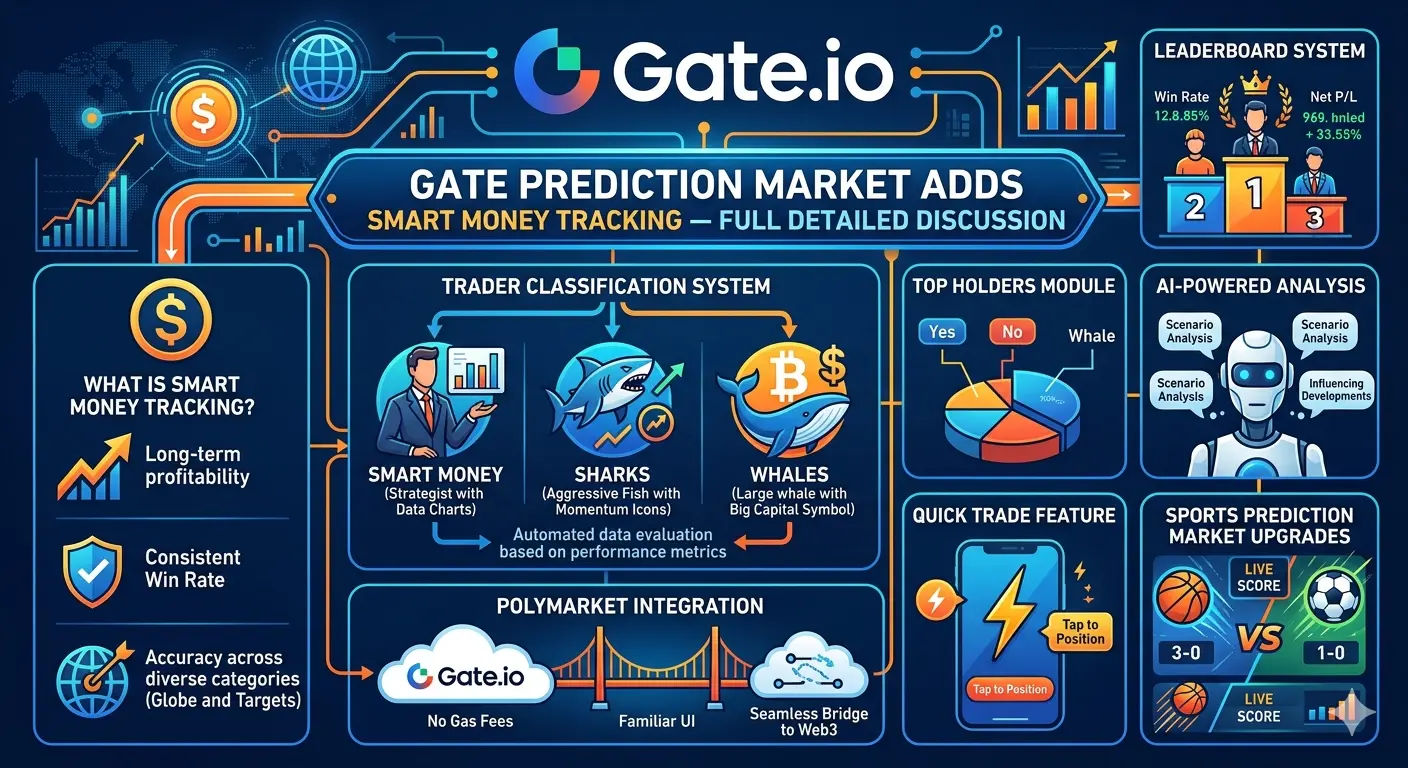
🔹 Polymarket monitoring feature launched, supporting smart money tracking, wallet-level monitoring, and strategy tracking based on position size
🔹 Brand new Live section, aggregating currently active prediction events, with real-time prices and trading dynamics clearly visible
🔹 Event comment section officially opened, supporting users to discuss market judgments, strategy ideas, and market sentiment
Through this upgrade, users can more quickly capture market changes on the same platform, better understand market sentiment, and discover potential trading opportunities in real time.
👉 Explore Polymarket: https://www.gate.com/prediction
👉 Learn more: https://www.gate.com/announcements/article/51362
repost-content-media
  • Reward
  • Comment
  • Repost
  • Share
Today’s CENTCOM strikes on southern Iran may appear like another isolated geopolitical headline on the surface, but for global financial markets — especially crypto — the implications are significantly larger. The United States reportedly carried out what it described as “self-defense strikes” targeting missile launch infrastructure and Iranian mining vessels, even while Iranian negotiators were simultaneously gathering in Qatar for ongoing peace discussions. Several IRGC-linked personnel were reportedly killed despite the formal ceasefire framework technically remaining active since April 8.
BTC-1.74%
  • Reward
  • 5
  • Repost
  • Share
Crypto_Buzz_with_Alex:
Ape In 🚀
View More
#EthereumPrivacyUpgradeRoadmap
The Ethereum Foundation made a historic decision in September 2025 by officially integrating privacy into its core roadmap through the Privacy Stewards of Ethereum (PSE) initiative. This marked a fundamental transformation from the previous approach where privacy was handled by third-party protocols and layer-2 solutions. Ethereum Foundation Co-Director Tomasz Stańczak emphasized that institutional privacy has become a mandatory requirement, not an optional feature. The Foundation established a dedicated 50-person privacy team operating outside the protocol team
HighAmbition
#EthereumPrivacyUpgradeRoadmap
The Ethereum Foundation made a historic decision in September 2025 by officially integrating privacy into its core roadmap through the Privacy Stewards of Ethereum (PSE) initiative. This marked a fundamental transformation from the previous approach where privacy was handled by third-party protocols and layer-2 solutions. Ethereum Foundation Co-Director Tomasz Stańczak emphasized that institutional privacy has become a mandatory requirement, not an optional feature. The Foundation established a dedicated 50-person privacy team operating outside the protocol team, demonstrating unprecedented commitment to this sector.
Three Pillars of Ethereum Privacy Architecture
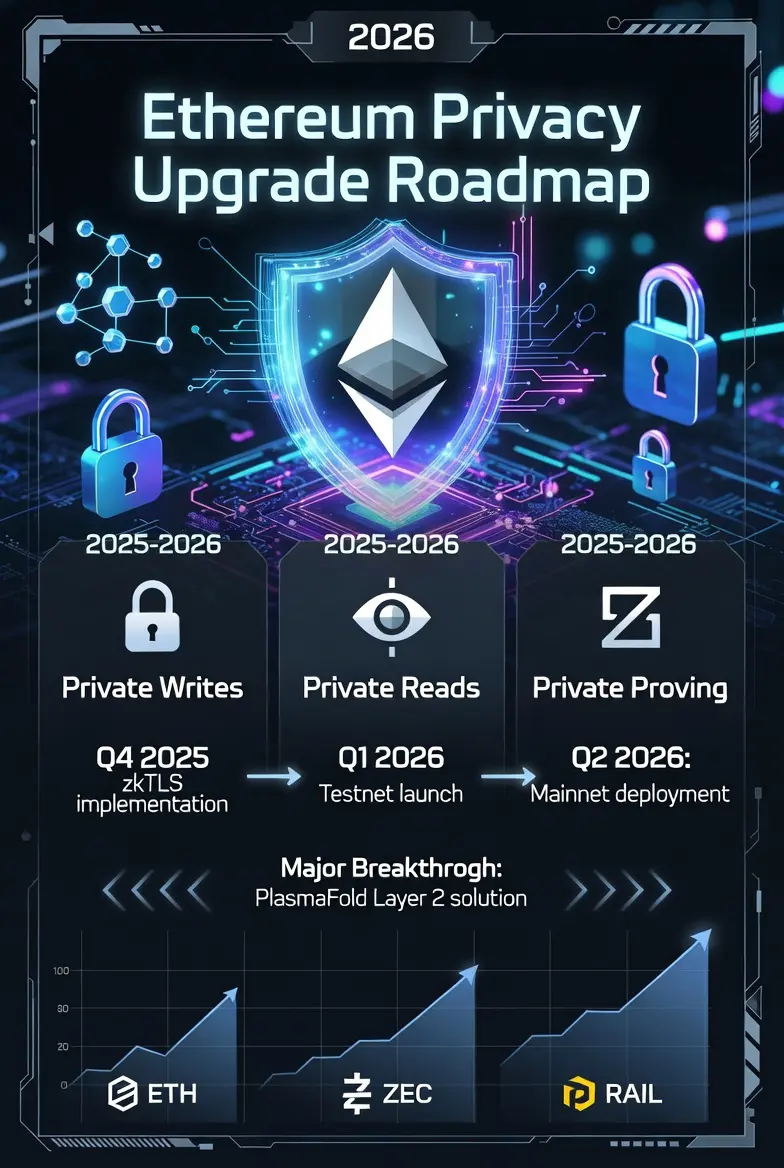
The roadmap centers on three fundamental capabilities that will define Ethereum's privacy infrastructure through 2026 and beyond. First, Private Writes enable confidential on-chain activities without exposing transaction details to the public. This pillar incorporates stealth addresses where recipients receive funds through one-time addresses derived from shared secrets, ensuring only the intended recipient can spend the funds. Homomorphic encryption allows smart contracts to process confidential information while keeping the underlying data hidden. Privacy Pools represent a breakthrough innovation enabling selective disclosure, allowing users to prove they are not mixing funds with sanctioned addresses while maintaining privacy from the general public.
Second, Private Reads address the critical vulnerability where every balance check and dApp interaction currently leaks information. RPC providers can see IP addresses, controlled addresses, token holdings, and activity patterns. The solution involves Oblivious RAM (ORAM) technology that accesses data without revealing which specific data was accessed. Privacy-preserving RPC architectures blind queries before sending them to providers, while client-side verification using cryptographic proofs eliminates trust requirements in RPC providers.
Third, Private Proving focuses on making zero-knowledge proof generation fast, cheap, and accessible on everyday devices. The "prove anywhere" initiative targets sub-30-second proof times on mobile devices by Q1 2026, with distributed proving networks launching in Q2 2026 that split proof generation across multiple devices.
PlasmaFold: The Technical Breakthrough
PlasmaFold represents Ethereum's most significant Layer 2 innovation for privacy. This experimental design employs a hybrid architecture where operators generate proofs server-side for honest block construction while users maintain balance proofs on their own devices. This separation enables instant, non-interactive exits via balance proofs while block proofs handle most validations, eliminating complex exit games and minimizing user costs. The architecture makes private and public transactions equally efficient without extra gas costs or longer confirmation times. The public testnet is expected in Q1 2026, with security audits scheduled for Q2 2026 and mainnet launch targeted for mid-2026.
Key Projects and Implementations
The Ethereum Foundation has supported over 50 open-source privacy research projects since 2018. Semaphore provides a zero-knowledge identity framework for anonymous signaling and voting. TLSNotary pioneered zkTLS technology to prove facts about web data with cryptographic guarantees. Zupass successfully demonstrated privacy-preserving event ticketing at Devcon 2025. Anon Aadhaar enables private national ID verification proving Indian citizenship without exposing ID documents. MACI delivers collusion-resistant private voting for DAOs.
Kohaku serves as Ethereum's comprehensive privacy-and-security toolkit for wallets, functioning as an open-source wallet SDK that allows any wallet to integrate privacy features using Railgun and Privacy Pools implementations. Vitalik Buterin first showcased Kohaku publicly at Devcon in late 2025, and the Ethereum Foundation described it as the most exciting upcoming privacy development in recent years.
zkTLS and Regulatory Compliance
The zkTLS technology entering production in Q4 2025 enables users to prove facts about web data without revealing underlying information. Users can demonstrate credit scores above 700 without showing actual scores, prove they are not on sanctions lists without revealing identity, demonstrate tax compliance without exposing trading history, and verify accredited investor status without sharing financial details. The Institutional Privacy Task Force (IPTF) actively works with regulatory bodies in the US, EU, and Asia to define standards for selective disclosure, positioning privacy and compliance as complementary rather than opposing forces.
Privacy Token Market Performance
The privacy sector experienced extraordinary price appreciation throughout 2025 and 2026. Zcash (ZEC) surged over 1,000% to exceed $440, driven by renewed institutional interest in privacy infrastructure. Railgun (RAIL) demonstrated exceptional performance with gains exceeding 300% year-to-date, reaching approximately $3.87 per token with a market capitalization of around $222 million. The token posted a 32% gain in a single 24-hour period during May 2026 as privacy protocol demand intensified. Railgun's market cap expanded by over 400% from May 2025 lows, reflecting strong investor confidence in Ethereum-based privacy solutions.
Monero (XMR) broke its 8-year high in 2026, demonstrating that privacy assets are experiencing sustained value appreciation rather than temporary sentiment-driven rallies. The broader privacy-token sector attracted significant attention from institutional investors and venture capital, with Andreessen Horowitz identifying privacy as the most important moat for 2026 in their State of Crypto report.
Ethereum Price Outlook
Ethereum's price predictions for 2026 vary considerably based on privacy upgrade execution and broader market conditions. Analysts project targets ranging from $2,700 to $3,000 in the near term if Ethereum breaks the $2,500 resistance level. More optimistic forecasts target $7,500 to $8,000 as institutional privacy features drive adoption. Some projections even eye $10,000 based on sustained institutional demand, ETF flows, staking growth, and broader market support.
However, Ethereum faces significant challenges. The cryptocurrency declined more than 30% in the first quarter of 2026 amid Trump's tariff war and rising geopolitical tensions. Prediction market Polymarket currently assigns nearly 60% probability to Ethereum losing its number two cryptocurrency ranking to Tether's USDT stablecoin in 2026. Technical analysis shows Ethereum trading near critical support at $2,130, with a decisive break below potentially triggering a slide toward the $800-$900 range. Conversely, a break above $2,460 would diminish bearish risks and support further upside.
Competitive Landscape
Ethereum and Cardano's Midnight currently represent the primary contenders aggressively developing institutional privacy solutions. Zcash maintains leadership in the privacy narrative but faces erosion of market share unless it expands beyond private transfers to offer more practical use cases. Railgun competes directly with Zcash and Monero while offering distinct advantages through its opt-in privacy features that align better with current regulatory environments for privacy-based tokens.
The Ethereum Foundation's 47-member Privacy Cluster, coordinated by Igor Barinov, includes PSE focusing on privacy protocol UX, the Institutional Privacy Task Force bridging institutions and Ethereum, and Kohaku providing reference wallet implementations. This coordinated approach gives Ethereum significant competitive advantages in the institutional privacy sector.
Timeline and Milestones
The privacy roadmap follows a structured timeline through 2026. Q4 2025 marked zkTLS entering production. Q1 2026 targets mobile proving becoming viable with sub-30-second proof times, first privacy-preserving RPC implementations going live, and PlasmaFold public testnet launch. Q2 2026 focuses on distributed proving networks launching, PlasmaFold security audits completion, standards finalization for private reads, and mainnet launch for PlasmaFold. Q3-Q4 2026 aims for client-side verification becoming standard and modular ZK wallets achieving widespread adoption.
Institutional Adoption Drivers
The privacy upgrade roadmap directly addresses institutional requirements that have previously limited Ethereum adoption in traditional finance. Enterprise treasury operations require confidential transaction capabilities to protect competitive information. Anonymous governance voting enables participation without revealing institutional positions. Private DeFi interactions allow sophisticated financial strategies without exposing proprietary trading patterns. Cross-border payments benefit from privacy features that protect commercial relationships while maintaining regulatory compliance.
The anticipated tokenization boom in 2026 positions Ethereum's privacy infrastructure as critical infrastructure for institutional adoption. As traditional financial assets move on-chain, the ability to conduct confidential transactions while maintaining audit trails and compliance capabilities becomes essential.
Ethereum's privacy upgrade roadmap represents one of the most significant protocol developments since the transition to proof-of-stake. The comprehensive approach addressing private writes, private reads, and private proving establishes Ethereum as the leading platform for institutional privacy solutions. The substantial price appreciation in privacy tokens like Railgun and Zcash demonstrates market recognition of this trend. Ethereum's success in executing this roadmap will determine whether it captures the institutional privacy market or cedes ground to competitors like Cardano's Midnight or maintains Zcash's dominance in the privacy narrative. The coordinated effort across 47 privacy experts, dedicated institutional task forces, and regulatory engagement positions Ethereum favorably for the privacy-centric evolution of blockchain technology in 2026 and beyond.@Gate_Square @Gate广场_Official #StockTradingChallengeUpTo17000U #TradeCFDWinGold #DailyPolymarketHotspot #SocialFiSectorUp5.9%
repost-content-media
  • Reward
  • Comment
  • Repost
  • Share
#EthereumPrivacyUpgradeRoadmap
The Ethereum Foundation made a historic decision in September 2025 by officially integrating privacy into its core roadmap through the Privacy Stewards of Ethereum (PSE) initiative. This marked a fundamental transformation from the previous approach where privacy was handled by third-party protocols and layer-2 solutions. Ethereum Foundation Co-Director Tomasz Stańczak emphasized that institutional privacy has become a mandatory requirement, not an optional feature. The Foundation established a dedicated 50-person privacy team operating outside the protocol team
HighAmbition
#EthereumPrivacyUpgradeRoadmap
The Ethereum Foundation made a historic decision in September 2025 by officially integrating privacy into its core roadmap through the Privacy Stewards of Ethereum (PSE) initiative. This marked a fundamental transformation from the previous approach where privacy was handled by third-party protocols and layer-2 solutions. Ethereum Foundation Co-Director Tomasz Stańczak emphasized that institutional privacy has become a mandatory requirement, not an optional feature. The Foundation established a dedicated 50-person privacy team operating outside the protocol team, demonstrating unprecedented commitment to this sector.
Three Pillars of Ethereum Privacy Architecture
The roadmap centers on three fundamental capabilities that will define Ethereum's privacy infrastructure through 2026 and beyond. First, Private Writes enable confidential on-chain activities without exposing transaction details to the public. This pillar incorporates stealth addresses where recipients receive funds through one-time addresses derived from shared secrets, ensuring only the intended recipient can spend the funds. Homomorphic encryption allows smart contracts to process confidential information while keeping the underlying data hidden. Privacy Pools represent a breakthrough innovation enabling selective disclosure, allowing users to prove they are not mixing funds with sanctioned addresses while maintaining privacy from the general public.
Second, Private Reads address the critical vulnerability where every balance check and dApp interaction currently leaks information. RPC providers can see IP addresses, controlled addresses, token holdings, and activity patterns. The solution involves Oblivious RAM (ORAM) technology that accesses data without revealing which specific data was accessed. Privacy-preserving RPC architectures blind queries before sending them to providers, while client-side verification using cryptographic proofs eliminates trust requirements in RPC providers.
Third, Private Proving focuses on making zero-knowledge proof generation fast, cheap, and accessible on everyday devices. The "prove anywhere" initiative targets sub-30-second proof times on mobile devices by Q1 2026, with distributed proving networks launching in Q2 2026 that split proof generation across multiple devices.
PlasmaFold: The Technical Breakthrough
PlasmaFold represents Ethereum's most significant Layer 2 innovation for privacy. This experimental design employs a hybrid architecture where operators generate proofs server-side for honest block construction while users maintain balance proofs on their own devices. This separation enables instant, non-interactive exits via balance proofs while block proofs handle most validations, eliminating complex exit games and minimizing user costs. The architecture makes private and public transactions equally efficient without extra gas costs or longer confirmation times. The public testnet is expected in Q1 2026, with security audits scheduled for Q2 2026 and mainnet launch targeted for mid-2026.
Key Projects and Implementations
The Ethereum Foundation has supported over 50 open-source privacy research projects since 2018. Semaphore provides a zero-knowledge identity framework for anonymous signaling and voting. TLSNotary pioneered zkTLS technology to prove facts about web data with cryptographic guarantees. Zupass successfully demonstrated privacy-preserving event ticketing at Devcon 2025. Anon Aadhaar enables private national ID verification proving Indian citizenship without exposing ID documents. MACI delivers collusion-resistant private voting for DAOs.
Kohaku serves as Ethereum's comprehensive privacy-and-security toolkit for wallets, functioning as an open-source wallet SDK that allows any wallet to integrate privacy features using Railgun and Privacy Pools implementations. Vitalik Buterin first showcased Kohaku publicly at Devcon in late 2025, and the Ethereum Foundation described it as the most exciting upcoming privacy development in recent years.
zkTLS and Regulatory Compliance
The zkTLS technology entering production in Q4 2025 enables users to prove facts about web data without revealing underlying information. Users can demonstrate credit scores above 700 without showing actual scores, prove they are not on sanctions lists without revealing identity, demonstrate tax compliance without exposing trading history, and verify accredited investor status without sharing financial details. The Institutional Privacy Task Force (IPTF) actively works with regulatory bodies in the US, EU, and Asia to define standards for selective disclosure, positioning privacy and compliance as complementary rather than opposing forces.
Privacy Token Market Performance
The privacy sector experienced extraordinary price appreciation throughout 2025 and 2026. Zcash (ZEC) surged over 1,000% to exceed $440, driven by renewed institutional interest in privacy infrastructure. Railgun (RAIL) demonstrated exceptional performance with gains exceeding 300% year-to-date, reaching approximately $3.87 per token with a market capitalization of around $222 million. The token posted a 32% gain in a single 24-hour period during May 2026 as privacy protocol demand intensified. Railgun's market cap expanded by over 400% from May 2025 lows, reflecting strong investor confidence in Ethereum-based privacy solutions.
Monero (XMR) broke its 8-year high in 2026, demonstrating that privacy assets are experiencing sustained value appreciation rather than temporary sentiment-driven rallies. The broader privacy-token sector attracted significant attention from institutional investors and venture capital, with Andreessen Horowitz identifying privacy as the most important moat for 2026 in their State of Crypto report.
Ethereum Price Outlook
Ethereum's price predictions for 2026 vary considerably based on privacy upgrade execution and broader market conditions. Analysts project targets ranging from $2,700 to $3,000 in the near term if Ethereum breaks the $2,500 resistance level. More optimistic forecasts target $7,500 to $8,000 as institutional privacy features drive adoption. Some projections even eye $10,000 based on sustained institutional demand, ETF flows, staking growth, and broader market support.
However, Ethereum faces significant challenges. The cryptocurrency declined more than 30% in the first quarter of 2026 amid Trump's tariff war and rising geopolitical tensions. Prediction market Polymarket currently assigns nearly 60% probability to Ethereum losing its number two cryptocurrency ranking to Tether's USDT stablecoin in 2026. Technical analysis shows Ethereum trading near critical support at $2,130, with a decisive break below potentially triggering a slide toward the $800-$900 range. Conversely, a break above $2,460 would diminish bearish risks and support further upside.
Competitive Landscape
Ethereum and Cardano's Midnight currently represent the primary contenders aggressively developing institutional privacy solutions. Zcash maintains leadership in the privacy narrative but faces erosion of market share unless it expands beyond private transfers to offer more practical use cases. Railgun competes directly with Zcash and Monero while offering distinct advantages through its opt-in privacy features that align better with current regulatory environments for privacy-based tokens.
The Ethereum Foundation's 47-member Privacy Cluster, coordinated by Igor Barinov, includes PSE focusing on privacy protocol UX, the Institutional Privacy Task Force bridging institutions and Ethereum, and Kohaku providing reference wallet implementations. This coordinated approach gives Ethereum significant competitive advantages in the institutional privacy sector.
Timeline and Milestones
The privacy roadmap follows a structured timeline through 2026. Q4 2025 marked zkTLS entering production. Q1 2026 targets mobile proving becoming viable with sub-30-second proof times, first privacy-preserving RPC implementations going live, and PlasmaFold public testnet launch. Q2 2026 focuses on distributed proving networks launching, PlasmaFold security audits completion, standards finalization for private reads, and mainnet launch for PlasmaFold. Q3-Q4 2026 aims for client-side verification becoming standard and modular ZK wallets achieving widespread adoption.
Institutional Adoption Drivers
The privacy upgrade roadmap directly addresses institutional requirements that have previously limited Ethereum adoption in traditional finance. Enterprise treasury operations require confidential transaction capabilities to protect competitive information. Anonymous governance voting enables participation without revealing institutional positions. Private DeFi interactions allow sophisticated financial strategies without exposing proprietary trading patterns. Cross-border payments benefit from privacy features that protect commercial relationships while maintaining regulatory compliance.
The anticipated tokenization boom in 2026 positions Ethereum's privacy infrastructure as critical infrastructure for institutional adoption. As traditional financial assets move on-chain, the ability to conduct confidential transactions while maintaining audit trails and compliance capabilities becomes essential.
Ethereum's privacy upgrade roadmap represents one of the most significant protocol developments since the transition to proof-of-stake. The comprehensive approach addressing private writes, private reads, and private proving establishes Ethereum as the leading platform for institutional privacy solutions. The substantial price appreciation in privacy tokens like Railgun and Zcash demonstrates market recognition of this trend. Ethereum's success in executing this roadmap will determine whether it captures the institutional privacy market or cedes ground to competitors like Cardano's Midnight or maintains Zcash's dominance in the privacy narrative. The coordinated effort across 47 privacy experts, dedicated institutional task forces, and regulatory engagement positions Ethereum favorably for the privacy-centric evolution of blockchain technology in 2026 and beyond.@Gate_Square @Gate广场_Official #StockTradingChallengeUpTo17000U #TradeCFDWinGold #DailyPolymarketHotspot #SocialFiSectorUp5.9%
repost-content-media
  • Reward
  • 3
  • Repost
  • Share
LittleGodOfWealthPlutus:
Hold firmly to 💎
View More
#DailyPolymarketHotspot ⚡ — THE CROWD IS WATCHING PRICE… SMART MONEY IS WATCHING FEAR
The market looks calm on the surface.
Bitcoin is holding strong.
Equities are stabilizing.
Oil volatility has cooled slightly.
And social media is once again filled with bullish predictions calling for the next breakout phase.
But underneath the surface…
Prediction markets are telling a completely different story.
And smart money is paying very close attention.
🧠 THE SILENT SHIFT HAPPENING INSIDE POLYMARKET
Over the past 48 hours, capital inside prediction markets has aggressively rotated toward:
⚠️ macro un
BTC-1.74%
  • Reward
  • 5
  • Repost
  • Share
Crypto_Buzz_with_Alex:
Diamond Hands 💎
View More
#DailyPolymarketHotspot
Will the U.S. and Iran reach a nuclear deal before the end of May?
Market optimism has risen sharply after reports suggested negotiations are progressing better than expected. President Trump recently stated talks are “going well,” while reports indicating the U.S. may soften its position on Iran’s enriched uranium triggered immediate reactions across oil, crypto, and global equity markets.
At the center of this entire situation is the Strait of Hormuz — one of the most strategically important energy corridors in the world. Any threat to Hormuz directly impacts oil pric
MrFlower_XingChen
#DailyPolymarketHotspot
Will the U.S. and Iran Reach a Nuclear Deal by the End of May?
The probability of some form of temporary framework or partial agreement before the end of May has increased significantly — but calling it a fully finalized nuclear deal may still be premature.
Recent comments from President Trump suggesting talks are “going well,” combined with reports that Washington may soften its position regarding Iran’s enriched uranium remaining inside the country under supervision, triggered a powerful reaction across global markets. Oil prices eased, risk assets stabilized, and crypto markets immediately rebounded as traders began pricing in lower geopolitical risk.
At the center of these negotiations is not just the nuclear issue itself, but the broader strategic importance of the Strait of Hormuz.
This narrow waterway controls a massive portion of global energy transportation. Any disruption there immediately impacts oil prices, inflation expectations, shipping routes, and global financial sentiment. That is why markets reacted so aggressively to reports suggesting a framework could reopen and stabilize Hormuz traffic.
But despite rising optimism, the situation remains extremely fragile.
The biggest obstacle is still uranium enrichment.
For years, the United States demanded that Iran either surrender or destroy highly enriched uranium stockpiles to reduce nuclear breakout risk. Recently, however, reports emerged suggesting the U.S. may accept a phased arrangement where enriched uranium temporarily remains inside Iran under international supervision while broader negotiations continue.
That shift matters enormously because it lowers the immediate barrier to reaching a temporary agreement.
However, conflicting reports show the situation is far from resolved. Some U.S. officials claim Iran agreed “in principle” to dispose of enriched uranium, while Iranian-linked sources strongly deny that any such final concession has been accepted.
This suggests what is currently developing is likely not a complete nuclear settlement, but rather a staged de-escalation framework.
The structure increasingly appears to look like this:
• first stabilize the ceasefire
• reopen the Strait of Hormuz
• reduce immediate war risk
• extend negotiations further into 2026
• postpone the hardest nuclear concessions for later phases
That approach would allow both sides to claim short-term diplomatic success without immediately forcing politically dangerous compromises.
From Trump’s perspective, even a partial agreement offers major advantages:
• lower oil prices
• reduced Middle East escalation risk
• improved market confidence
• geopolitical leverage ahead of elections
• stronger economic optics globally
For Iran, a temporary framework could:
• ease sanctions pressure
• restore export activity
• stabilize domestic conditions
• avoid immediate military escalation
• preserve negotiating leverage over uranium later
This is why both sides have incentives to reach at least some form of interim arrangement before May ends.
But several risks remain extremely serious.
First, internal divisions inside Iran appear unresolved regarding how much nuclear compromise is acceptable. Some factions reportedly oppose surrendering enrichment leverage entirely.
Second, military tensions have not fully disappeared. Reports of continued strikes and regional instability show how quickly negotiations could collapse if another escalation occurs.
Third, even U.S. officials are openly acknowledging that the nuclear details themselves are still unfinished. Marco Rubio recently stated that “very serious talks” about enrichment and uranium would still need to happen after reopening Hormuz.
That is why traders and investors should be careful about assuming a permanent resolution is already guaranteed.
Right now, the market is trading optimism faster than certainty.
My prediction:
There is a strong probability — roughly 60–70% — that the U.S. and Iran announce some type of temporary framework, ceasefire extension, or partial diplomatic breakthrough before the end of May. That framework will likely focus on:
• reopening the Strait of Hormuz
• reducing immediate military tensions
• extending negotiations
• creating phased nuclear discussions rather than instant full concessions
However, the probability of a complete, finalized, long-term nuclear agreement by May remains much lower.
The hardest issues are still unresolved:
• enriched uranium ownership
• enrichment rights
• inspection mechanisms
• sanctions relief
• regional military guarantees
• long-term enforcement structures
Those topics are politically explosive for both governments and unlikely to be fully solved within days.
For markets, though, perception may matter more than completion in the short term.
If a framework is announced:
• oil prices could continue easing
• crypto markets may extend relief rallies
• equities could strengthen temporarily
• risk sentiment may improve globally
But if talks collapse unexpectedly:
• oil could spike rapidly
• Bitcoin and risk assets may face sharp volatility
• safe-haven demand could return aggressively
The market is currently betting that diplomacy will temporarily outrun escalation.
The real question is whether that optimism survives once negotiations move from headlines into difficult enforcement details.
@Gate_Square
repost-content-media
  • Reward
  • 2
  • Repost
  • Share
MasterChuTheOldDemonMasterChu:
Just charge forward 👊
View More
#GatePredictionMarketAddsSmartMoneyTracking
What Is Gate Prediction Market?
Gate.io is widely recognized as one of the most established and innovative cryptocurrency exchanges in the global digital asset ecosystem. With a user base in the tens of millions and support for thousands of listed assets, it has built a reputation for combining liquidity, accessibility, and advanced trading infrastructure in one unified platform.
In 2026, Gate took a significant step forward by integrating prediction market functionality directly into its ecosystem through a seamless in-app experience. This allows u
post-image
post-image
  • Reward
  • 24
  • Repost
  • Share
Crypto_Buzz_with_Alex:
LFG 🔥
View More
#DailyPolymarketHotspot ⚡ — THE CROWD IS WATCHING PRICE… SMART MONEY IS WATCHING FEAR
The market looks calm on the surface.
Bitcoin is holding strong.
Equities are stabilizing.
Oil volatility has cooled slightly.
And social media is once again filled with bullish predictions calling for the next breakout phase.
But underneath the surface…
Prediction markets are telling a completely different story.
And smart money is paying very close attention.
🧠 THE SILENT SHIFT HAPPENING INSIDE POLYMARKET
Over the past 48 hours, capital inside prediction markets has aggressively rotated toward:
⚠️ macro un
BTC-1.74%
  • Reward
  • 9
  • Repost
  • Share
ShainingMoon:
To The Moon 🌕
View More
#DailyPolymarketHotspot 📢 Gate Square | 5/26 Polymarket Daily : Will the U.S. and Iran Reach a Nuclear Deal by the End of May?
Trump recently hinted that U.S.-Iran talks are “going well,” while the U.S. has reportedly softened its stance on Iran’s enriched uranium remaining in the country. With hopes rising for the reopening of the Strait of Hormuz, will this move forward smoothly?
🎁 Share your prediction, 5 lucky users with quality insights will each win $5 in tokens!
📝 How to Join:
Post with #PolymarketDailyHotspot
🔹 Predict the outcome and attach the event card
🔹 Or post your trade sc
post-image
Gate_Square
📢 Gate Square | 5/26 Polymarket Daily : Will the U.S. and Iran Reach a Nuclear Deal by the End of May?
Trump recently hinted that U.S.-Iran talks are “going well,” while the U.S. has reportedly softened its stance on Iran’s enriched uranium remaining in the country. With hopes rising for the reopening of the Strait of Hormuz, will this move forward smoothly?
🎁 Share your prediction, 5 lucky users with quality insights will each win $5 in tokens!
📝 How to Join:
Post with #PolymarketDailyHotspot
🔹 Predict the outcome and attach the event card
🔹 Or post your trade screenshot and explain your strategy
Join now: https://gate.onelink.me/Hls0/prediction?page=detail&event_ticker=429471&source=cex
repost-content-media
  • Reward
  • 3
  • Repost
  • Share
MasterChuTheOldDemonMasterChu:
DYOR 🤓 🤓
View More
Load More