



#InstitutionalCapitalRotatesFromBTCToHYPEAndXRP
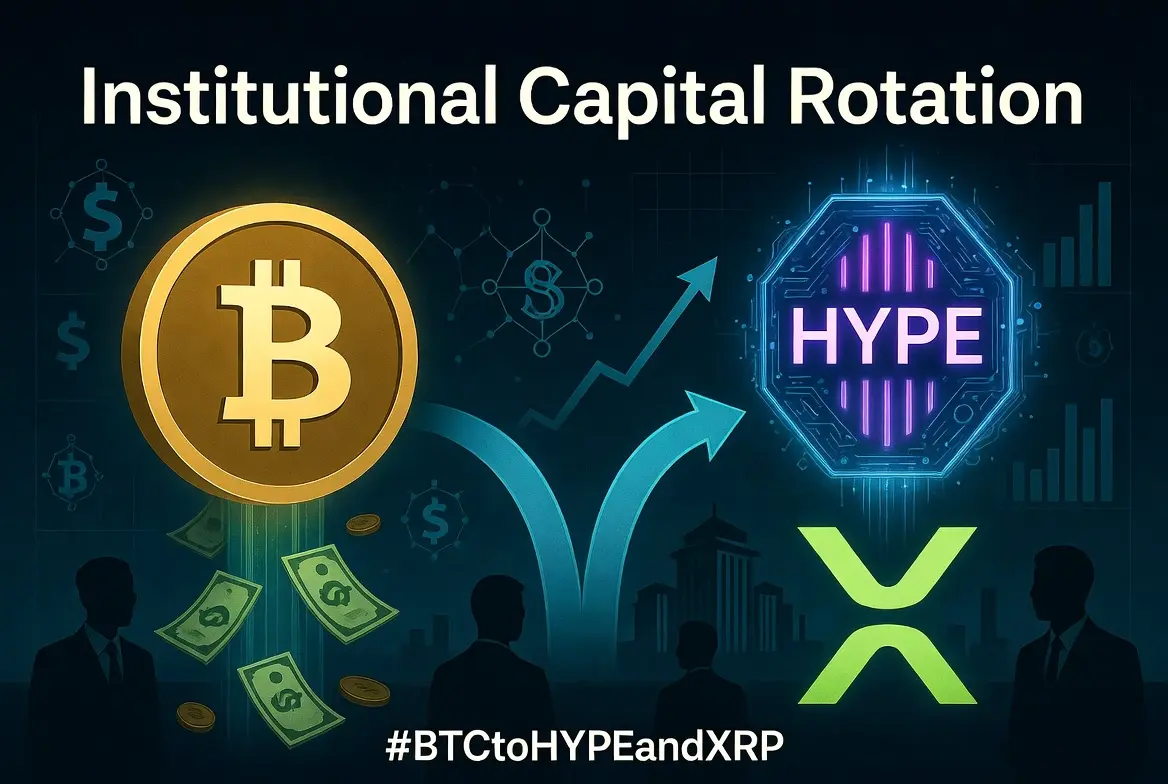
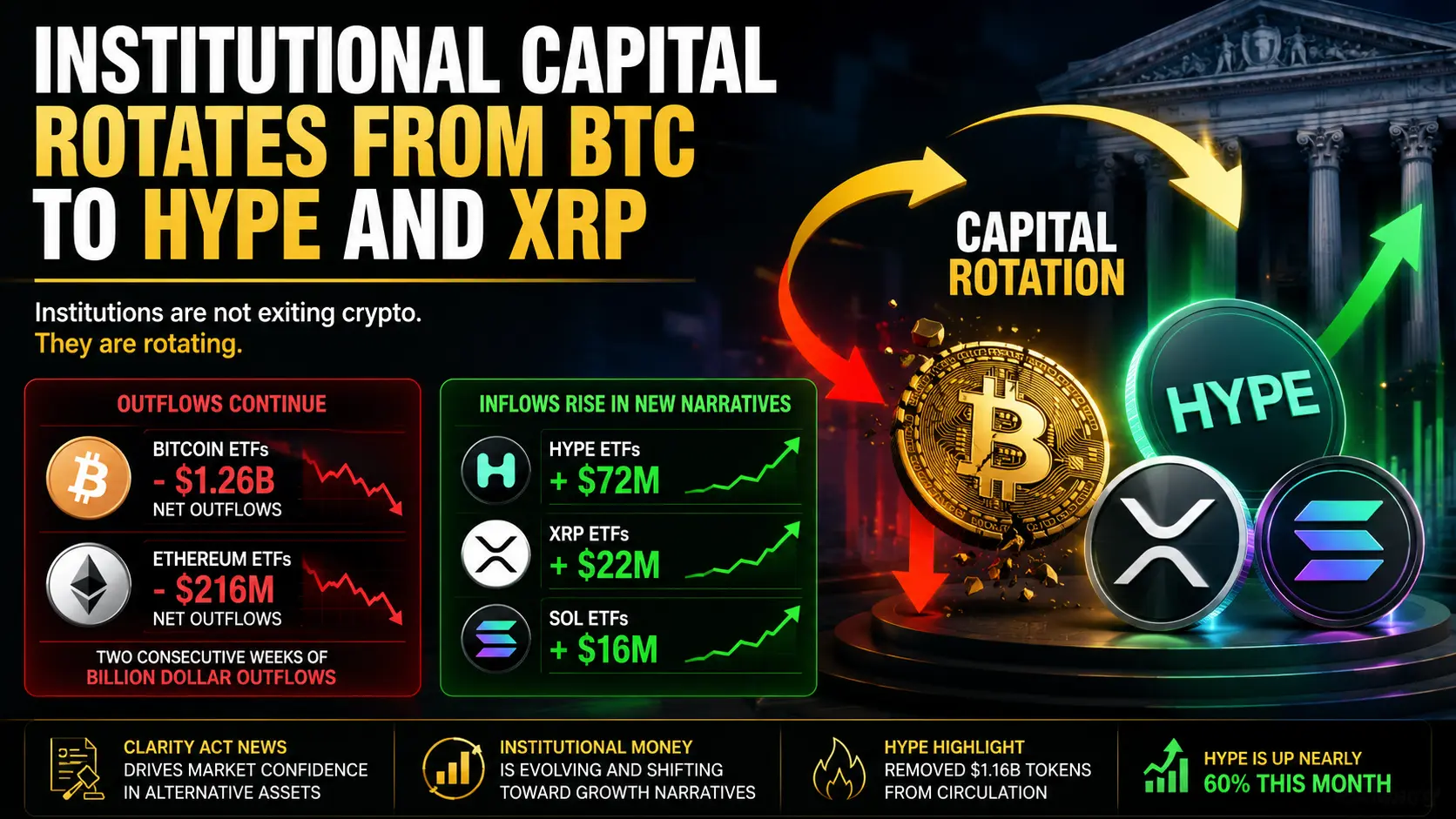
Institutional capital rotation is one of the most powerful forces shaping cryptocurrency markets in 2025–2026. It refers to the movement of large-scale capital from one digital asset to another by hedge funds, asset managers, ETFs, corporate treasuries, and quantitative trading firms. This flow of capital is not random; it is driven by macro conditions, valuation differences, liquidity depth, regulatory clarity, and evolving narratives around blockchain utility.
The narrative highlights a broader market transition where Bitcoin, despite remaining dominant, is increasingly viewed as a mature macro asset, while capital searches for higher growth opportunities in alternative ecosystems such as HYPE and XRP. These rotations reflect structured portfolio rebalancing rather than emotional trading behavior.
At a structural level, institutional investors operate under strict mandates. Their capital allocation decisions are based on volatility models, Sharpe ratios, liquidity thresholds, ESG constraints, and compliance frameworks. This creates predictable phases of accumulation and rotation across crypto cycles, especially when Bitcoin dominance stabilizes after strong rallies.
Bitcoin's Current Position and Institutional Challenges
Bitcoin remains the largest cryptocurrency with a market capitalization fluctuating around $1.3 trillion to $1.5 trillion depending on market cycles. It has traded in a wide macro range between $50,000 and $75,000+, recently peaking above $73,000 in 2024 before entering consolidation phases.
Despite its dominance, institutional investors face several structural challenges with Bitcoin allocation at scale:
First, Bitcoin’s size limits exponential upside. A move from $60,000 to $120,000 requires hundreds of billions in inflows, making returns more gradual compared to smaller-cap assets. This shifts Bitcoin into a “macro reserve asset” category rather than a high-growth instrument.
Second, volatility compression after ETF approval in 2024 reduced the aggressive momentum trading opportunities that hedge funds previously exploited. Spot Bitcoin ETFs from major issuers created stable institutional exposure, with flows sometimes exceeding $1–2 billion per week during peak demand periods, but also showing periods of stagnation.
Third, Bitcoin’s core narrative as “digital gold” around scarcity (21 million supply cap) and decentralization is strong but limited in utility expansion. Unlike programmable chains, Bitcoin’s ecosystem growth is relatively slow, with transaction throughput remaining around 7 transactions per second at base layer.
Energy consumption also remains a key ESG consideration. Annualized Bitcoin network energy usage is often estimated in the 80–120 TWh range, influencing European and ESG-compliant institutional portfolios.
HYPE: The Emerging Institutional Favorite
HYPE represents a new-generation digital asset narrative driven by high-growth expectations, low market capitalization, and technology-forward positioning. While still emerging, it reflects institutional interest in early-stage asymmetric opportunities.
HYPE’s appeal is primarily driven by valuation dynamics. With a significantly smaller market cap compared to Bitcoin and XRP, even moderate inflows of $500 million to $2 billion can create large percentage price movements. This is a key attraction for hedge funds seeking alpha generation.
From a price discovery perspective, emerging assets like HYPE typically trade in highly volatile ranges, sometimes experiencing daily swings of 10%–25%, which institutional trading desks can exploit using algorithmic execution and derivatives hedging strategies.
The ecosystem narrative around HYPE is centered on next-generation blockchain infrastructure themes such as Layer-2 scaling, AI integration, and modular architecture. These themes align with institutional venture-style exposure strategies inside liquid markets.
Liquidity is another key factor. While Bitcoin absorbs billions in daily volume, newer assets rely heavily on exchange depth and market-making infrastructure. As liquidity improves, institutional participation increases, reinforcing upward rotation cycles.
Technically, HYPE is often analyzed using accumulation zones and breakout structures rather than long-term moving averages due to its early-stage price history. Institutional positioning often appears in the form of gradual absorption rather than aggressive breakouts.
XRP: Regulatory Clarity Driving Institutional Confidence
XRP stands out due to its regulatory clarity and real-world financial use case. Following years of legal uncertainty, court rulings in 2023–2024 clarified that secondary market sales of XRP are not securities transactions, significantly improving institutional confidence.
XRP has traded in a wide recovery range between approximately $0.50 (during legal uncertainty phases) and $2.00–$3.00 in post-clarity recovery cycles, with prior all-time highs near $3.84 acting as a major psychological resistance zone.
The institutional thesis for XRP is fundamentally different from Bitcoin and HYPE. It is not purely a store of value or speculative growth asset—it is positioned as a cross-border settlement and liquidity bridge asset.
Ripple’s enterprise ecosystem includes partnerships with banks, remittance providers, and financial infrastructure firms. This supports real transaction utility in global payment flows, which exceed $800 billion annually in remittances alone, with even larger multi-trillion-dollar FX settlement markets.
Energy efficiency is another institutional advantage. XRP Ledger consensus consumes minimal energy compared to proof-of-work systems, making it more aligned with ESG mandates. This creates a unique advantage for pension funds and regulated financial institutions.
Token supply structure also adds predictability. XRP’s circulating supply and escrow release mechanism allow institutions to model inflation-like dilution effects more accurately compared to less structured tokens.
Comparative Analysis: BTC vs HYPE vs XRP
The capital rotation between these three assets reflects distinct institutional strategies:
Bitcoin trades as a macro hedge asset with high liquidity, low risk of protocol failure, and strong institutional adoption through ETFs. Its market cap exceeding $1 trillion makes it stable but slower in percentage growth terms.
HYPE represents high-beta innovation exposure. It carries higher risk but also significantly higher upside potential due to lower valuation base and emerging ecosystem development.
XRP sits between the two, offering regulatory clarity, real-world utility, and moderate volatility. Its appeal lies in structured financial use cases rather than speculative narratives alone.
From a performance perspective, Bitcoin typically leads during risk-off phases, XRP performs during regulatory-driven sentiment expansions, and HYPE tends to outperform during high-liquidity risk-on cycles.
Correlation dynamics also matter. During strong Bitcoin dominance phases, altcoins often move in sync. However, during consolidation phases, capital rotation becomes more visible as relative strength shifts toward XRP and HYPE.
Market Mechanics of Institutional Rotation
Institutional rotation does not occur through simple spot buying. Instead, it is executed through OTC desks, algorithmic execution systems, derivatives hedging, and staggered order placement across exchanges.
Large funds may split orders across days or weeks to avoid slippage, especially when moving from Bitcoin into lower-liquidity assets like HYPE. This creates gradual accumulation patterns visible in on-chain data and exchange inflows.
Quarterly portfolio rebalancing is a major trigger for rotation. Hedge funds and asset managers adjust exposure based on performance benchmarks, risk models, and macro outlook changes.
Derivatives markets also play a critical role. Futures open interest, funding rates, and options skew often reveal early signs of institutional repositioning before spot price movements fully reflect rotation.
Macroeconomic Context and Institutional Crypto Allocation
Macro conditions strongly influence capital rotation. When interest rates are high, institutions prefer lower-volatility or yield-generating assets, reducing speculative exposure. When liquidity expands, risk appetite increases, benefiting assets like HYPE.
Inflation narratives have also evolved. Bitcoin’s role as inflation hedge is now evaluated alongside real yield environments, reducing its exclusive dominance in portfolio hedging strategies.
Crypto is increasingly treated as part of the broader “risk asset basket” alongside technology equities, meaning capital rotation often mirrors Nasdaq-style risk cycles.
Regulation remains a key driver. XRP’s clarity shows how legal certainty can rapidly unlock institutional inflows, while uncertainty suppresses allocation in other assets.
Technical Analysis and Price Levels
Bitcoin’s key structural range remains between $60,000 support and $75,000 resistance, with breakout above this range potentially triggering renewed institutional inflows.
The 50-day and 200-day moving averages remain critical trend indicators for algorithmic funds managing exposure across digital assets.
XRP faces major resistance near $2.50–$3.00, with breakout above previous highs near $3.84 acting as a major macro signal.
HYPE, being early-stage, is more sensitive to volume expansion and breakout formations rather than long-term historical levels.
Relative strength analysis shows rotation when XRP and HYPE outperform Bitcoin during consolidation phases, indicating capital redistribution rather than new inflows alone.
Risk Factors and Considerations
Despite strong narratives, institutional rotation carries risks. Concentration risk increases when capital exits Bitcoin’s deep liquidity pool and enters smaller-cap assets with thinner order books.
Volatility risk is significantly higher in HYPE due to early-stage price discovery. XRP carries regulatory dependency risk across jurisdictions, while Bitcoin remains sensitive to macro liquidity cycles.
Liquidity fragmentation, leverage cycles, and sudden sentiment shifts can accelerate downside movements across all assets during stress periods.
Institutional investors therefore rely heavily on hedging strategies, diversification frameworks, and staged allocation models to manage rotation exposure effectively.@Gate_Square @Gate广场_Official #TradeCFDWinGold #StockTradingChallengeUpTo17000U #DailyPolymarketHotspot
Institutional capital rotation is one of the most powerful forces shaping cryptocurrency markets in 2025–2026. It refers to the movement of large-scale capital from one digital asset to another by hedge funds, asset managers, ETFs, corporate treasuries, and quantitative trading firms. This flow of capital is not random; it is driven by macro conditions, valuation differences, liquidity depth, regulatory clarity, and evolving narratives around blockchain utility.
The narrative highlights a broader market transition where Bitcoin, despite remaining dominant, is increasingly viewed as a mature macro asset, while capital searches for higher growth opportunities in alternative ecosystems such as HYPE and XRP. These rotations reflect structured portfolio rebalancing rather than emotional trading behavior.
At a structural level, institutional investors operate under strict mandates. Their capital allocation decisions are based on volatility models, Sharpe ratios, liquidity thresholds, ESG constraints, and compliance frameworks. This creates predictable phases of accumulation and rotation across crypto cycles, especially when Bitcoin dominance stabilizes after strong rallies.
Bitcoin's Current Position and Institutional Challenges
Bitcoin remains the largest cryptocurrency with a market capitalization fluctuating around $1.3 trillion to $1.5 trillion depending on market cycles. It has traded in a wide macro range between $50,000 and $75,000+, recently peaking above $73,000 in 2024 before entering consolidation phases.
Despite its dominance, institutional investors face several structural challenges with Bitcoin allocation at scale:
First, Bitcoin’s size limits exponential upside. A move from $60,000 to $120,000 requires hundreds of billions in inflows, making returns more gradual compared to smaller-cap assets. This shifts Bitcoin into a “macro reserve asset” category rather than a high-growth instrument.
Second, volatility compression after ETF approval in 2024 reduced the aggressive momentum trading opportunities that hedge funds previously exploited. Spot Bitcoin ETFs from major issuers created stable institutional exposure, with flows sometimes exceeding $1–2 billion per week during peak demand periods, but also showing periods of stagnation.
Third, Bitcoin’s core narrative as “digital gold” around scarcity (21 million supply cap) and decentralization is strong but limited in utility expansion. Unlike programmable chains, Bitcoin’s ecosystem growth is relatively slow, with transaction throughput remaining around 7 transactions per second at base layer.
Energy consumption also remains a key ESG consideration. Annualized Bitcoin network energy usage is often estimated in the 80–120 TWh range, influencing European and ESG-compliant institutional portfolios.
HYPE: The Emerging Institutional Favorite
HYPE represents a new-generation digital asset narrative driven by high-growth expectations, low market capitalization, and technology-forward positioning. While still emerging, it reflects institutional interest in early-stage asymmetric opportunities.
HYPE’s appeal is primarily driven by valuation dynamics. With a significantly smaller market cap compared to Bitcoin and XRP, even moderate inflows of $500 million to $2 billion can create large percentage price movements. This is a key attraction for hedge funds seeking alpha generation.
From a price discovery perspective, emerging assets like HYPE typically trade in highly volatile ranges, sometimes experiencing daily swings of 10%–25%, which institutional trading desks can exploit using algorithmic execution and derivatives hedging strategies.
The ecosystem narrative around HYPE is centered on next-generation blockchain infrastructure themes such as Layer-2 scaling, AI integration, and modular architecture. These themes align with institutional venture-style exposure strategies inside liquid markets.
Liquidity is another key factor. While Bitcoin absorbs billions in daily volume, newer assets rely heavily on exchange depth and market-making infrastructure. As liquidity improves, institutional participation increases, reinforcing upward rotation cycles.
Technically, HYPE is often analyzed using accumulation zones and breakout structures rather than long-term moving averages due to its early-stage price history. Institutional positioning often appears in the form of gradual absorption rather than aggressive breakouts.
XRP: Regulatory Clarity Driving Institutional Confidence
XRP stands out due to its regulatory clarity and real-world financial use case. Following years of legal uncertainty, court rulings in 2023–2024 clarified that secondary market sales of XRP are not securities transactions, significantly improving institutional confidence.
XRP has traded in a wide recovery range between approximately $0.50 (during legal uncertainty phases) and $2.00–$3.00 in post-clarity recovery cycles, with prior all-time highs near $3.84 acting as a major psychological resistance zone.
The institutional thesis for XRP is fundamentally different from Bitcoin and HYPE. It is not purely a store of value or speculative growth asset—it is positioned as a cross-border settlement and liquidity bridge asset.
Ripple’s enterprise ecosystem includes partnerships with banks, remittance providers, and financial infrastructure firms. This supports real transaction utility in global payment flows, which exceed $800 billion annually in remittances alone, with even larger multi-trillion-dollar FX settlement markets.
Energy efficiency is another institutional advantage. XRP Ledger consensus consumes minimal energy compared to proof-of-work systems, making it more aligned with ESG mandates. This creates a unique advantage for pension funds and regulated financial institutions.
Token supply structure also adds predictability. XRP’s circulating supply and escrow release mechanism allow institutions to model inflation-like dilution effects more accurately compared to less structured tokens.
Comparative Analysis: BTC vs HYPE vs XRP
The capital rotation between these three assets reflects distinct institutional strategies:
Bitcoin trades as a macro hedge asset with high liquidity, low risk of protocol failure, and strong institutional adoption through ETFs. Its market cap exceeding $1 trillion makes it stable but slower in percentage growth terms.
HYPE represents high-beta innovation exposure. It carries higher risk but also significantly higher upside potential due to lower valuation base and emerging ecosystem development.
XRP sits between the two, offering regulatory clarity, real-world utility, and moderate volatility. Its appeal lies in structured financial use cases rather than speculative narratives alone.
From a performance perspective, Bitcoin typically leads during risk-off phases, XRP performs during regulatory-driven sentiment expansions, and HYPE tends to outperform during high-liquidity risk-on cycles.
Correlation dynamics also matter. During strong Bitcoin dominance phases, altcoins often move in sync. However, during consolidation phases, capital rotation becomes more visible as relative strength shifts toward XRP and HYPE.
Market Mechanics of Institutional Rotation
Institutional rotation does not occur through simple spot buying. Instead, it is executed through OTC desks, algorithmic execution systems, derivatives hedging, and staggered order placement across exchanges.
Large funds may split orders across days or weeks to avoid slippage, especially when moving from Bitcoin into lower-liquidity assets like HYPE. This creates gradual accumulation patterns visible in on-chain data and exchange inflows.
Quarterly portfolio rebalancing is a major trigger for rotation. Hedge funds and asset managers adjust exposure based on performance benchmarks, risk models, and macro outlook changes.
Derivatives markets also play a critical role. Futures open interest, funding rates, and options skew often reveal early signs of institutional repositioning before spot price movements fully reflect rotation.
Macroeconomic Context and Institutional Crypto Allocation
Macro conditions strongly influence capital rotation. When interest rates are high, institutions prefer lower-volatility or yield-generating assets, reducing speculative exposure. When liquidity expands, risk appetite increases, benefiting assets like HYPE.
Inflation narratives have also evolved. Bitcoin’s role as inflation hedge is now evaluated alongside real yield environments, reducing its exclusive dominance in portfolio hedging strategies.
Crypto is increasingly treated as part of the broader “risk asset basket” alongside technology equities, meaning capital rotation often mirrors Nasdaq-style risk cycles.
Regulation remains a key driver. XRP’s clarity shows how legal certainty can rapidly unlock institutional inflows, while uncertainty suppresses allocation in other assets.
Technical Analysis and Price Levels
Bitcoin’s key structural range remains between $60,000 support and $75,000 resistance, with breakout above this range potentially triggering renewed institutional inflows.
The 50-day and 200-day moving averages remain critical trend indicators for algorithmic funds managing exposure across digital assets.
XRP faces major resistance near $2.50–$3.00, with breakout above previous highs near $3.84 acting as a major macro signal.
HYPE, being early-stage, is more sensitive to volume expansion and breakout formations rather than long-term historical levels.
Relative strength analysis shows rotation when XRP and HYPE outperform Bitcoin during consolidation phases, indicating capital redistribution rather than new inflows alone.
Risk Factors and Considerations
Despite strong narratives, institutional rotation carries risks. Concentration risk increases when capital exits Bitcoin’s deep liquidity pool and enters smaller-cap assets with thinner order books.
Volatility risk is significantly higher in HYPE due to early-stage price discovery. XRP carries regulatory dependency risk across jurisdictions, while Bitcoin remains sensitive to macro liquidity cycles.
Liquidity fragmentation, leverage cycles, and sudden sentiment shifts can accelerate downside movements across all assets during stress periods.
Institutional investors therefore rely heavily on hedging strategies, diversification frameworks, and staged allocation models to manage rotation exposure effectively.@Gate_Square @Gate广场_Official #TradeCFDWinGold #StockTradingChallengeUpTo17000U #DailyPolymarketHotspot