PreStocks and traditional Pre-IPO investments both target pre-IPO companies, giving market participants exposure to value growth opportunities in firms like OpenAI, SpaceX, and Anthropic — companies that have yet to go public. However, their underlying structures and operational logic diverge significantly.
As Real World Asset (RWA) tokenization advances, on-chain private equity has emerged as a key direction in capital market digitization. PreStocks leverages blockchain to reshape how private markets circulate assets, whereas traditional Pre-IPO investments follow the well-established frameworks of venture capital and private equity.
PreStocks vs. Traditional Pre-IPO: A Quick Overview
PreStocks uses an SPV to hold equity interests in target companies, mapping the corresponding economic value into blockchain tokens. What users hold are not the company's official shares, but on-chain assets tied to the company's value fluctuations.
Traditional Pre-IPO investment refers to private equity placements made before a company lists, directly involving ownership of corporate equity. As such, it carries a clear legal rights structure — including shareholder rights, disclosure obligations, and legal protections.
Currently, venture capital firms, private equity funds, high-net-worth investors, and company employees typically acquire shares through funding rounds, secondary equity markets, or share transfer agreements.
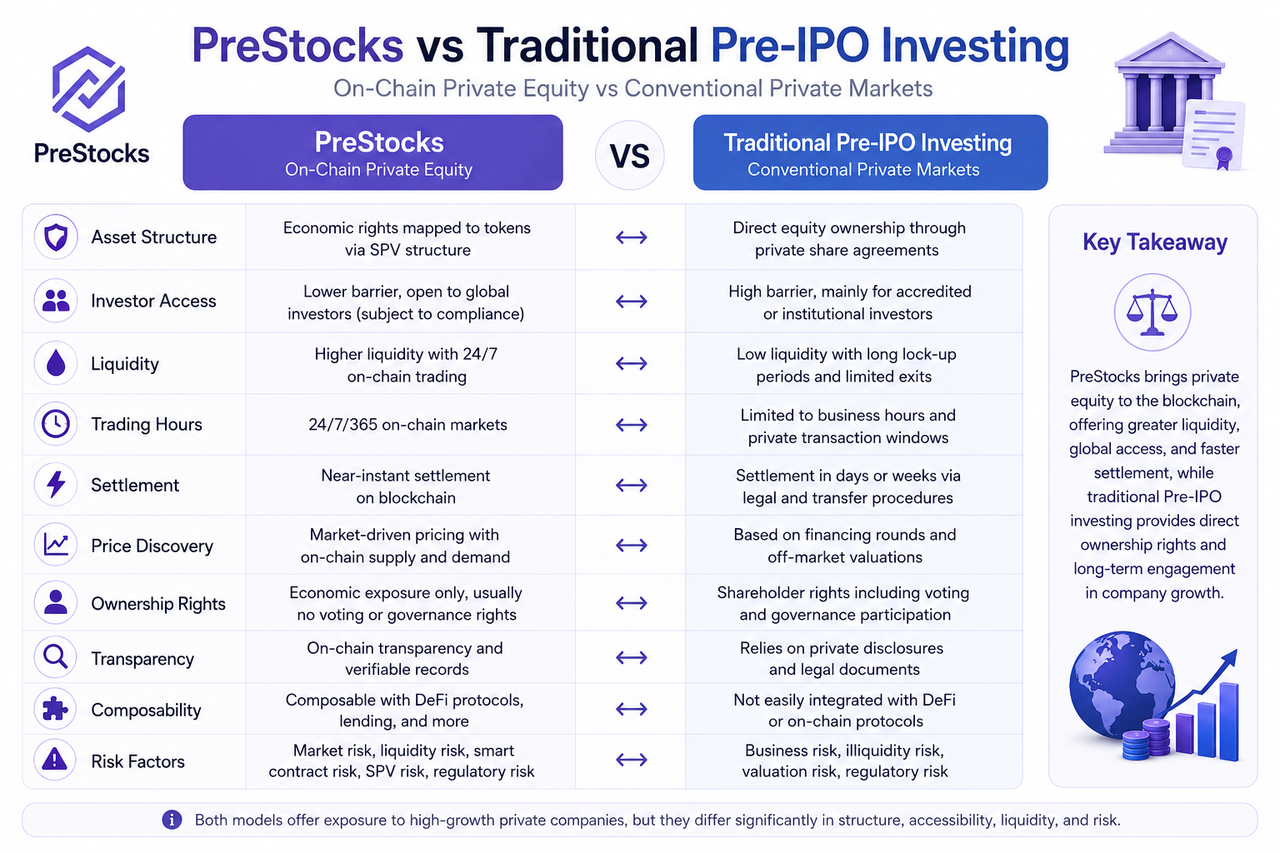
How Does Asset Ownership Structure Differ?
Asset ownership structure is one of the most fundamental differences between the two.
Traditional Pre-IPO investment represents actual equity in the company. Investors gain partial ownership via equity agreements and enjoy corresponding rights under the applicable legal framework.
PreStocks, by contrast, maps economic interests through an SPV structure. On-chain tokens generally reflect changes in the target company's value but do not necessarily confer shareholder status.
This creates a fundamental distinction in legal standing and the attribution of rights.
How Do Investment Thresholds Compare?
Traditional private markets impose high barriers to entry.
Many private placements are open only to institutional or accredited investors and carry minimum investment amounts. Some require complex identity verification and legal documentation.
PreStocks was designed in part to improve market accessibility.
By enabling participation through digital assets, it offers greater flexibility and enhanced asset divisibility, lowering the access barriers typical of traditional private markets.
Why Is Liquidity So Different?
Liquidity is one of the most talked-about advantages of on-chain private equity.
Traditional Pre-IPO shares typically have long lock-up periods. Exiting an investment often means finding a buyer and navigating a cumbersome equity transfer process.
PreStocks converts assets into on-chain tokens that can be traded continuously on supported markets.
While on-chain liquidity still depends on market depth, its trading efficiency generally exceeds that of traditional private equity transfers.
How Do Trading and Settlement Differ?
Traditional private equity transactions rely on lawyers, custodians, and equity registry systems.
The process may involve multiple rounds of document review, identity checks, and fund settlement, often taking days or weeks to complete.
PreStocks operates on a blockchain network.
Once a trade is agreed, assets and funds settle on-chain according to smart contract rules, dramatically reducing intermediary involvement.
This contrast highlights the value of blockchain infrastructure in modernizing capital markets.
How Do Price Discovery Mechanisms Differ?
Price discovery determines how asset values are formed in the market.
Traditional Pre-IPO markets rely mainly on funding rounds and OTC transactions for valuation. Each new round provides an updated reference point.
PreStocks adds the on-chain trading market as a price formation channel.
Token prices are influenced not only by changes in the company's valuation but also by on-chain supply and demand, market sentiment, and trading activity.
As a result, the two markets exhibit distinct price volatility characteristics.
How Do Risk Structures Differ?
The two models face different sets of risk factors.
Traditional Pre-IPO investment focuses on the company's operations, fundraising ability, competitive landscape, and IPO timeline.
PreStocks carries those same business risks plus additional on-chain risks: liquidity risk, smart contract risk, SPV management risk, and digital asset market volatility.
The broader risk profile makes on-chain private equity a more complex proposition.
PreStocks vs. Traditional Pre-IPO: Comparison Table
| Dimension |
PreStocks |
Traditional Pre-IPO |
| Underlying Asset |
Economic interest mapping |
Actual equity ownership |
| Legal Status |
Typically not a direct shareholder |
Clear shareholder standing |
| Market Type |
On-chain market |
Private market |
| Liquidity |
Relatively high |
Relatively limited |
| Trading Hours |
24/7 |
Non-continuous |
| Settlement Speed |
Real-time or fast settlement |
Days to weeks |
| Access |
Via digital assets |
Primarily accredited investors |
| Risk Sources |
Business + on-chain risks |
Primarily business risks |
When Does On-Chain Private Equity Make Sense?
On-chain private equity suits scenarios that prioritize liquidity and digital asset composability.
Because the assets are already digitized, they can integrate with lending protocols, asset management tools, and other RWA products.
Moreover, the on-chain market operates globally around the clock, reaching participants that traditional private markets often miss.
This model is pushing capital markets from closed structures toward open digital networks.
When Does the Traditional Pre-IPO Market Make More Sense?
Traditional Pre-IPO investment emphasizes legal rights and long-term capital allocation.
Venture capital and private equity firms care about governance, board seats, and strategic partnerships.
These rights are difficult to replicate with simple token mapping, so the traditional model remains essential in corporate fundraising.
In many cases, on-chain and traditional markets will complement rather than replace each other.
Summary
PreStocks and traditional Pre-IPO both revolve around pre-IPO companies, but their core differences lie in asset structure and market infrastructure. Traditional Pre-IPO directly holds equity, while PreStocks uses an SPV to map economic interests into on-chain assets, enabling a more open and efficient trading model.
From investment thresholds, liquidity, and settlement speed to risk profiles, the two models represent different evolutionary paths for capital markets. The traditional private market offers a clearer legal framework, while on-chain private equity points to the future of RWA and digital capital markets.
FAQs
Does PreStocks equal buying shares of a pre-IPO company?
No. PreStocks tokens generally do not directly represent the company's official shares. They are on-chain instruments that map economic interests via an SPV structure, distinct from the equity held by traditional shareholders.
Why does PreStocks typically offer higher liquidity?
PreStocks digitizes assets and places them on an on-chain market, enabling continuous trading and transfer. This improves circulation efficiency compared to the traditional equity transfer process.
Do PreStocks holders have voting rights?
In most cases, PreStocks holders do not directly hold shareholder voting rights. Specific entitlements depend on the SPV structure and product's legal arrangements.
Is on-chain private equity considered RWA?
Yes. On-chain private equity is a key part of Real World Asset (RWA) tokenization. Its underlying assets come from real-world corporate equity or related economic interests.
Will PreStocks replace the traditional Pre-IPO market?
PreStocks and traditional Pre-IPO address different needs. The traditional market focuses on equity ownership and corporate governance; the on-chain market prioritizes liquidity and digital trading. The two are more likely to coexist and complement each other over the long term.