


June 2, 2026: Virgin Galactic (SPCE) surged over 21.36% intraday, reaching a high of $8.8, and was trading at $7.52 at the time of writing. Starting from a recent low near $2.6, the stock has climbed nearly 200% in the past month, with gains exceeding 300% over the last two weeks.
Against the backdrop of a broadly stable US stock market, such dramatic price action from a space tourism company that has yet to turn a profit warrants close scrutiny. This is especially true as other companies in the sector have seen sharp corrections due to rocket accidents and divergent IPO expectations, making Virgin Galactic’s unilateral rally stand out as particularly anomalous. This divergence reflects the logic behind capital allocation across assets and offers crypto market investors a window into high-risk appetite sentiment.
Virgin Galactic: Business Fundamentals and Current Status
Virgin Galactic’s core business is space tourism—using its proprietary spacecraft system to take paying passengers to suborbital space for several minutes of weightlessness. Unlike SpaceX or Rocket Lab, Virgin Galactic does not provide rocket launch services or satellite deployment; its business model is closer to a "space experience provider."
Operating data shows that in Q1 2026, the company generated $227,000 in revenue, a sharp drop from $461,000 a year earlier. Net loss narrowed to $64.72 million from $84.49 million year-over-year. Free cash flow for Q1 was negative $93 million, with cash and marketable securities totaling about $251 million at quarter’s end. Meanwhile, Virgin Galactic has transferred its first next-generation Delta-class spacecraft from the assembly facility to the testing and launch hangar, with ground tests underway. Management expects the spacecraft to enter commercial service in Q4 2026.
These figures paint a clear picture: Virgin Galactic remains in an early stage characterized by extremely limited revenue, ongoing cash burn, and reliance on external financing to sustain cash flow. The core assumption of its business model hinges on whether the Delta-class spacecraft can be mass-produced and support frequent commercial flights—the company’s long-term goal is for each spacecraft to fly twice weekly, with a lifecycle exceeding 500 missions.
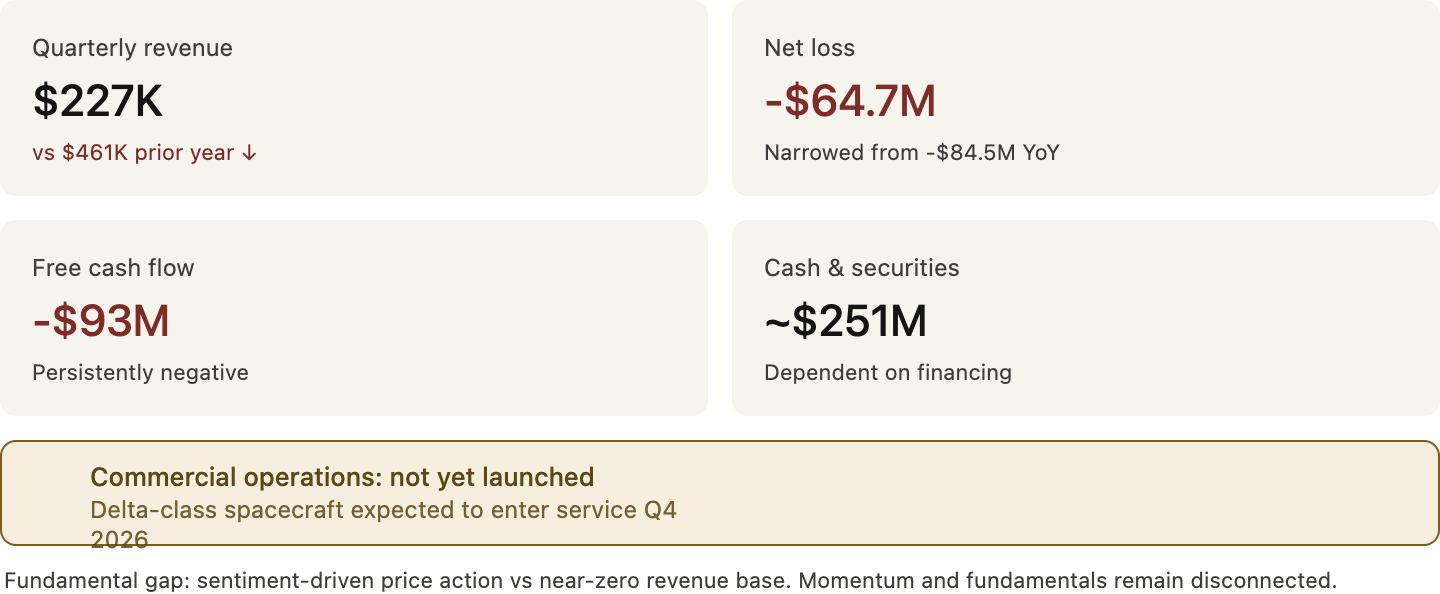
Still burning cash for the space dream—Virgin Galactic Q1 2026 financial snapshot
What Events Have Driven the Recent Stock Surge?
The rally was not triggered by a single event but resulted from a cluster of catalysts converging in a short period.
First, disclosure of institutional holdings acted as a direct "catalyst." On June 1, 2026, SEC filings revealed that Rich Huang and his RichRich Capital collectively hold about 9.9% of Virgin Galactic shares. Such large-scale holdings disclosures are typically interpreted by the market as "confidence signals," directly triggering significant gains that day. By the close on June 1, the stock finished at $7.95, up roughly 28.56%.
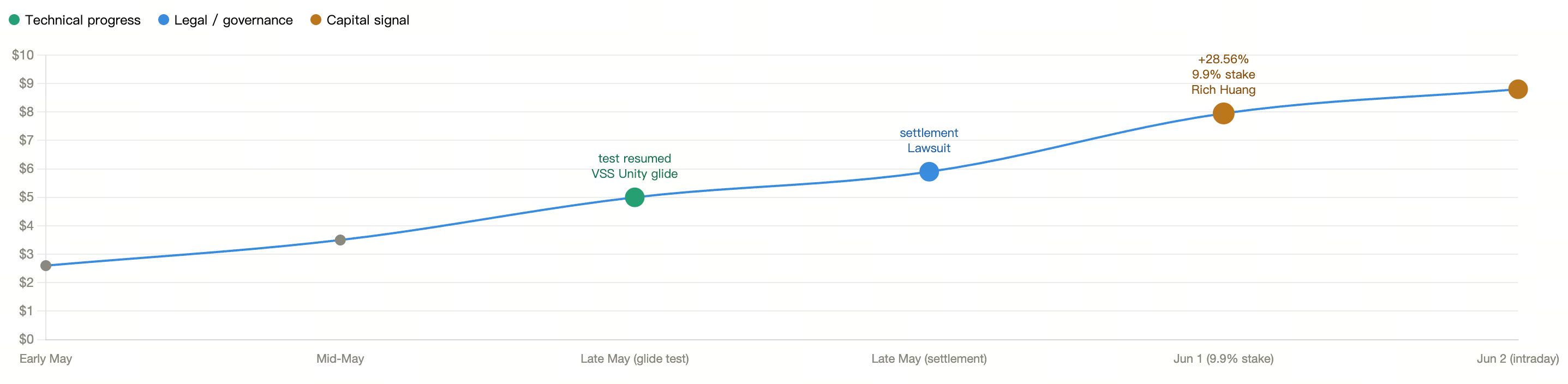
SPCE’s nearly 200% monthly rally: event-driven timeline
Second, technical progress provided narrative support. Virgin Galactic recently resumed glide flight tests for VSS Unity, ending a prolonged grounding. Management plans to continue glide tests in Q3 2026 and begin rocket-powered flight tests in Q4. These clear milestones have shifted market focus from "Can they fly?" to "When will commercial operations begin?"
Additionally, a long-standing legal issue was preliminarily resolved. A federal court approved a settlement for a shareholder derivative lawsuit, with insurers paying the company about $2.75 million, removing an operational risk that had lingered since 2022. While the payout is not large, investors often react more strongly to the removal of uncertainty than to the economic impact itself.
How SpaceX IPO Expectations Are Fueling Sector Sentiment
Virgin Galactic’s current rally is set against the macro backdrop of SpaceX IPO anticipation, which has ignited enthusiasm for the entire space sector. SpaceX is expected to list on June 12, 2026, with rumored valuations as high as $1.8 trillion, potentially making it one of the largest IPOs in US stock market history.
For public market investors, SpaceX is not yet listed and cannot be bought directly. As a result, Virgin Galactic and other listed space stocks have become "proxy targets" for some capital flows. Market commentary notes that this logic even extends to ticker similarity—SPCE and SpaceX’s anticipated ticker SPCX are nearly identical, which may cause some retail investors to confuse the two, intensifying buying pressure.
From a broader perspective, the SpaceX IPO narrative is reshaping the valuation framework for the space economy. In 2025, SpaceX posted total revenue of $18.7 billion, with Starlink contributing $11.4 billion and global paying users surpassing 10.3 million, crossing the breakeven point. EBITDA margin reached 63%. Analysts believe SpaceX’s valuation logic is shifting from "rocket company" to "AI + global connectivity network + space infrastructure" platform assets, with its addressable market estimated at $28.5 trillion. This narrative expansion has significantly raised the sector’s valuation ceiling and opened up new possibilities for unprofitable peers like Virgin Galactic.
Why Sector Leaders Are Showing Divergent Performance
It’s important to note that space stocks are not rising collectively; instead, there’s marked divergence. On June 1, Rocket Lab (RKLB) closed down 14.7% at $122.39; AST SpaceMobile (ASTS) dropped as much as 20% intraday, ending at $113.41, down about 14.8%; Intuitive Machines (LUNR) fell roughly 15%, and Redwire (RDW) was down as much as 16%.
The underlying reason for this divergence lies in fundamental differences in business models and market narratives:
Rocket Lab provides end-to-end satellite launch services and has successfully delivered over 100 satellites to orbit, operating more as a "commercial rocket operator." Its share price decline was mainly driven by negative sentiment from Blue Origin’s rocket test explosion and concerns about a possible "sell the news" effect after the SpaceX IPO.
AST SpaceMobile focuses on building space-based cellular broadband networks and is in the early infrastructure deployment phase. Its drop was also triggered by Blue Origin’s launch accident, which heightened industry uncertainty, along with the financial reality of not yet operating a satellite network.
Virgin Galactic’s business model has little overlap with the above—it does not participate in satellite launches or rely on rockets, and its flight system is not directly connected to Rocket Lab or ASTS’s supply chains. This means Blue Origin’s accident has no substantive impact on Virgin Galactic. As market sentiment seeks "space stocks immune to negative events," SPCE’s relative "immunity" makes it a safe haven for capital.
This divergence demonstrates that differences in business models within the space sector determine each company’s sensitivity to external events. For cross-market investors, understanding these differentiated transmission mechanisms is far more important than lumping "all space stocks" together.
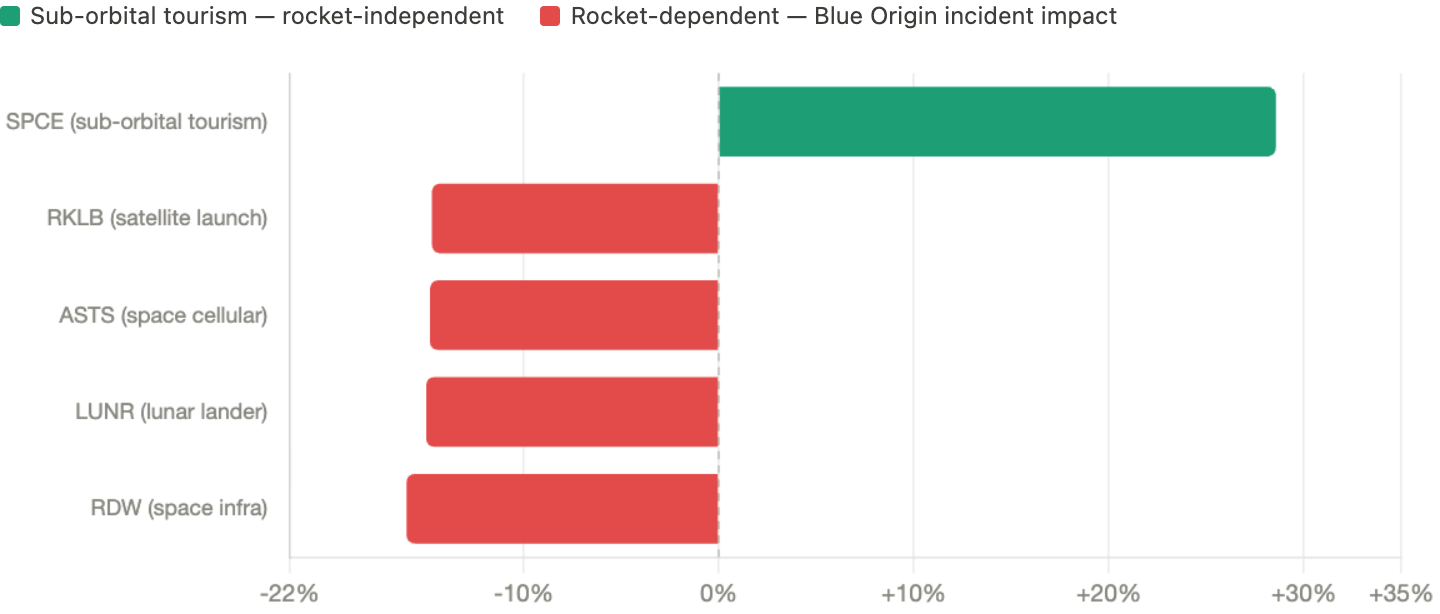
Internal divergence among space stocks—same day, different outcomes (June 1 performance)
How Capital Structure Amplifies Short-Term Price Movements
Virgin Galactic’s share structure and trading characteristics provide fertile ground for short-term surges. The company’s market cap is relatively small, and short interest was high before the rally. When buying pressure intensifies, shorts are forced to cover, pushing prices higher and creating a self-reinforcing short squeeze. Market observers note that retail sentiment has surged, with related discussion posts up 245% from previous levels. Combined with elevated short interest, a squeeze is brewing.
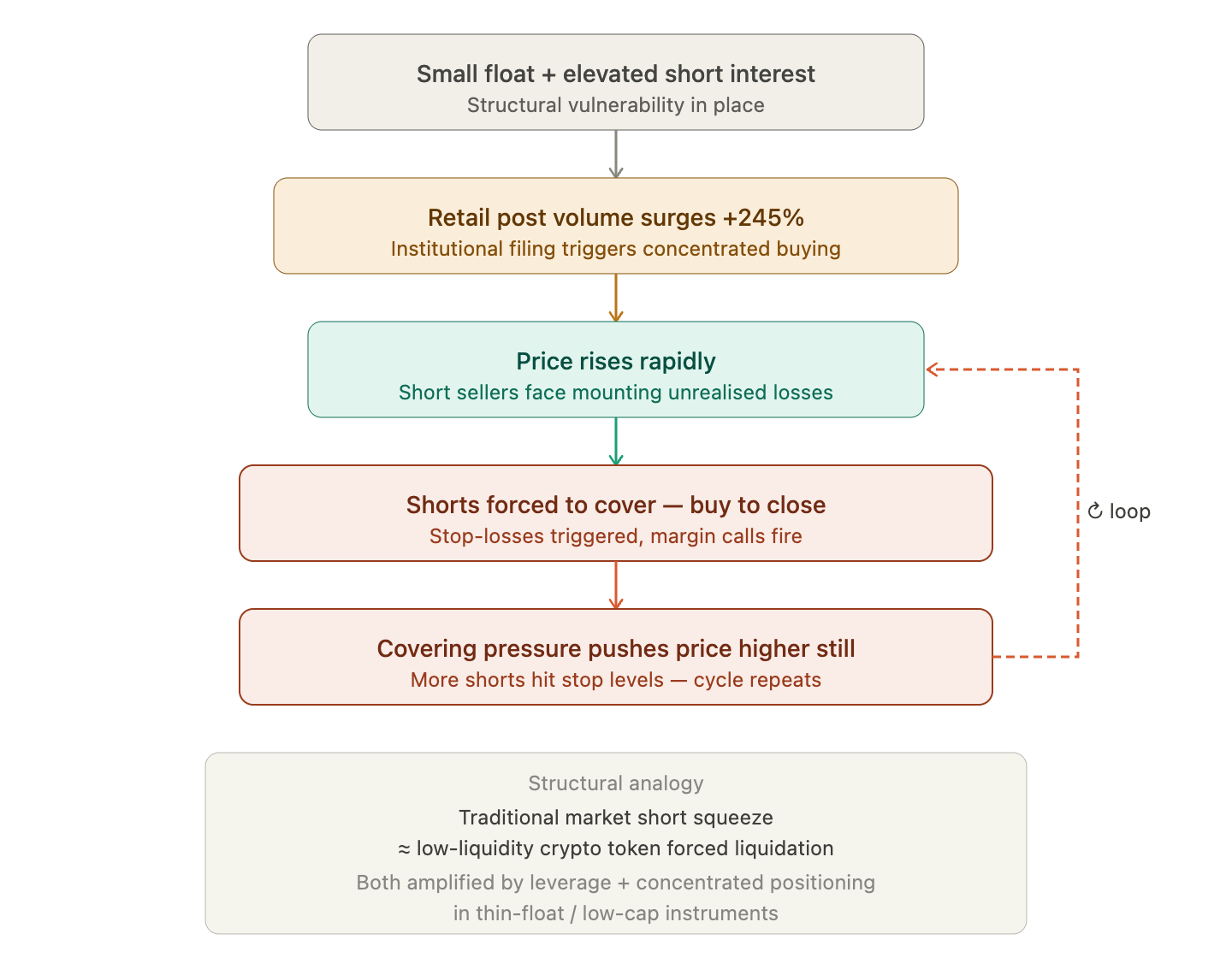
Short squeeze spiral—SPCE’s capital structure and price amplification mechanism
This mechanism is familiar in crypto markets. Low-liquidity tokens often experience similar squeeze events when sentiment reverses. The structural similarity—stock market short selling versus crypto contract shorts—means price behavior faces the same constraints: rapid gains during upswings, with corrections potentially triggering cascading stop-losses.
What Can Crypto Markets Learn from Space Stock Volatility?
From an asset allocation perspective, high-risk assets in traditional markets (meme stocks, illiquid small caps, concept-driven targets) and sentiment-driven tokens in crypto share the same pool of risk-seeking capital. When extreme profit opportunities arise in one area, capital often replicates strategies across assets with similar risk profiles. Virgin Galactic’s surge offers at least two signals for crypto markets.
First, it acts as a risk appetite thermometer. A small-cap stock with no profits or stable revenue rising nearly 200% without clear fundamental change indicates that risk-tolerant capital is highly active. This closely mirrors the "sentiment rotation" seen in altcoins. In a weak market lacking incremental liquidity, capital tends to concentrate on "small-cap, low-profile, highly elastic" targets to seek relative returns.
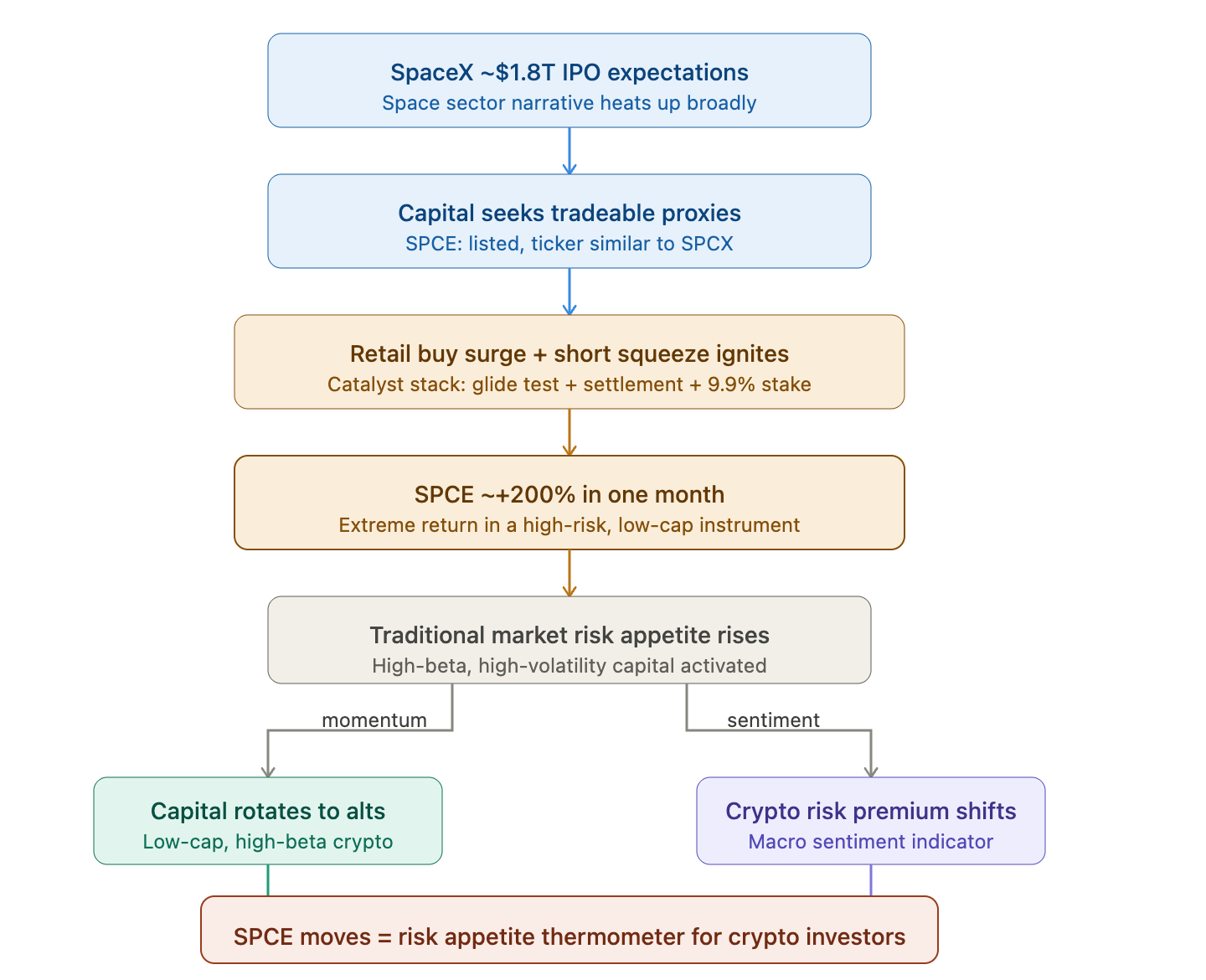
From space to crypto—cross-market transmission of high-risk capital
Second, event-driven cross-market validation. The SPCE rally narrative includes not only fundamental progress and institutional holdings, but also sector sentiment and "proxy buying" based on the space concept. This type of driver is highly fragile—if key assumptions (such as post-IPO capital absorption for SpaceX) are disproven, gains can quickly reverse. In crypto, "narrative-driven" rallies are equally common. Investors must clearly recognize whether they are trading a narrative or trading fundamentals, as the risk management frameworks for each are entirely different.
Conclusion
Virgin Galactic’s nearly 200% monthly rally is the result of multiple overlapping factors: institutional holdings disclosures, technical progress with flight tests, sector sentiment fueled by the SpaceX IPO, and retail-driven short squeezes. However, its fundamentals remain unchanged—the company is still loss-making, commercial operations have not started, and cash flow is highly dependent on external financing.
For crypto market investors, the value in tracking such traditional market anomalies lies not in predicting how much further SPCE can rise, but in identifying behavioral patterns of risk-seeking capital. When a "cash-burning" space tourism company can be pushed up 300% in two weeks, it signals that risk appetite is at a level that warrants caution. The common trait of sentiment-driven assets is a lack of fundamental anchors during rallies and insufficient liquidity support during declines. This underlying logic remains constant across markets.
FAQ
How does Virgin Galactic’s business fundamentally differ from other space companies?
Virgin Galactic focuses on suborbital space tourism and does not engage in rocket launches or satellite deployment. Its flight system is not directly linked to the supply chains of Rocket Lab, AST SpaceMobile, or similar companies. This is a key reason why it was relatively "immune" to recent sector-wide negative events.
Why did other companies in the sector drop sharply after the Blue Origin accident?
Rocket Lab and AST SpaceMobile both rely on or are connected to rocket launches. Blue Origin’s two consecutive test failures sparked broad concerns about commercial rocket reliability, prompting capital to temporarily exit related supply chain stocks. SPCE does not depend on rocket launches and was thus unaffected.
What reference value does SPCE’s surge offer for crypto markets?
Sharp gains in low-liquidity, high-short-interest stocks in traditional markets typically signal that risk-seeking capital is highly active and may spill over into similar assets in crypto. However, SPCE’s rally is mainly driven by sentiment and narrative, lacking fundamental support, and should not be used as a reference for mid- to long-term investment.
Is SPCE’s current rally sustainable?
Virgin Galactic’s commercial operations have not yet begun. The Delta-class spacecraft must complete rocket-powered flight tests in Q4 2026 before entering service, requiring significant capital expenditures in the meantime. Historical experience shows that sentiment-driven rallies without sustained buying often rise and fall rapidly, with subsequent performance highly dependent on capital inflows and short interest dynamics.


