In a Layer 1 network dedicated to RWA and on-chain wealth management, a token model that stops at "Gas + Staking" rarely translates real on-chain business activity into sustainable value capture. ZIG uses its ModFee mechanism to channel module usage fees into the chain-level economic cycle. Governance decides whether these fees fund buyback-and-burn programs or reinvest in the ecosystem, forging a direct link between token demand and tangible activities like WME strategy creation, token issuance, and on-chain trading. This design is what sets ZIG apart from native tokens of general-purpose L1s ZIGChain.
The following sections dissect ZIG's core functions, distribution and release schedule, staking incentives, governance and modular roles, on-chain asset management support, value drivers, investment risks, and long-term potential. The goal: to help readers grasp how ZIG's token economy powers ZIGChain's wealth ecosystem.
Core Functions and Use Cases of the ZIG Token
ZIG performs five pivotal roles on ZIGChain, each tied to specific on-chain behaviors and participant profiles:
-
Network Security (Blockchain Consensus)
Validators and Delegators stake ZIG to uphold PoS consensus, validate transactions, and produce blocks. A higher staked amount directly correlates to stronger network security.
-
Transaction Gas Fees
All on-chain state changes and smart contract executions require ZIG for Gas. Gas revenue is split between validators and delegators, with the remainder funneled into the community pool.
-
On-Chain Governance
ZIG holders can propose and vote on protocol upgrades, parameter tweaks, and community pool fund allocations. Staked ZIG typically carries voting weight, giving long-term participants meaningful influence over the network's trajectory.
-
Module Fees (ModFee)
Chain-level modules like Token Factory, Exchange Module, and WME charge fees in ZIG when used. Through governance consensus, ModFee can be directed to buyback-and-burn or reinvested in ecosystem development and user incentives. This creates a self-reinforcing loop: "on-chain activity → module revenue → token supply-demand adjustment."
-
Native DeFi Asset
ZIG serves as the base asset for DeFi activities such as liquidity provision, lending collateral, and protocol rewards. Valdora Finance's stZIG liquid staking solution allows users to stake ZIG while retaining composability across other DeFi protocols.
ZIG was initially issued in April 2021 and upgraded to the mainnet's native Gas and governance token with the ZIGChain Mainnet Beta (Genesis Day: June 25, 2025). This "New Chain, Seasoned Token" strategy preserved the existing community and liquidity base.
ZIG Token Distribution and Release Mechanism
The ZIG mainnet has a fixed maximum supply of 2.5 billion tokens, allocated as follows:
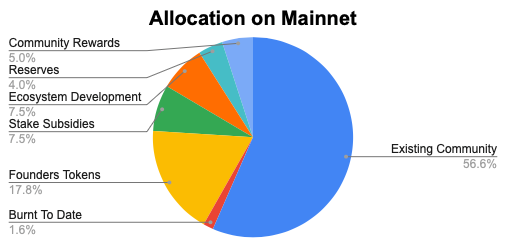
The mainnet circulating supply stands at approximately 1.726 billion ZIG (69.06% of total). The remainder consists of locked founder shares, foundation funds, and the staking subsidy pool. Some market trackers report a total supply of around 2 billion, reflecting post-burn and post-migration adjustments.
Key Release and Lock-Up Details:
- Founder Shares: Originally, 545 million ZIG from TGE were scheduled for linear release over 30 months. The team has voluntarily extended the lock-up three consecutive years, with 445 million ZIG now locked until 2026. In 2024, an additional 100 million ZIG was donated to the ZIGChain Foundation, vesting linearly over 30 months starting January 2025 for ecosystem incubation.
- Staking Subsidies: Distributed programmatically to validators and delegators to bootstrap network security. The emission rate is governed by the Cosmos SDK Mint module and governance parameters.
- Foundation & Community Pool: Unlocking ecosystem development, community reward, and reserve funds requires on-chain governance approval to prevent opaque large transfers.
- Inflation Management: The Mint module dynamically adjusts the inflation rate based on the staking ratio, balancing security incentives with supply dilution.
In September 2025, ZIG-related entities published a MiCAR-compliant whitepaper, classifying ZIG as a utility token with no ownership, profit-sharing, or claims rights to underlying physical assets—providing a framework for EU market compliance.
How Staking and Validator Incentive Systems Work
ZIGChain runs on Tendermint BFT PoS consensus, with staking as the bedrock of ZIG's economic security.
Validators operate full nodes, propose and validate blocks, and rank by total delegated stake (self-stake plus delegations) to enter the active set. After deducting commission, remaining rewards are distributed to delegators.
Delegators delegate ZIG to validators via ZIGChain Hub, CLI, or compatible wallets—earning rewards without running nodes. When selecting validators, consider commission rate, uptime, slashing history, and governance stance.
Reward Sources include:
- Block rewards (Mint module issuance per inflation parameters)
- Gas fee share from transactions
- Foundation-led staking subsidies (Stake Subsidies pool)
Unbonding Mechanism: After unstaking, ZIG enters a 21-day unbonding period during which tokens are locked and generate no rewards. Free transfer is only possible after unbonding completes.
Slashing Penalties:
- Double Signing: 5% of stake slashed and removal from the active set
- Prolonged Downtime: 0.01% slashed, borne by both delegator and validator
In December 2025, ZIGChain's PoS mechanism received Shariah certification. Under this compliance framework, validators are defined as "investment agents (Wakala)," and staking rewards follow profit-sharing logic (not fixed interest)—a significant differentiator for Middle Eastern and Islamic finance users. Valdora Finance's stZIG liquid staking product lets users earn staking yields while using the liquidity receipt across other DeFi protocols, boosting ZIG's capital efficiency within the ecosystem.
ZIG's Role in Governance and Ecosystem Modules
Governance: ZIG uses token-weighted voting. Staked ZIG holders can vote on protocol upgrades, module parameters (e.g., ModFee rate, inflation rate, max validator count), and community pool spending. Delegators inherit the validator's vote by default but may also select a validator with a preferred governance stance, aligning staking decisions with the network's long-term direction.
Module Layer: ZIG is the native settlement unit for chain-level modules:
- Token Factory: Permissionlessly create native tokens (factory/{creator}/{subdenom}); creation and management operations can generate ModFee.
- Exchange Module: On-chain trading and liquidity operations settle Gas and module fees in ZIG.
- Wealth Management Engine (WME): Strategy deployment, capital custody, and fee allocation all use ZIG as the underlying pricing and settlement asset.
ModFee Economic Routing: This is a core value capture mechanism for ZIG. Higher module usage leads to higher ModFee revenue. Governance decides whether to channel revenue into buyback and burn (deflationary) or ecological reinvestment (growth). This ties token supply and demand to real on-chain economic activity, not pure speculation.
The ZIGChain Foundation manages the ecosystem development pool (187.5 million ZIG) and community reward pool (125 million ZIG), both requiring governance approval to unlock. These funds support ZIGLabs incubation, developer incentives, and partner integration, creating a three-tier ecosystem funding structure: "module revenue + foundation grants + community governance."
How ZIG Supports the On-Chain Asset Management Ecosystem
ZIG's support for on-chain asset management operates on three levels: underlying settlement, module abstraction, and strategy tokenization.
Underlying Settlement: In WME, users deposit capital, receive Strategy Tokens, and the module automatically handles compounding and fee distribution—all settled in ZIG for Gas and module fees. Strategy creators and fund managers generate ModFee directly through on-chain activity, feeding back into ZIG's economic cycle.
Module Abstraction: WME inherits Zignaly's Profit-Sharing ecosystem logic, encoding delegated investment, performance tracking, and fee routing into chain-level modules. This reduces duplicate development for upper-layer protocols. ZIG, as WME's native asset, aligns strategy tokens and Gas economy on a single chain.
Ecosystem Synergies:
- Zamanat: A Shariah-compliant RWA tokenization platform where on-chain activities pay Gas in ZIG.
- RWA Lending Engine (launched November 2025, in partnership with Apex Group): RWA collateralized lending generates trading and module fees, boosting ZIG demand.
- Nawa Finance, Oroswap and other native DeFi protocols use ZIG as liquidity and reward assets.
Zignaly's historical base of 600,000+ users and 150+ fund managers provides initial demand for ZIG's on-chain asset management. After the mainnet Beta launch in June 2025, the ZIGStake program ended; users must now bridge ZIG to the mainnet and stake via the Hub, migrating tokens from ERC-20/BEP-20 forms to native mainnet assets and increasing real ZIG lock-up and usage.
Key Factors Driving ZIG Token Value
ZIG's price and value capture depend on multiple dimensions:
-
On-Chain Activity & ModFee Revenue: Higher volumes of WME strategy creation, Token Factory issuance, and Exchange trading generate more ModFee income in ZIG. If governance consistently directs this to buyback and burn, it creates deflationary pressure on circulating supply.
-
Staking Lock-Up Ratio: A higher staking ratio means more ZIG is locked, reducing circulating supply. However, the inflationary emission of staking rewards must be evaluated against lock-up size and network usage.
-
Ecosystem Growth & Institutional Partnerships: The 2026 ZIGChain Summit featured Circle, Apex Group, Beehive, and Taurus. Progress in RWA lending, private credit tokenization, and compliant fund on-chain initiatives—if they attract real users and assets—will strengthen demand for ZIG as a Gas and module fee token.
-
Supply Release Pace: Founder shares locked until 2026, linear vesting of foundation donations, and programmatic emission of staking subsidies all affect periodic circulating supply. The team's multiple voluntary lock-ups provide a buffer against supply pressure.
-
Market Sentiment & Liquidity: ZIG trades on KuCoin, MEXC, Bybit, Kraken, and natively on the mainnet. Overall crypto market trends, RWA sector sentiment, and exchange liquidity depth influence short-term price.
-
Burn & Buyback Execution: Approximately 41.06 million ZIG have been burned (1.64% of original allocation). The frequency and scale of ModFee buyback and burn depend on on-chain usage intensity and governance decisions—a key variable for long-term value support.
Risks to Consider When Investing in ZIG
Market Risk: Crypto assets are highly volatile. ZIG's price is influenced by overall market conditions, sector sentiment, and liquidity. Some 2026 technical analyses show the price trading below long-term moving averages; independent analysis is essential.
Inflation & Unlock Risk: Staking subsidies continue to emit; foundation and founder shares gradually release per vesting schedules, potentially increasing circulating supply at certain stages. Monitor the official Emissions Schedule and governance announcements.
Slashing & Liquidity Risk: The 21-day unbonding period limits quick exits. Validator double signing or prolonged downtime may lead to slashed delegated assets; careful validator selection is critical.
Regulatory & Compliance Risk: ZIG has published a MiCAR whitepaper, but RWA and on-chain wealth management products vary by jurisdiction. Policy changes could affect partner institutions and product launch timelines.
Ecosystem Execution Risk: As the mainnet is in Beta, modules like WME are still iterating. If user growth for on-chain strategy protocols and RWA products falls short, ModFee and buyback support for ZIG will weaken.
RWA & Counterparty Risk: On-chain RWA tokens rely on off-chain mechanisms for asset mapping, custody, and legal structures. Evaluate based on specific product documentation; do not conflate ZIG token investment with RWA credit risk.
Utility Token Positioning: The MiCAR whitepaper clarifies that ZIG does not confer ownership or profit-sharing rights. Its value derives primarily from on-chain functional demand, not traditional equity or income rights.
Long-Term Development Potential of the ZIG Ecosystem
ZIG's long-term potential is deeply tied to ZIGChain's strategic positioning as a "wealth management-specific L1."
Short Term (2026): Completion of the Hub and cross-chain bridges, productionization of WME modules, realization of RWA lending and Beehive private credit partnerships. The ZIGChain Summit 2026 signals the ecosystem entering an institutional execution phase; ModFee revenue and staking lock-ups are expected to grow alongside mainnet activity.
Medium-Term Direction:
- Expand compliant RWA product lines under Shariah and MiCA frameworks; platforms like Zamanat drive Gas and module fee demand.
- IBC/EVM dual-track attract more developers and liquidity; Exchange Module and Token Factory usage frequency increases.
- $100 million ecosystem fund (from DWF Labs, UDHC Finance, Disrupt.com) and ZIGLabs continue incubating native applications.
- Liquid staking products like stZIG enhance ZIG's capital efficiency in DeFi portfolios.
Value Capture Logic: If RWA and on-chain wealth management continue to expand, ZIG—as the sole native Gas, staking, and ModFee settlement asset—could see demand rise with network activity. The combination of ModFee buyback and burn and staking lock-ups may create a positive cycle under a "usage-driven demand + supply adjustment" framework. Conversely, competition from general-purpose L1s in DeFi and RWA, regulatory uncertainty, and macro interest rates remain long-term variables.
Zignaly's real user base, founders' long-term lock-up commitment, and institutional partnerships (Apex Group manages trillions in assets; Beehive is DFSA-regulated) provide differentiated support for the ZIG ecosystem. However, ultimate value realization depends on whether real on-chain economic activity can be consistently converted into ModFee and staking demand.
Conclusion
The core logic of ZIG's token economy is to integrate four functions—network security (Staking), daily use (Gas), ecosystem decision-making (Governance), and business capture (ModFee)—into a single native asset. This links ZIG demand to real on-chain behaviors: WME strategy activity, RWA module usage, and DeFi protocol interactions. A fixed supply of 2.5 billion tokens, founder long-term lock-ups, ModFee buyback and burn options, and programmatic staking subsidies together form a dynamic framework: "inflation incentive—deflationary adjustment—governance allocation."
For holders, understanding ZIG requires simultaneous attention to: distribution and release pace, staking yields and slashing rules, actual ModFee execution and governance decisions, and the real adoption progress of the WME/RWA ecosystem. Beyond the long-term value logic driven by Gas demand and module fees, investors must also weigh market volatility, unlock emissions, regulatory changes, and ecosystem execution risks. ZIG is not a speculative asset independent of ZIGChain; it is the economic hub of the wealth ecosystem. The faster the ecosystem grows and the more active on-chain activity, the more ZIG's strategic value as a settlement and incentive core can be realized.