Crypto markets rarely move in a straight line. A coin can look overbought on a short timeframe while still being strong on a higher timeframe. It can also look oversold for hours or even days while sellers remain in control. This is why relying on a single oscillator can lead to early entries, false exits, and confusing signals.
The Ultimate Oscillator was created to solve part of that problem. Instead of measuring momentum from only one period, it combines several timeframes into a single value. The result is a smoother view of buying pressure, which can help traders understand whether a move has real support or is only a short term reaction.
For beginners, UO is best understood as a confirmation tool. It does not predict the market by itself. Like the Awesome Oscillator (AO), RSI, MACD, or volume based tools, it works better when used alongside price structure, trend direction, support and resistance, and market context.
What the Ultimate Oscillator is
The Ultimate Oscillator measures buying pressure in relation to price movement. It usually moves between 0 and 100, and traders often watch the areas near 30 and 70 for possible oversold or overbought conditions.
Still, UO’s real value does not come simply from those levels. Its main strength comes from combining multiple periods into one reading. This helps traders avoid overreacting to small price swings that may look important in a short timeframe but carry little meaning in the broader trend.
In crypto trading, this matters because price can move sharply after news, liquidation events, exchange activity, or sudden changes in sentiment. A standard single-period oscillator may flash a reversal signal too early. UO helps filter that noise by checking whether buying pressure appears across several time horizons.
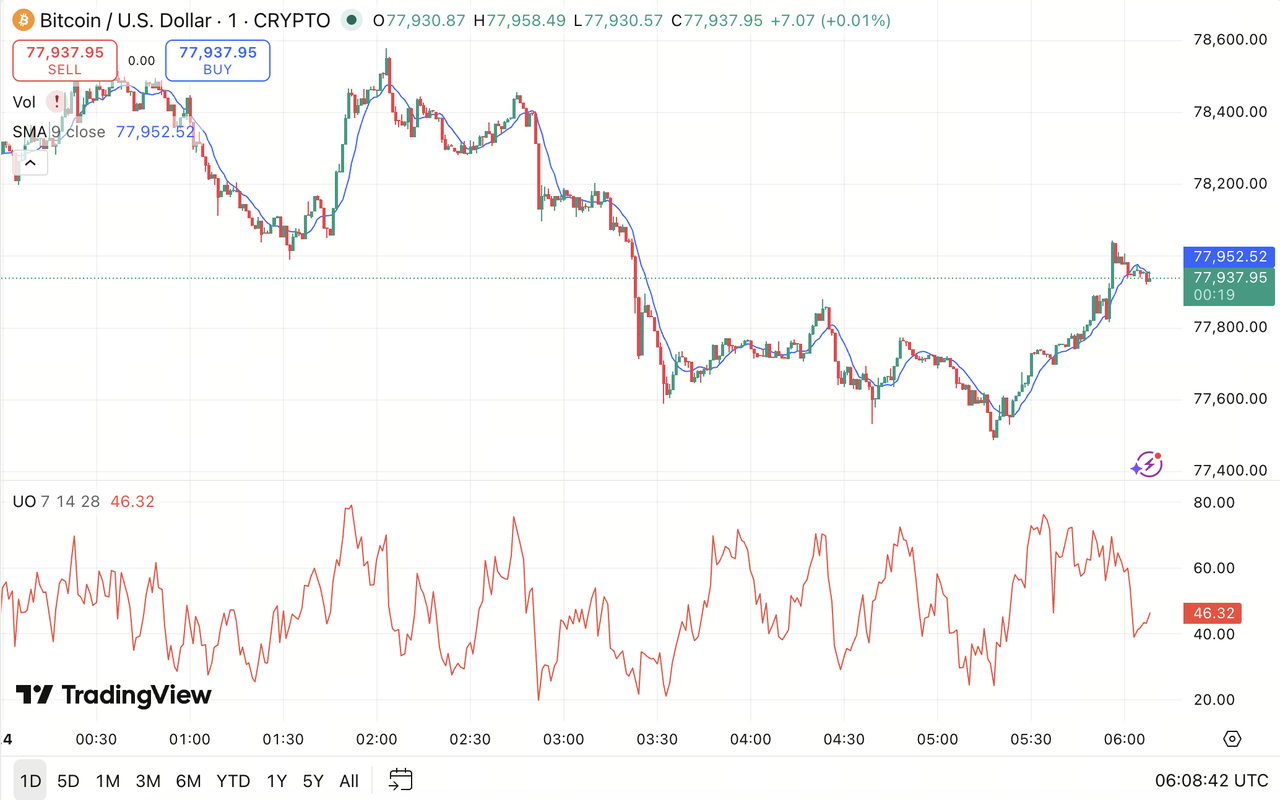
Source: TradingView
How Multiple Timeframes Are Combined
The Ultimate Oscillator typically looks at three periods: short, medium, and longer term momentum. A common setup uses 7, 14, and 28 periods. The shorter period reacts faster, the middle period adds balance, and the longer period helps smooth the overall reading.
This does not mean UO shows three separate lines. Instead, it blends them into one oscillator. The short period usually receives more weight, but the longer periods still influence the final result. This creates a signal that is responsive without being as jumpy as many fast oscillators.
Here is a simple way to understand the structure:
| UO Component |
What It Represents |
How Traders Use It |
| Short period |
Fast changes in buying pressure |
Helps identify early momentum shifts |
| Medium period |
Balanced market pressure |
Reduces short term noise |
| Longer period |
Broader momentum direction |
Helps confirm whether the signal has support |
For a beginner, the key idea is simple: UO does not judge momentum from one angle only. It asks whether buying pressure is visible across more than one timeframe. This is also what separates it from other technical indicators such as the Awesome Oscillator (AO), which measures momentum differently and is usually read through histogram behavior around a zero line.
Reading Buying Pressure Signals
The Ultimate Oscillator is built around buying pressure. When UO rises, it suggests buyers are gaining strength compared with recent price action. When it falls, it suggests buying pressure is weakening or sellers are becoming more dominant.
Many traders watch the 30 and 70 areas. A reading below 30 may suggest the market is oversold, while a reading above 70 may suggest it is overbought. Still, these levels should not be treated as automatic buy or sell signals.
In a strong crypto uptrend, UO can remain elevated for a long time. Selling only because it reaches 70 may cause a trader to exit too early. In a strong downtrend, UO can stay weak for a long period, and buying just because it moves below 30 can be risky.
A practical reading looks at three things together: the UO level, the direction of the line, and the price chart. If price is rising and UO is also rising, buying pressure supports the move. If price is rising but UO is falling, momentum may be weakening. If price falls but UO begins to rise, buyers may quietly returning.
Divergence in UO
Divergence is one of the most useful ways to apply the Ultimate Oscillator. It happens when price and the indicator move in different directions.
Bullish divergence appears when price makes a lower low, but UO makes a higher low. This suggests that even though price has dropped further, selling pressure may be losing strength and buyers may be stepping in. Traders often watch this near support zones or after a sharp selloff.
Bearish divergence appears when price makes a higher high, but UO makes a lower high. This suggests that price is still pushing upward, but buying pressure is not keeping up. In crypto markets, this can happen near resistance, after a fast rally, or when late buyers enter while stronger traders begin taking profit.
Divergence is more meaningful when it matches the chart context. A bullish divergence near a major support level is usually more useful than one in the middle of a clear downtrend. A bearish divergence near resistance is often more important than one during a fresh breakout with strong volume.
UO divergence is often valued because it reflects pressure across multiple periods. This can make the signal more balanced than divergence from a very fast oscillator. Still, traders should confirm it with price action, trendline breaks, volume, or other tools such as the Awesome Oscillator (AO).
Why UO Reduces False Signals
False signals are common in crypto because volatility is high. A quick price spike can make an indicator look overbought. A sudden dip can make it look oversold. If the trader reacts immediately, they may enter against the real trend.
The Ultimate Oscillator reduces some of this noise by blending different timeframes. A short term move must be supported by broader buying pressure to create a stronger reading. This does not remove false signals completely, but it can make the indicator less reactive than tools based on only one period.
This is useful during strong trends. For example, if Bitcoin is moving steadily upward, a short pullback may cause a fast oscillator to drop sharply. UO may respond more calmly because the medium and longer periods still show strength. That can help traders avoid mistaking a normal pullback for a full reversal.
The same logic applies in downtrends. A short bounce may not be enough to create a strong UO signal if broader buying pressure remains weak. This helps traders avoid buying every small recovery in a falling market.
Limitations of the Ultimate Oscillator
The Ultimate Oscillator is helpful, but it is not perfect. It is still a lagging indicator because it uses past price data. It can confirm momentum conditions, but it cannot guarantee what price will do next.
It may also give weak signals in sideways markets. When price is moving within a range, UO may rise and fall without leading to a strong breakout. In these conditions, traders should pay close attention to support, resistance, and volume.
Another limitation is that overbought and oversold readings can be misleading during strong trends. A coin can stay overbought while continuing higher, or remain oversold while continuing lower. This is why UO should never be used as a standalone trading system.
Beginners should also avoid combining too many momentum indicators that show similar information. Using UO, RSI, MACD, and the Awesome Oscillator (AO) all at once may create confusion instead of clarity. It is better to choose a small set of tools and understand how each one supports the trading decision.
Conclusion
The Ultimate Oscillator is a momentum indicator that helps traders read buying pressure across multiple timeframes. Its main strength is that it combines short, medium, and longer term periods into one oscillator, which can reduce some of the noise found in single timeframe tools.
For crypto traders, UO is especially useful when reading divergence, checking whether buying pressure supports a price move, and avoiding weak reversal signals during volatile conditions. It can be compared with indicators such as the Awesome Oscillator (AO), but its multi timeframe design gives it a different role.
The best way to use UO is not as a magic entry signal, but as a confirmation tool. When combined with trend direction, support and resistance, volume, and clear price action, it can help traders make more balanced decisions in fast moving crypto markets.
FAQs
What does the Ultimate Oscillator measure?
The Ultimate Oscillator measures buying pressure across multiple timeframes. It helps traders see whether momentum is supported by short, medium, and longer term market activity.
Is UO the same as the Awesome Oscillator (AO)?
No. UO and the Awesome Oscillator (AO) are both momentum tools, but they work differently. UO focuses on buying pressure across multiple periods, while AO compares moving averages to show momentum through a histogram.
What is a good UO reading?
Many traders watch levels near 30 and 70. A reading below 30 may suggest oversold conditions, while a reading above 70 may suggest overbought conditions. These levels should always be confirmed with price action.
How does bullish divergence work in UO?
Bullish divergence happens when price makes a lower low while UO makes a higher low. This can suggest that selling pressure is weakening and buyers may be starting to return.
Can beginners use the Ultimate Oscillator?
Yes. Beginners can use UO, but they should keep it simple. Focus on trend direction, buying pressure, and divergence rather than trying to trade every overbought or oversold reading.
Should UO be used alone?
No. UO works best with confirmation tools such as support and resistance, trendlines, volume, moving averages, or another momentum tool like the Awesome Oscillator (AO).







