In the modern economy, banks do far more than hold deposits and issue loans. They are key financial intermediaries connecting savings, investment, consumption and corporate financing. Whether an individual is applying for a mortgage, a company is seeking working capital, or an investor is managing assets, banks play a central role in the movement of funds.
Compared with large banks such as JPMorgan Chase, which operate across global markets, PNC is more focused on the U.S. domestic market. It builds long term customer relationships through a broad branch network, digital banking platforms and wealth management services. As digital finance develops rapidly and demand for financial services continues to evolve, PNC has become one of the most representative financial institutions in the U.S. regional banking sector.
What Is PNC, or PNC Financial Services?
From a business model perspective, PNC is a typical diversified banking institution. Banks create funding sources by accepting customer deposits, then generate returns through lending, credit services and investment activities. At the same time, wealth management and advisory services provide non interest income, creating a more diversified revenue structure.
PNC Financial Services is a financial services group headquartered in Pittsburgh, Pennsylvania. It is also one of the largest regional banks in the United States by asset size. The company’s businesses cover personal banking, commercial banking, wealth management, asset custody and capital markets services.
In the U.S. financial market, PNC is generally classified as a regional bank. Although it is smaller than several of the country’s largest nationwide banks, it has strong market coverage across multiple states and has long maintained an important position in the U.S. regional banking market.
PNC’s History and Market Position
PNC’s history can be traced back to the mid nineteenth century. Through long term mergers, integration and business expansion, the company gradually grew from a local bank into a large financial services group operating across many U.S. states.
The U.S. banking industry has undergone a long process of consolidation. As the regulatory environment changed and financial markets developed, large regional banks continued to expand their market share through acquisitions. PNC’s development path reflects this broader industry trend. By acquiring regional financial institutions and expanding its service network, PNC gradually built a business system covering markets in the eastern, midwestern and southern United States.
Today, PNC is positioned between community banks and global banks. Compared with smaller local banks, PNC can provide a broader range of financial products. Compared with global financial giants, it is more focused on the U.S. domestic market and regional customer needs. This positioning gives PNC a distinct competitive advantage in the regional banking market.
How PNC’s Commercial Banking Business Works
Commercial banking is one of PNC’s most important revenue sources and the foundation of the banking group’s overall operations. It mainly revolves around deposits, loans and payment services, providing daily financial support to individuals and businesses.
The bank first builds its funding base by accepting money through savings accounts, checking accounts and time deposits. These deposits form an important foundation for lending and investment activities. The bank then provides mortgages, auto loans and consumer loans to individual customers, while offering business loans, equipment financing and credit lines to corporate clients.
The core profit logic of commercial banking comes from net interest income. The interest banks pay to depositors is usually lower than the interest they charge on loans, and the difference between the two becomes an important source of profit. As a result, loan scale, funding costs and the interest rate environment all affect the bank’s overall operating performance.
PNC’s Retail Banking and Wealth Management System
Retail banking mainly serves individual customers and acts as an important entry point for PNC to build long term customer relationships. Through its broad branch network and digital banking platform, PNC provides account management, payment services, credit products and personal financing solutions.
As customers accumulate wealth, their financial needs gradually expand from basic banking services to asset allocation and wealth management. For this reason, PNC has built a complete wealth management system, offering investment planning, retirement planning, trust services and wealth transfer solutions for high net worth clients and families.
Wealth management is becoming increasingly important. Compared with traditional lending, wealth management can usually generate more stable fee income while reducing the bank’s dependence on interest rate cycles. This is one of the key reasons modern banks continue to expand their wealth management businesses.
PNC’s Corporate Finance and Capital Markets Services
In addition to personal financial services, corporate customers are also an important market for PNC. Corporate financial services cover small and medium sized businesses, large corporations and institutional clients, providing support in financing, cash management and risk management.
Corporate financing is one of the core businesses in this area. Companies often need substantial funding for expansion, equipment purchases or day to day operations, and bank loans and credit lines are important financing channels. Through long term partnerships, PNC can continue participating in corporate growth and generate stable revenue.
Capital markets services further expand PNC’s business scope. These services include bond issuance advisory, merger and acquisition financing support, foreign exchange transactions and interest rate risk management. Through these higher value financial services, PNC not only strengthens customer loyalty, but also improves the diversification of its overall revenue structure.
PNC’s Role in the U.S. Regional Banking Market
Regional banks are an important part of the U.S. financial system, connecting local economies with national financial markets. Compared with large nationwide banks, regional banks usually have a deeper understanding of local markets and customer needs, allowing them to build closer customer relationships.
PNC holds a leading position in the U.S. regional banking market. Its service area covers many economically active regions, and the company has a strong market share in commercial lending, small and medium sized business finance and wealth management. For many corporate clients, PNC can provide the professional services of a large bank while retaining the more flexible operating characteristics of a regional bank.
As the U.S. economy develops and corporate financing needs grow, regional banks continue to play an important role. In particular, in small and medium sized business financing and local economic development, large regional banks such as PNC continue to perform key financial intermediary functions.
How PNC Differs from JPMorgan Chase and Bank of America
Although PNC, JPMorgan Chase and Bank of America are all major U.S. banking institutions, they differ clearly in business structure and market positioning.
| Bank |
Core Positioning |
Key Features |
| PNC |
Regional bank |
Broad coverage in the U.S. domestic market |
| JPMorgan Chase |
Global diversified bank |
Leading investment banking and global operations |
| Bank of America |
Nationwide bank |
Large scale retail banking network |
JPMorgan Chase has a global investment banking business, asset management capabilities and an international financial services network, with operations spanning markets around the world. Bank of America is known for its large retail customer base and nationwide banking network.
By comparison, PNC is more focused on the development of U.S. regional markets. Its strength lies in deeply serving local businesses and individual customers while building long term relationships through its regional network. This differentiated positioning helps PNC maintain a distinct market space in the highly competitive banking industry.
Main Use Cases for PNC’s Services
PNC’s financial services are widely used across personal consumption, wealth management and business operations. For ordinary consumers, the most common use cases include deposit account management, credit card use, mortgage applications and mobile payment services.
Wealth management services serve customers with asset allocation needs. Through portfolio management, retirement planning and wealth transfer services, PNC helps clients work toward long term financial goals. These services are in strong demand among high net worth individuals and family clients.
Corporate clients mainly use PNC’s loan financing, cash management and capital markets services. From startups to large companies, banking services are often an essential part of business operations. By supporting corporate financing and fund management, PNC plays an important role in U.S. commercial activity.
How to Buy PNC Financial Services Stock
PNC is the ticker symbol for PNC Financial Services Group, which is listed and traded on the New York Stock Exchange in the United States. Traditionally, investors can buy PNC stock through brokerage accounts that support U.S. stock trading, allowing them to participate in the development of the U.S. banking industry.
Because PNC’s operating performance is closely tied to U.S. economic growth, loan demand and the interest rate environment, many investors view it as an important representative company for observing the U.S. regional banking sector.
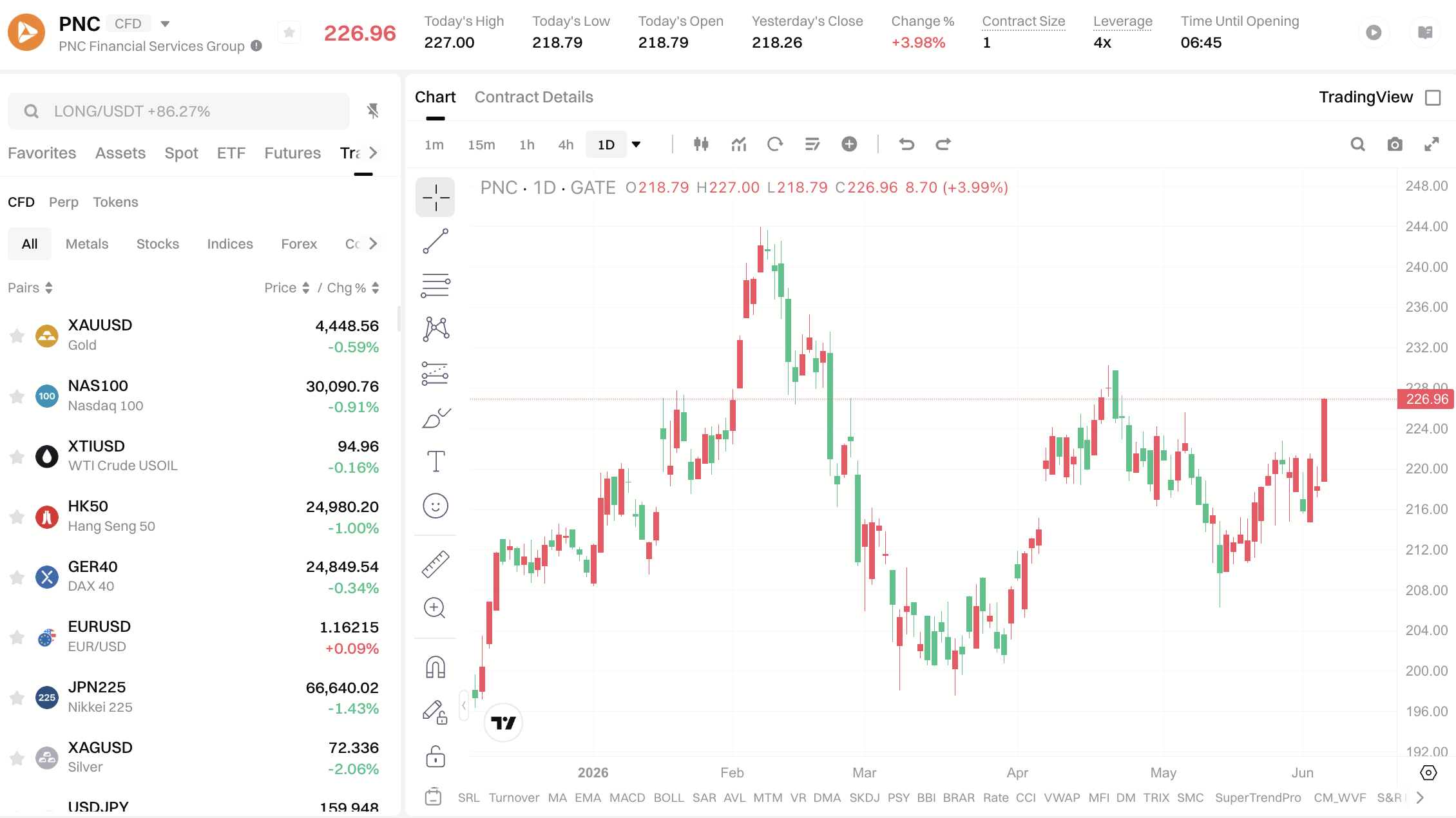
As digital asset markets and traditional financial markets gradually converge, more trading tools linked to bank stock price movements have also emerged. For example, some platforms offer CFD products tied to U.S. stock prices, allowing users to participate in market movements through price changes without directly holding the underlying shares.
Gate TradFi is continuing to expand its coverage of traditional financial assets. Users can track digital assets, U.S. stocks, ETFs, indices and commodity markets within a unified account environment. Some markets also offer Gate CFD products, providing more options for cross market asset allocation and market observation.
Whichever method investors use to participate in the market, they should fully understand the product structure, trading rules and regulatory requirements in their own region.
PNC’s Strengths and Limitations
PNC’s greatest strengths lie in its diversified business structure and broad regional market coverage. Commercial banking, wealth management and corporate financial services together make up its revenue sources, helping the company reduce dependence on any single business. At the same time, long established customer relationships and brand reputation create important competitive barriers.
The growth of wealth management further strengthens revenue stability. Compared with banks that rely solely on loan spread income, PNC can use fee and advisory income to balance the impact of interest rate cycles. Continued improvement in digital banking capabilities can also help increase operating efficiency and enhance the customer experience.
That said, the banking industry is still affected by economic cycles and the interest rate environment. When economic growth slows or loan demand declines, bank revenue may come under pressure. At the same time, changes in regulatory policy, credit risk management and fintech competition will continue to influence industry development. For PNC, advancing digital transformation while maintaining stable operations will remain an important long term challenge.
Conclusion
PNC Financial Services is one of the largest regional banking groups in the United States, with businesses covering commercial banking, retail banking, wealth management and corporate financial services. It generates net interest income through deposits and loans, while using wealth management and capital markets services to diversify revenue. PNC holds an important position in the U.S. regional banking market. As digital finance develops and customer needs become more sophisticated, PNC continues to connect individual clients, corporate customers and capital markets through its integrated financial services system.
FAQs
What kind of company is PNC?
PNC Financial Services is a large U.S. regional banking group that mainly provides commercial banking, retail banking, wealth management and corporate financial services.
Is PNC an investment bank?
PNC’s core businesses remain commercial banking and retail banking, although it also provides some capital markets and corporate financial services.
How does PNC mainly make money?
PNC mainly generates revenue through loan spread income, wealth management fee income and corporate financial services income.
How is PNC different from JPMorgan Chase?
JPMorgan Chase is a global diversified financial institution, while PNC mainly focuses on U.S. regional markets and domestic customer services.
Why is wealth management important?
Wealth management can generate stable fee income and help banks reduce their dependence on changes in interest rate cycles.
Which customers does PNC serve?
PNC serves individual customers, small and medium sized businesses, large corporations and institutional investors, covering a broad range of financial service needs.