In the modern financial system, asset management companies play a key role in connecting capital with investment opportunities. Individual investors, pension funds, insurance companies, sovereign wealth funds and corporate clients all entrust capital to professional institutions in order to pursue long-term wealth allocation and risk management goals. As global capital markets continue to expand, the asset management industry has become one of the most important parts of the financial ecosystem.
Invesco has grown into a global asset management institution within this broader environment. Its business spans multiple areas, including equities, bonds, multi-asset strategies, ETFs and alternative investments, with assets under management across North America, Europe, Asia Pacific and emerging markets. For many investors, Invesco’s best-known product may be the Invesco QQQ ETF, but its business extends far beyond a single ETF product.
What Is Invesco (IVZ)
Invesco was founded in 1935 and is headquartered in Atlanta, United States. It is one of the longer-established asset management firms in the world. Through decades of expansion and acquisitions, the company gradually developed from a regional investment management firm into an international asset management group.
Invesco has gone through several important stages in its development. In its early years, the business mainly focused on traditional mutual fund management. As the ETF market expanded and global capital flows accelerated, the company began to broaden its presence in index investing, fixed income investing and institutional asset management. In recent years, Invesco has further strengthened its competitive position in the global asset management industry by continuously expanding its ETF product lineup and global market footprint.
From an industry positioning perspective, Invesco is a diversified asset management institution. Compared with fund companies that focus on a single area, Invesco can provide active investment, passive investment, multi-asset allocation and institutional solutions at the same time, allowing it to serve a much broader range of client needs.
How Invesco’s Asset Management Business Works
Asset management is Invesco’s core source of revenue and the foundation of its overall business.
At its essence, an asset management company accepts client capital and manages it on their behalf, making asset allocation and investment decisions based on specific investment objectives. Invesco operates a wide range of funds and investment strategies covering equities, bonds, money market instruments, alternative assets and other categories.
When investors buy Invesco fund products, their capital is pooled into the relevant investment portfolio and managed by professional investment teams according to a defined strategy. These teams continuously study macroeconomic conditions, industry trends and company fundamentals to identify assets that match the portfolio’s investment goals.
This model allows investors to access professional investment services, while Invesco earns revenue through management fees and related service fees. As a result, assets under management, or AUM, are often used as an important measure of the scale of an asset management company’s business.
Invesco’s ETF and Index Investing Ecosystem
ETFs have become one of Invesco’s most representative business segments.
An ETF is a fund product that can be traded in real time on a securities exchange. It is typically designed to track a specific index, sector or investment theme. Because ETFs combine the diversification benefits of funds with the trading convenience of stocks, they have become widely popular among global investors in recent years.
Invesco’s best-known ETF product is Invesco QQQ. This ETF tracks the Nasdaq 100 Index and includes many large technology companies, making it one of the world’s most closely watched technology-themed ETFs.
Beyond QQQ, Invesco also offers a broad range of ETF products covering equities, bonds, commodities and thematic investing. Through this extensive ETF ecosystem, Invesco can meet the needs of clients with different risk preferences and investment goals.
The continued expansion of its ETF ecosystem has also helped Invesco build meaningful influence in the global passive investment market.
Invesco’s Active Management and Multi-Asset Investment Framework
Although the ETF business attracts broad attention, active management remains an important part of Invesco.
Active management strategies emphasize the role of investment teams in selecting securities through research and analysis, with the goal of outperforming market benchmarks. These products typically cover areas such as equity funds, bond funds and sector-themed funds.
At the same time, Invesco has also built a multi-asset investment framework. Multi-asset investing is not limited to a single market. Instead, it combines equities, bonds, cash and other asset classes in one allocation approach to balance risk and return.
For pension funds, insurance companies and large institutional investors, multi-asset solutions can help support long-term investment objectives. As a result, they have become an important direction of development for the global asset management industry.
By building both active management and passive investment businesses, Invesco has formed a more balanced product structure.
Invesco’s Role in the Global Asset Management Market
Invesco is one of the important participants in the global asset management industry.
The core role of the asset management industry is to improve the efficiency of capital allocation. With the involvement of professional investment institutions, capital can flow into corporate financing, infrastructure development, innovative industries and other areas, thereby supporting economic growth.
Invesco serves not only individual investors, but also large institutional clients such as pension plans, university endowments, insurance companies and sovereign wealth funds. Different clients have different risk preferences, which creates a need for diversified investment solutions.
As global investment demand continues to grow, Invesco has gradually built a business network spanning multiple countries and regions, becoming one of the important participants connecting global capital markets.
How Invesco Differs from BlackRock and Fidelity
Invesco, BlackRock and Fidelity are all globally recognized asset management institutions, but their business priorities differ clearly.
| Company |
Core Strength |
Representative Product |
| Invesco (IVZ) |
ETFs and multi-asset investing |
Invesco QQQ |
| BlackRock (BLK) |
The world’s largest asset management scale |
iShares ETF |
| Fidelity |
Active investing and retirement services |
Fidelity Funds |
BlackRock is known for having the world’s largest asset management scale, and its iShares ETF series holds a very high market share. Fidelity has long focused on active investing and retirement management, with a deep foundation in the US individual investment market.
Invesco’s strengths lie in ETF product innovation, multi-asset investment capabilities and global market coverage. In particular, in the field of technology index investing, QQQ has become a widely used investment tool among global investors.
These differences allow the three companies to establish their own distinct positions in the highly competitive asset management industry.
Main Use Cases for Invesco
Invesco’s products and services are widely used in wealth management, retirement planning, institutional investing, asset allocation and other areas.
For individual investors, ETFs and mutual funds provide convenient long-term investment tools. Investors can use Invesco products to gain exposure to US equities, international equities, bonds and thematic investment assets.
For institutional clients, Invesco provides asset allocation, risk management and investment advisory services to help large pools of capital pursue long-term investment objectives.
In addition, multi-asset investment solutions are widely used in pension and insurance fund management to meet the need for long-term stable returns.
Therefore, Invesco’s use cases cover not only the individual investment market, but also the broader institutional investment ecosystem.
How to Buy IVZ (Invesco) Stock
IVZ is the stock ticker of Invesco Ltd. in the US securities market. Traditionally, investors can buy IVZ stock through brokerage accounts that support US stock trading, allowing them to participate in the development of the global asset management industry.
Because Invesco’s revenue is closely tied to assets under management, ETF inflows and the level of activity in global capital markets, many investors view it as one of the representative companies for observing the development of the asset management industry.
As digital asset markets and traditional financial markets become increasingly connected, more trading tools have emerged around the price movements of US stocks. For example, some platforms offer CFD products linked to stock prices, allowing users to participate in market price changes without directly holding the underlying stock assets.
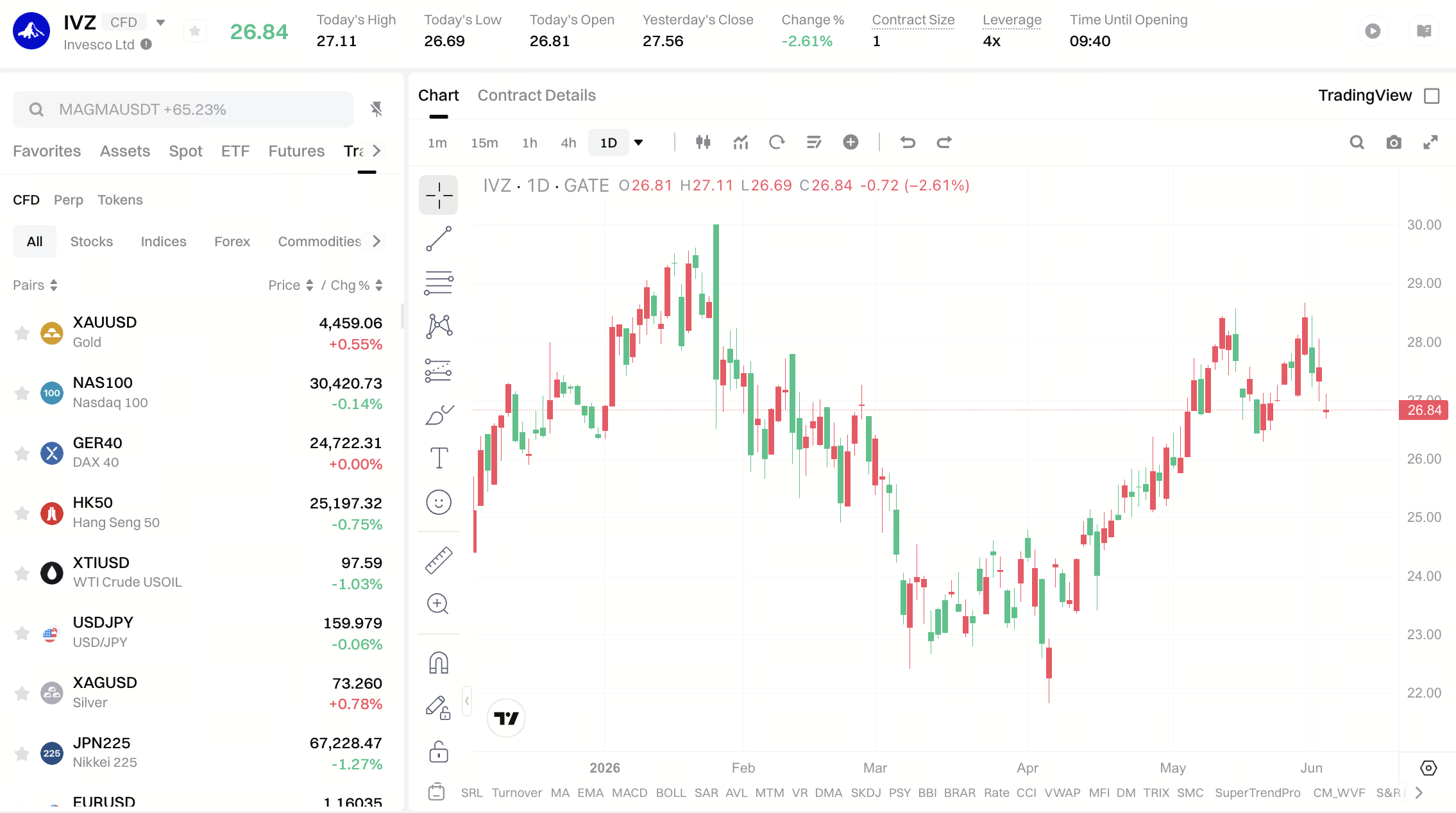
Gate TradFi is continuing to expand its coverage of traditional financial assets. Users can monitor digital assets, US stocks, ETFs, indices and commodity markets within a unified account environment. Some markets also provide Gate CFD products, offering more choices for cross-market asset allocation and price observation.
Regardless of how investors participate in the market, they should fully understand the product structure, trading rules and regulatory requirements in their region.
Invesco’s Strengths and Limitations
Invesco’s greatest strength comes from its diversified asset management system and global investment platform. The company covers ETFs, active management, multi-asset investing and institutional services at the same time, giving it a relatively balanced revenue base.
In the ETF market, core products such as QQQ have strong brand recognition and market influence. At the same time, its global business footprint helps Invesco reach a wider investor base.
However, the asset management industry itself is highly competitive. Large institutions such as BlackRock, Vanguard and Fidelity all hold significant market share. In addition, the continued decline in ETF expense ratios may put pressure on the profitability of asset management companies.
As a result, Invesco needs to keep improving its investment capabilities and product innovation in order to maintain its long-term competitive advantage.
Conclusion
Invesco is one of the world’s leading asset management institutions. Through asset management, ETF products, multi-asset investing and institutional services, it helps investors around the world pursue asset allocation goals. The company not only manages the widely followed QQQ ETF, but has also built a complete ecosystem covering both active management and passive investing. As global capital markets continue to develop, Invesco’s importance and influence within the asset management industry remain significant.
FAQs
What kind of company is IVZ?
IVZ is the stock ticker of Invesco Ltd. Invesco is a global asset management company that provides funds, ETFs and institutional investment services.
What is Invesco’s best-known product?
One of Invesco’s best-known products is the Invesco QQQ ETF, which tracks the Nasdaq 100 Index.
How does Invesco mainly make money?
Invesco mainly earns revenue through asset management fees, ETF management fees and institutional investment service income.
Does QQQ belong to Invesco?
Yes. QQQ ETF is issued and managed by Invesco and is one of the world’s largest technology-themed ETFs.
How is Invesco different from BlackRock?
BlackRock is the world’s largest asset management company, while Invesco has strong competitiveness in ETF innovation and multi-asset investing. Their business priorities are different.
Is Invesco an active investment company or an ETF company?
Invesco has both active management and ETF businesses. It is a diversified asset management institution.