Spot trading, CFDs, futures, and perpetual contracts form the main trading framework of modern financial markets. As global capital markets become increasingly digital, investors can not only buy and sell stocks, commodities, or digital assets directly, but also participate in price movements through derivatives, creating a wider range of trading strategies.
From traditional securities markets to commodities, foreign exchange, and digital assets, these four trading methods have become important infrastructure for global asset allocation. Although they may all be based on the same underlying asset, their trading logic, capital usage, and risk characteristics differ significantly.
What Is Spot Trading?
Spot Trading refers to a trading method in which assets are bought and sold directly at the current market price.
In the spot market, once a trade is completed, investors usually obtain actual ownership of the underlying asset. For example, buying stocks gives the investor the corresponding shares, buying physical gold gives ownership of gold, and buying digital assets gives ownership of the corresponding tokens.
Spot trading is the most basic form of trading in financial markets, and it is also the price foundation for all derivatives markets. Most asset prices ultimately come from supply and demand in the spot market.
Key Features of Spot Trading
-
Ownership of the real asset
-
Usually does not require leverage
-
No expiration time
-
Relatively straightforward risk profile
-
Suitable for long-term holding and asset allocation
What Is a CFD?
A CFD, or Contract for Difference, is a financial derivative settled based on the price difference of an asset. Traders do not need to actually hold the underlying asset. Instead, profits and losses are calculated according to price changes.
In CFD trading, investors and the trading platform agree to settle the price difference between opening and closing a position. When the price rises, long positions generate profits. When the price falls, they generate losses.
CFDs are widely used in stock indices, gold, silver, crude oil, foreign exchange, and digital asset markets.
Key Features of CFDs
-
No ownership of the underlying asset
-
Supports two-way trading
-
Supports leverage mechanisms
-
No fixed delivery date
-
Profits and losses come from price movements
What Is a Futures Contract?
A Futures Contract is a standardized agreement to buy or sell an asset at a specific price at a future date.
Futures originally emerged in agricultural and commodity markets to help producers and buyers manage price risk. As financial markets developed, futures gradually expanded into indices, interest rates, foreign exchange, and digital assets.
Unlike the spot market, futures trading does not involve trading the asset itself, but the rights and obligations of future delivery.
Key Features of Futures Contracts
-
Fixed expiration date
-
Usually uses a margin system
-
Supports leveraged trading
-
Can be used for hedging
-
Can be used for price discovery
What Is a Perpetual Contract?
A Perpetual Contract is a derivative contract that removes the expiration and delivery mechanism. Unlike traditional futures, perpetual contracts allow traders to hold positions indefinitely.
To keep the perpetual contract price close to the spot market price, the market introduces a funding rate mechanism. When the contract price deviates from the spot price, long and short participants make periodic funding payments to help restore price balance.
Perpetual contracts have become one of the most active derivative products in the digital asset market.
Key Features of Perpetual Contracts
-
No fixed expiration time
-
Supports long-term position holding
-
Introduces a funding rate mechanism
-
Supports high-leverage trading
-
Widely used in digital asset markets
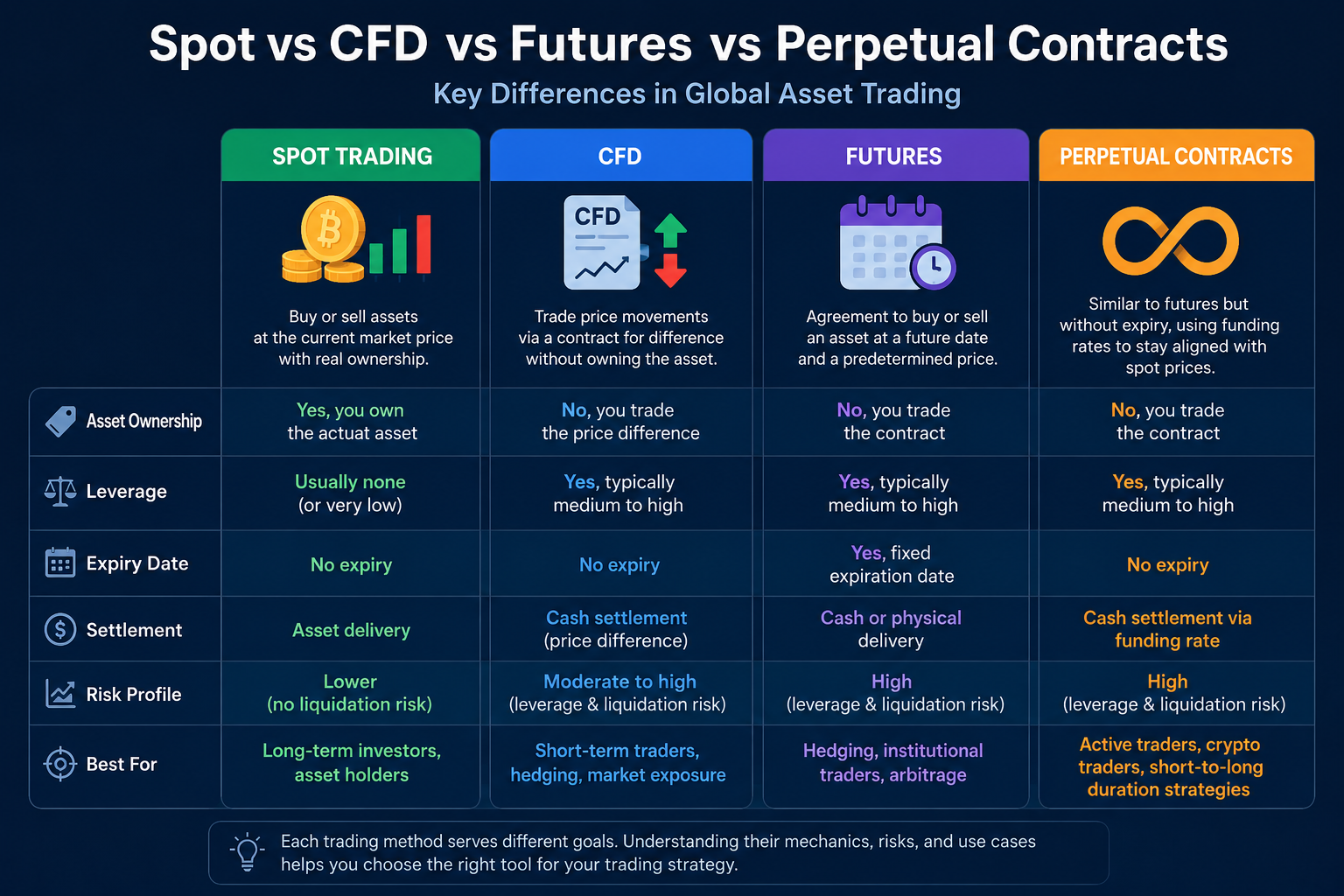
What Is the Difference in Asset Ownership?
Asset ownership is the most important standard for distinguishing spot trading from derivatives.
After a spot trade is completed, the investor actually owns the underlying asset. Whether the asset is a stock, gold, or a digital asset, ownership is transferred. CFDs, futures, and perpetual contracts, by contrast, are essentially contracts on price movements. Investors hold contract positions, not the asset itself.
This difference makes spot trading more suitable for long-term holding, while derivatives are more suitable for risk management and price trading.
| Trading Method |
Owns the Asset |
| Spot |
Yes |
| CFD |
No |
| Futures |
No |
| Perpetual contracts |
No |
What Is the Difference in Leverage Mechanisms?
Leverage is an important feature of derivatives markets. Through the margin system, traders can use a smaller amount of capital to control a larger position.
Spot markets are usually based on full capital payment, while CFDs, futures, and perpetual contracts widely use leverage models. Leverage can improve capital efficiency, but it also magnifies the risks caused by market volatility.
Therefore, the higher the leverage level, the greater the need for strong risk management.
What Is the Difference in Expiration and Settlement Mechanisms?
There is no expiration issue in the spot market, since assets can be held for the long term. CFDs usually use a continuous holding model and also have no unified delivery date.
Futures markets have a clear expiration structure. After a contract expires, traders need to complete cash settlement or physical delivery, which is why futures markets involve contract rolling and rollover operations.
Perpetual contracts use funding rates instead of an expiration mechanism, so traders do not need to switch contracts frequently.
| Trading Method |
Has Expiration |
Main Settlement Method |
| Spot |
No |
Asset delivery |
| CFD |
No |
Difference settlement |
| Futures |
Yes |
Cash or physical delivery |
| Perpetual contracts |
No |
Funding rate balance |
What Is the Difference in Risk Structure?
The spot market mainly carries the risk of asset price fluctuations. As long as the asset does not fall to zero, investors usually will not be forced out of the market simply because of price volatility.
Derivatives markets introduce margin systems and leverage mechanisms, so in addition to market risk, they also involve margin call risk, liquidity risk, and forced liquidation risk.
Especially in highly volatile market environments, derivative prices may change much faster than spot market prices. As a result, risk management becomes a core part of the trading system.
As global trading platforms develop, spot trading, CFDs, futures, and perpetual contracts are gradually being integrated into unified account systems.
The Gate platform allows traders to participate in different markets in one place while sharing capital management and risk control systems. For example, multi-asset trading architecture is trying to integrate spot markets, CFD markets, and derivatives markets to improve cross-market trading efficiency.
At the same time, AI trading tools are also beginning to support market analysis, risk identification, and strategy-assisted decision-making, pushing trading infrastructure further toward intelligence.
Conclusion
Spot trading, CFDs, futures, and perpetual contracts each represent different stages in the development of financial market trading models.
Spot trading centers on the transfer of asset ownership. CFDs enable market participation through price difference settlement. Futures use fixed expiration mechanisms for risk management and price discovery. Perpetual contracts have created a long-term trading model without delivery in the digital asset market.
FAQs
What Is the Biggest Difference Between Spot Trading and CFDs?
Spot trading involves the transfer of real asset ownership, while CFD trading only settles the price difference based on market movements. Traders participate in changes in market price, not in the asset itself.
What Is the Difference Between Perpetual Contracts and Futures Contracts?
Futures contracts have fixed expiration dates and need to be settled or delivered at a specific time. Perpetual contracts have no expiration date and use a funding rate mechanism to maintain the connection between contract prices and the spot market.
Are CFDs a Type of Futures?
CFDs and futures are both financial derivatives, but they use different settlement and trading mechanisms. CFDs usually do not have a fixed expiration structure, while futures have standardized delivery cycles.
Why Do Derivatives Markets Commonly Use Leverage?
Leverage improves capital efficiency, allowing traders to control larger market positions with less capital. However, leverage also magnifies both potential returns and risks from price movements.
Which Trading Method Has the Lowest Risk?
Structurally, spot trading usually does not involve margin or forced liquidation mechanisms, so its risks are relatively simpler. However, all market trading involves price volatility risk, and different products have different risk characteristics.
Why Can Perpetual Contracts Have No Expiration Date?
Perpetual contracts use a funding rate mechanism to regulate market supply and demand, keeping contract prices close to spot prices over the long term. As a result, they do not need to rely on the expiration and delivery mechanism used in traditional futures markets.