As DePIN and satellite internet become important directions for Web3 infrastructure, more projects are beginning to combine real-world communication networks with blockchain technology. Compared with traditional ISPs, or internet service providers, which rely on centralized operating models, Spacecoin places greater emphasis on an open network structure and on-chain coordination mechanisms. As a result, it is often viewed as one of the notable examples of Web3 satellite internet.
Spacecoin’s operating process involves more than satellite communications alone. It also includes node collaboration, data routing, on-chain payments, token incentives, and several other components.
What Components Make Up Spacecoin’s Network Architecture?
Spacecoin’s overall architecture mainly consists of four core layers: the satellite layer, the ground terminal layer, the blockchain settlement layer, and the node network layer.
Low Earth orbit (LEO) satellites are responsible for global data coverage and communication transmission. Users need to establish a connection with satellites through ground receiving devices, while data is relayed between satellites and ground networks.
The blockchain layer mainly handles payments, settlement, and network resource coordination. Unlike the traditional internet subscription model, Spacecoin uses an on-chain payment system, allowing internet services to be settled through crypto assets.
The node network is responsible for certain parts of data validation, routing coordination, and network maintenance, and it receives incentives through SPACE tokens.
| Network Layer |
Main Function |
| Satellite Layer |
Data transmission and global coverage |
| Ground Terminal Layer |
User internet access |
| Blockchain Layer |
Payments, settlement, and governance |
| Node Layer |
Network coordination and validation |
This structure makes Spacecoin not only a communication network, but also an on-chain economic system.
How Do Users Connect to the Spacecoin Network?
The first step for users to access the Spacecoin network is to establish a communication link with low Earth orbit satellites through ground terminal equipment.
After a ground terminal sends a request, a nearby LEO satellite receives the signal and transmits the data to a ground gateway or other network nodes. Because low Earth orbit satellites are closer to Earth, they can provide a lower-latency internet experience than traditional high-orbit satellites.
This process is similar to traditional satellite internet, but Spacecoin introduces blockchain mechanisms into later stages of resource coordination and payment. As a result, users are not only internet consumers, but may also become part of the network economy.
As the number of satellites increases, network coverage and communication capacity will expand as well.
What Is Spacecoin’s Data Transmission Process?
When a user sends a network request, the data passes through several transmission stages.
First, the user terminal sends the data to the nearest low Earth orbit satellite. The satellite then forwards the data to a ground gateway node or transmits it further to the target region through inter-satellite communication.
After the data reaches an internet exit point, the target server sends a response, and that data returns to the user terminal along the same path.
The whole process can be understood as:
User terminal → LEO satellite → Ground node → Internet server → Back to user
Compared with traditional ISPs, which rely entirely on ground-based communication infrastructure, Spacecoin depends more on space-based communication networks. This allows it to provide network coverage in remote regions or areas where communication infrastructure is insufficient.
How Does Spacecoin’s On-Chain Payment System Work?
Beyond network connectivity, one of Spacecoin’s core innovations lies in its on-chain payment mechanism.
In the traditional internet model, users usually subscribe to services with fiat currency. Spacecoin, by contrast, places more emphasis on on-chain resource settlement. Users can pay for network access, data usage, or other network service costs with SPACE tokens.

The blockchain system records payment information and coordinates the allocation of network resources. For example, when a user purchases bandwidth resources, the system can automatically complete settlement and assign access permissions.
This mechanism gives internet services greater openness and global accessibility, making it especially suitable for emerging markets where traditional financial services are limited.
At the same time, on-chain payments can also integrate more deeply with Web3 wallets, digital identity, and on-chain financial systems.
How Do Spacecoin Nodes Participate in the Network?
Some of Spacecoin’s network functions depend on distributed nodes working together.
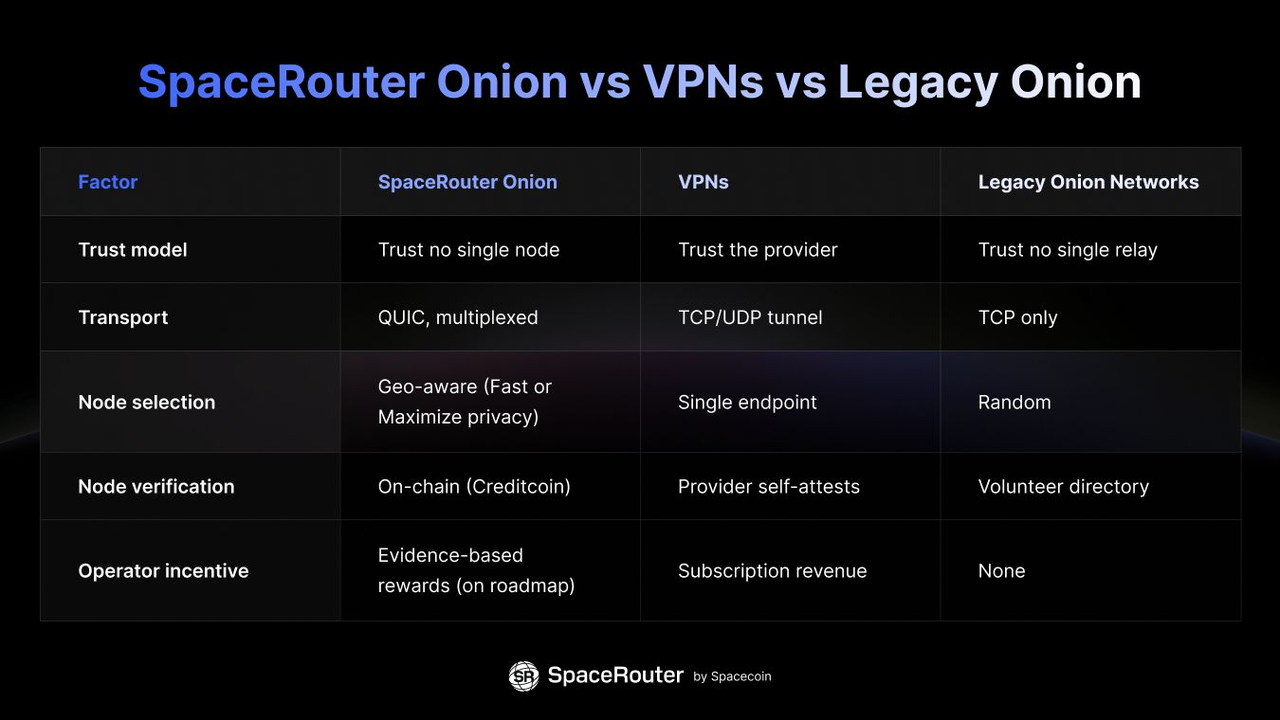
Nodes may take on tasks such as network validation, data routing, resource coordination, or ground communication support. Through an open participation mechanism, more network participants can join the ecosystem without relying entirely on a single operator.
To encourage nodes to maintain network stability, the system distributes rewards to participants through SPACE tokens.
This structure is a typical DePIN model, using crypto economic incentives to coordinate real-world infrastructure resources.
How Is Spacecoin Different From Traditional ISPs?
Traditional ISPs, or internet service providers, mainly rely on fiber optics, cables, and ground base stations to build their networks, while Spacecoin depends more on satellite communications and an on-chain payment system.
The biggest difference between the two lies in how the network is controlled. Traditional ISPs usually operate under a centralized model, while Spacecoin places greater emphasis on open networks and decentralized governance.
| Comparison Dimension |
Spacecoin |
Traditional ISP |
| Network Structure |
Satellite + blockchain |
Ground communication infrastructure |
| Payment Method |
On-chain payments |
Fiat subscription |
| Network Governance |
Decentralized |
Corporate operation |
| Coverage Scope |
Global satellite coverage |
Regional network coverage |
| Infrastructure Logic |
DePIN |
Centralized operation |
This difference makes Spacecoin better suited to global open network scenarios, but it also means the project must face new challenges such as satellite deployment and network expansion.
Conclusion
Spacecoin builds a decentralized internet network through low Earth orbit satellites, a blockchain payment system, and DePIN architecture. Its operating process covers user terminal access, satellite data transmission, on-chain resource settlement, node incentives, and several other stages.
However, satellite communications remain a highly technical and capital-intensive industry. Its long-term development will still depend on the scale of network deployment, the regulatory environment, and user adoption.
FAQs
What Is an LEO Satellite?
LEO, or Low Earth Orbit, refers to satellites that operate at relatively low altitudes, allowing them to provide lower network latency and higher communication efficiency.
How Do Users Connect to the Spacecoin Network?
Users need to connect to low Earth orbit satellites through ground terminal equipment, then complete internet data transmission through satellites and ground nodes.
What Is the SPACE Token Used For?
SPACE is used to pay for network service fees, incentivize node participation, and support future network governance.
Is Spacecoin a DePIN Project?
Yes. Spacecoin belongs to the decentralized physical infrastructure network, or DePIN, sector, with satellite internet networks as its core infrastructure.
What Is the Difference Between Spacecoin and Starlink?
Starlink is a centralized commercial satellite internet service, while Spacecoin places greater emphasis on blockchain payments, open networks, and decentralized governance.