Digital payments are shifting from centralized clearing systems to on-chain infrastructure. As stablecoins and blockchain technology enter real-world commercial applications, users care not only about payment speed but also about the authenticity of transaction records, verification efficiency, and auditability. Traditional payment systems rely on centralized entities for clearing and data management, while blockchain networks aim to reshape payment flows through distributed ledgers.
Compared to public chains designed primarily for general smart contract development, KONET Network focuses more on payment verification, on-chain receipts, and enterprise-grade settlement. Understanding how KONET works helps clarify how blockchain payment infrastructure can unify transaction confirmation, credential management, and data verification into a single trusted network.
KONET Network Transaction Process Overview
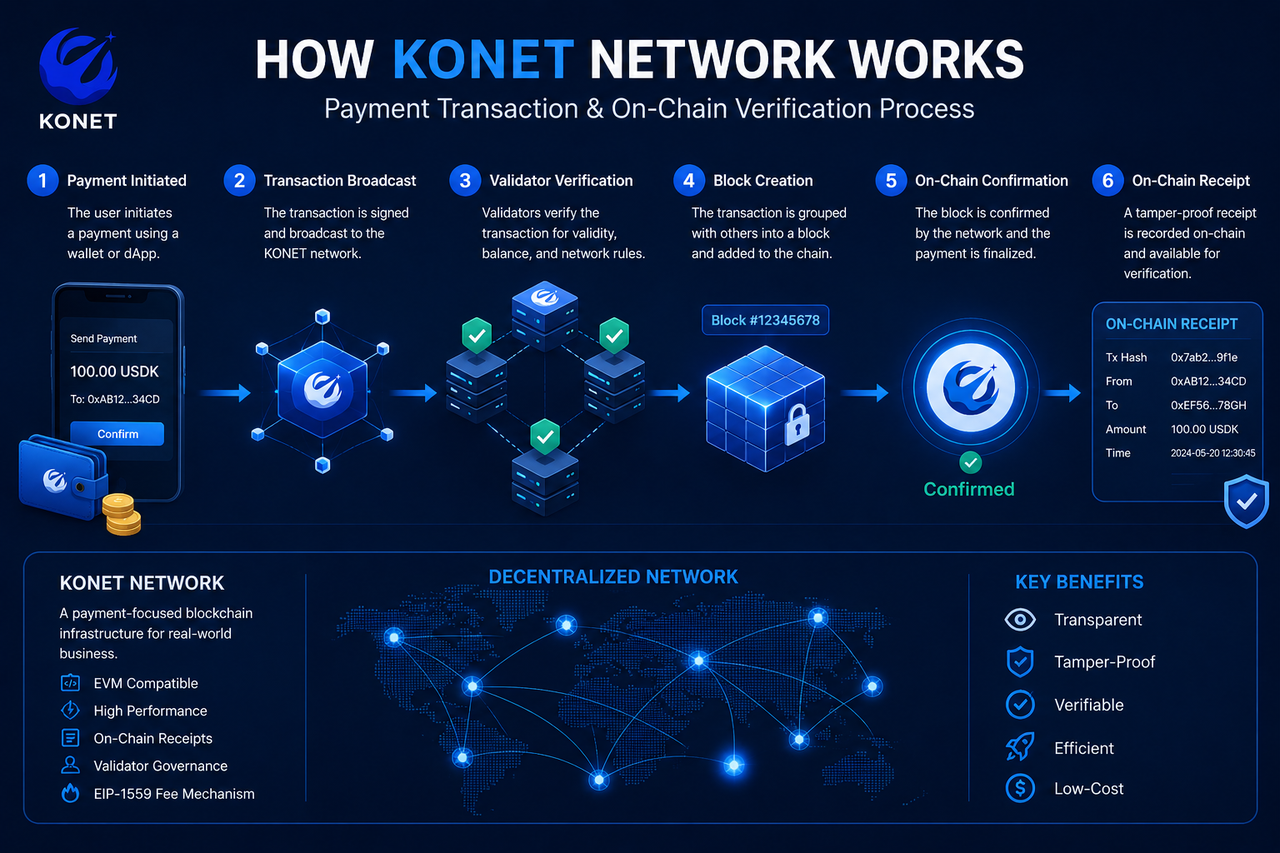
KONET Network’s payment process can be broken down into four core stages: transaction initiation, network verification, block confirmation, and on-chain receipt generation.
After a user submits a payment request, the transaction first enters the network awaiting verification. Verification nodes inspect the transaction and confirm its validity through a consensus mechanism. Once confirmed, the transaction is written to the blockchain ledger, generating a permanent, queryable on-chain record.
This creates a closed loop from payment to verification to credential management.
What Happens When a User Initiates a Payment?
When a user initiates a payment via a wallet or application, the system creates transaction data containing the sender’s address, recipient’s address, transaction amount, and signature information.
Digital signatures are a critical component of transaction security. The signature proves that the transaction was authorized by the account holder and not forged by a third party.
After signing, the transaction is broadcast to the KONET network and enters a pending verification state.
At this stage, the transaction has not yet been finalized and still requires network verification.
How Do Verification Nodes Check Transaction Validity?
Verification nodes are key participants that maintain the KONET network.
When a transaction is broadcast to the network, verification nodes first check whether the sending account has sufficient balance and verify that the digital signature matches the account address.
Then, nodes check whether the transaction format complies with protocol rules and whether there are duplicate transactions or potential attacks.
Only transactions that pass all verification conditions proceed to the block packaging stage.
This process ensures that the network ledger remains consistent and secure.
How Are Blocks Generated and Confirmed?
Once verified, transactions are collected into new blocks.
A block is essentially a set of confirmed transaction records. After a new block is generated, verification nodes confirm its contents and add it to the blockchain ledger.
Once a new block is written on-chain, the transaction status changes from pending to confirmed.
As subsequent blocks continue to be added, transaction records become increasingly irreversible and secure.
This chain structure makes it extremely difficult for anyone to alter already confirmed data.
How Does the On-Chain Receipt System Generate Payment Credentials?
The on-chain receipt system is a key part of the KONET payment architecture.
In traditional payment systems, receipts are typically stored by payment service providers, requiring third-party institutions for verification.
KONET, by contrast, records payment results directly on the blockchain and generates an on-chain credential for each transaction.
On-chain receipts typically include the transaction hash, payment time, involved accounts, and confirmation status.
Since this data is stored on the blockchain ledger, any authorized party can independently verify whether a payment actually occurred.
This approach reduces reconciliation costs between enterprises while boosting the credibility of payment records.
What Role Do Smart Contracts Play in the Payment Process?
KONET supports an EVM-compatible environment, enabling it to run smart contracts.
Smart contracts can automatically execute payment logic based on predefined rules—for example, releasing funds automatically when certain conditions are met, or completing phased payments according to business rules.
Compared to traditional manual review processes, smart contracts reduce intermediate steps and increase automation.
For enterprises, smart contracts also support membership management, ticketing systems, supply chain payments, and automatic settlement.
Thus, smart contracts are not only development tools but also critical infrastructure for payment automation.
How Does KONET’s Payment Verification Differ from Traditional Payment Systems?
Traditional payment systems rely on banks, payment institutions, or clearing centers to maintain transaction records.
After a user completes a payment, transaction information is recorded in a centralized database, and the operating entity is responsible for subsequent verification.
KONET, however, uses a blockchain ledger to record payment data.
Multiple verification nodes in the network jointly maintain ledger consistency, rather than a single entity controlling transaction records.
The verification logic differs significantly between the two models.
| Comparison Dimension |
KONET Network |
Traditional Payment System |
| Ledger Maintenance |
Distributed network |
Centralized institution |
| Data Verification |
Jointly by verification nodes |
By third-party institutions |
| Payment Credentials |
On-chain receipts |
Platform receipts |
| Data Transparency |
Verifiable |
Relies on institutional disclosure |
| Audit Method |
On-chain queries |
Manual verification |
| Automation Capability |
Supported by smart contracts |
Limited support |
This distinction gives blockchain payment networks a unique advantage in transparency and verifiability.
Summary
KONET Network’s payment process consists of multiple stages: transaction submission, verification node review, block confirmation, and on-chain receipt generation. The entire process is maintained by a decentralized network, ensuring the authenticity and immutability of transaction records.
Compared to traditional payment systems, KONET unifies payment verification, credential management, and data audit within the blockchain ledger, improving transparency and verification efficiency. Additionally, the EVM-compatible environment and smart contract capabilities expand payment automation scenarios, enabling KONET to support enterprise-grade settlement, commercial payments, and the development needs of the Web3 application ecosystem.
FAQs
What is the role of verification nodes in the KONET network?
Verification nodes are responsible for checking transaction legitimacy, verifying account signatures, confirming block data, and maintaining network ledger consistency. They are a vital part of network security.
What is KONET’s on-chain receipt system?
The on-chain receipt system is a mechanism that records payment credentials directly on the blockchain. After each payment is completed, a verifiable and immutable on-chain record is generated.
How does KONET ensure payment data cannot be tampered with?
KONET stores transaction data using the blockchain’s distributed ledger structure. Confirmed blocks are linked in a chain, so altering historical records would require simultaneously modifying a large amount of data across many network nodes, making it virtually impossible.
Does KONET support automatic payments via smart contracts?
Yes. KONET uses an EVM-compatible architecture, allowing developers to deploy smart contracts for automatic settlement, conditional payments, and business process automation.
What is the biggest difference between KONET and traditional payment verification mechanisms?
Traditional payment verification relies on centralized institutions to manage data, while KONET uses verification nodes to jointly maintain the ledger and leverages the on-chain receipt system to provide publicly verifiable payment proof.