Why Does the On-Chain Derivatives Market Need New Infrastructure?
In recent years, perpetual contracts have become one of the most critical trading instruments in the crypto market. Compared to the spot market, they offer leverage, two-way trading, and higher capital efficiency, attracting a large number of professional traders.
Most decentralized derivative platforms are still built on general-purpose blockchains. While this architecture offers strong openness, it is often prone to network congestion, transaction delays, and rising Gas costs during periods of high volatility. For retail users, these issues may only cause a poor experience, but for professional traders who depend on speed and execution efficiency, any delay can directly impact profitability. AFX was created to address these needs by building blockchain infrastructure purpose-built for the derivatives market.
What Is the Core Concept of AFX?
 (Source: AFX_XYZ)
AFX positions itself as a Layer 1 network designed exclusively for financial trading, rather than a general-purpose public chain. Most blockchains must simultaneously serve diverse needs such as DeFi, NFTs, gaming, and community applications, meaning all applications share the same network resources.
AFX takes a different approach. It focuses the entire blockchain design on trading markets, prioritizing network computing power for critical financial operations like order execution, price updates, and risk management. In short, AFX is more like a financial trading system built specifically for the derivatives market, rather than a conventional blockchain.
What Is the Sovereign Trading Layer?
The Sovereign Trading Layer proposed by AFX is a key architectural concept. "Sovereign" implies autonomy and independence. In traditional centralized exchanges, trading speed is typically very fast, but users must entrust their assets to the platform’s custody. On general DeFi platforms, users retain control of their assets, but trading efficiency is often constrained by the blockchain.
AFX aims to combine the advantages of both worlds. Users maintain asset control and on-chain transparency while achieving execution efficiency comparable to centralized exchanges. This model essentially seeks a new equilibrium between decentralization and trading performance.
How Does AFX Improve Trading Speed?
Trading speed is one of AFX's most emphasized technical strengths. According to the team, the network uses a DAG (Directed Acyclic Graph) architecture combined with a modular execution layer, enabling faster order processing and confirmation.
Unlike traditional blockchains that generate blocks in a fixed sequence, the DAG architecture allows more transactions to be processed in parallel, significantly reducing network latency. For the perpetual contract market, where prices can shift within seconds, lower latency means traders can execute closer to their expected prices. This is also a key reason why AFX positions itself in the high-frequency trading market.
How Does the Zero Gas Model Work?
On most blockchains, every transaction incurs a Gas Fee. While individual costs may seem low, for traders who frequently place, modify, and cancel orders, these fees add up to a significant expense.
AFX introduces a Zero Gas model to reduce transaction friction. From a user experience standpoint, this design allows traders to adjust their strategies more frequently without worrying about extra fees. This model is especially suited for quantitative trading, high-frequency trading, and arbitrage strategies, which rely on large volumes of rapid order execution.
How Is AFX's Trade Execution Architecture Different?
Beyond improving network performance, AFX has also redesigned the trade execution flow. In a typical blockchain environment, all transactions enter a public Mempool and wait for validators to process them. However, this design can lead to MEV (Maximal Extractable Value) issues, where participants observe pending transactions and engage in arbitrage or front-running.
AFX establishes a dedicated trade execution environment to reduce such fairness concerns. By using an independent Mempool, order optimization mechanisms, and a separate execution layer, the trading process becomes more stable and predictable. For professional traders, execution quality is often directly tied to the success of their strategies, making this infrastructure optimization highly valuable.
Why Is the FIX Protocol Attracting Market Attention?
Another feature that sets AFX apart from traditional DeFi platforms is its native support for the FIX Protocol. FIX (Financial Information eXchange) is a widely adopted trading communication standard in global financial markets. Many banks, hedge funds, and quantitative trading firms rely on FIX for automated trading and market access.
With AFX supporting the FIX Protocol, professional institutions can easily connect their existing trading systems to the on-chain market without rebuilding their entire technical stack. This also reflects AFX's broader vision: not only to serve crypto-native users but also to attract traditional financial participants into the on-chain derivatives market.
What Does the Mainnet Launch Represent?
 (Source: AFX_XYZ)
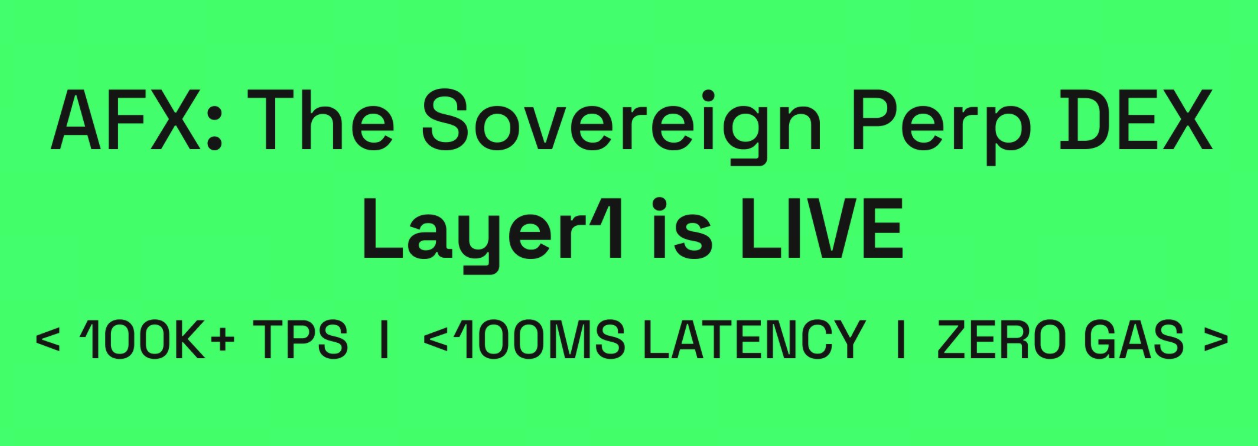
The official Mainnet launch marks AFX's transition from the testing phase to live operation. It means the underlying blockchain is now running, and its trading system, margin mechanisms, and market structure are being tested under real market conditions. For any financial infrastructure, technical specs are only the starting point—what truly matters is whether the system can maintain stability during market volatility, high trading volumes, and complex scenarios. The Mainnet launch thus signals AFX's entry into a new competitive phase among derivative platforms.
What Kind of Market Is AFX Building?
From a holistic design perspective, AFX is not just creating another decentralized exchange. It aims to build dedicated financial infrastructure for the on-chain derivatives market, with the core goal of enabling users to achieve trading efficiency comparable to traditional markets without relying on centralized custody.
As more professional traders and institutions enter the DeFi space, demand for high-performance trading infrastructure continues to grow. AFX's emergence also reflects a broader trend in the blockchain industry: a shift from competition among general-purpose public chains toward specialized, purpose-built solutions for specific financial applications.
Summary
AFX is a Layer 1 blockchain purpose-built for the on-chain derivatives market. Its core vision is to combine the transparency of decentralized finance with the execution efficiency of centralized exchanges through the Sovereign Trading Layer architecture. With a high-speed trading engine, Zero Gas Model, dedicated execution environment, and native FIX Protocol support, AFX aims to create an on-chain trading market optimized for professional traders and institutions. As perpetual contracts and the on-chain derivatives market continue to grow, this type of specialized financial infrastructure may well become a key development direction for the blockchain industry.







